Why Enterprises Need Super Apps in 2026: Strategic Advantages Beyond Consumer Applications
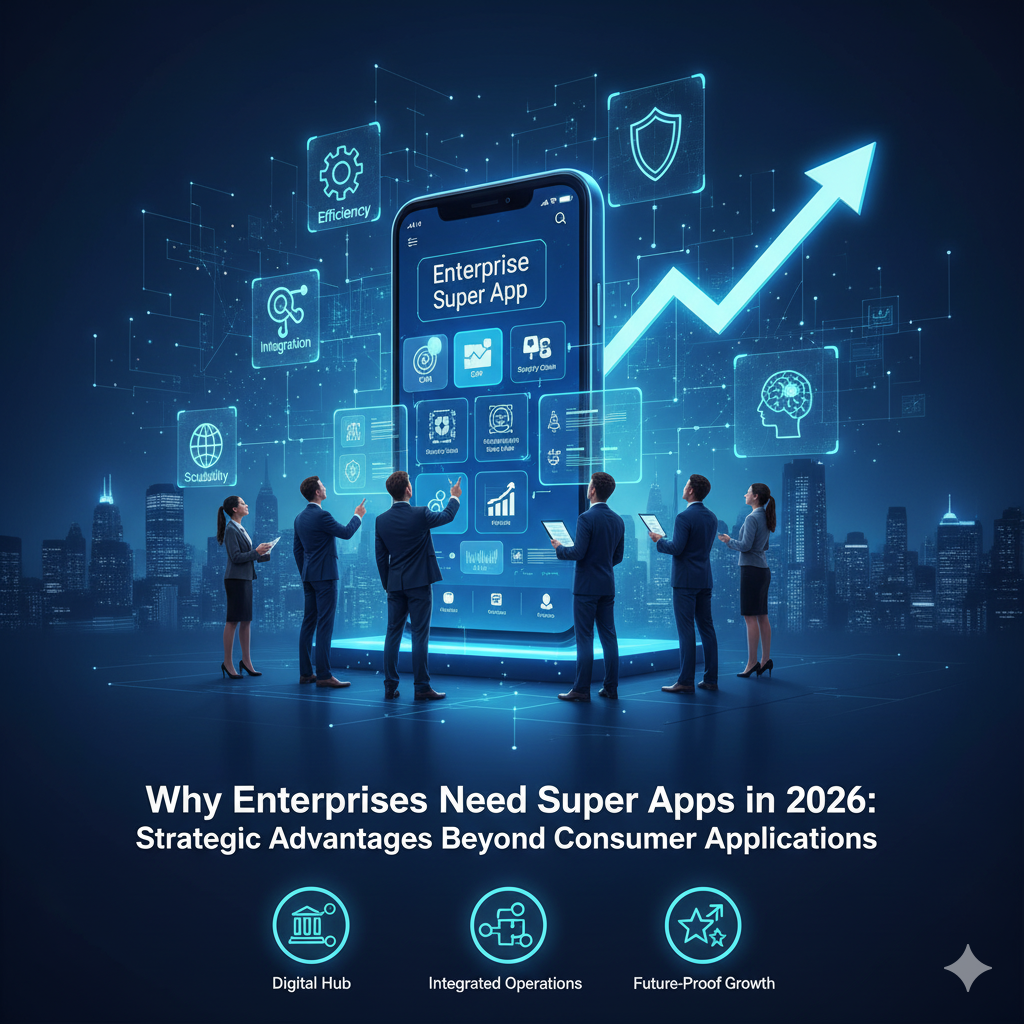
Enterprise Super Apps provide consolidated digital workplaces that integrate disparate tools, streamline workflows, and enable rapid service deployment while maintaining security and compliance standards across diverse user populations. Unlike consumer Super Apps that aggregate third-party services for convenience, enterprise implementations focus on productivity enhancement, cost reduction, and digital transformation acceleration. The strategic advantages extend beyond simple app consolidation to fundamentally reshape how organizations deliver digital services to employees, partners, and customers while addressing the fragmentation, security challenges, and development bottlenecks that plague traditional enterprise IT approaches.
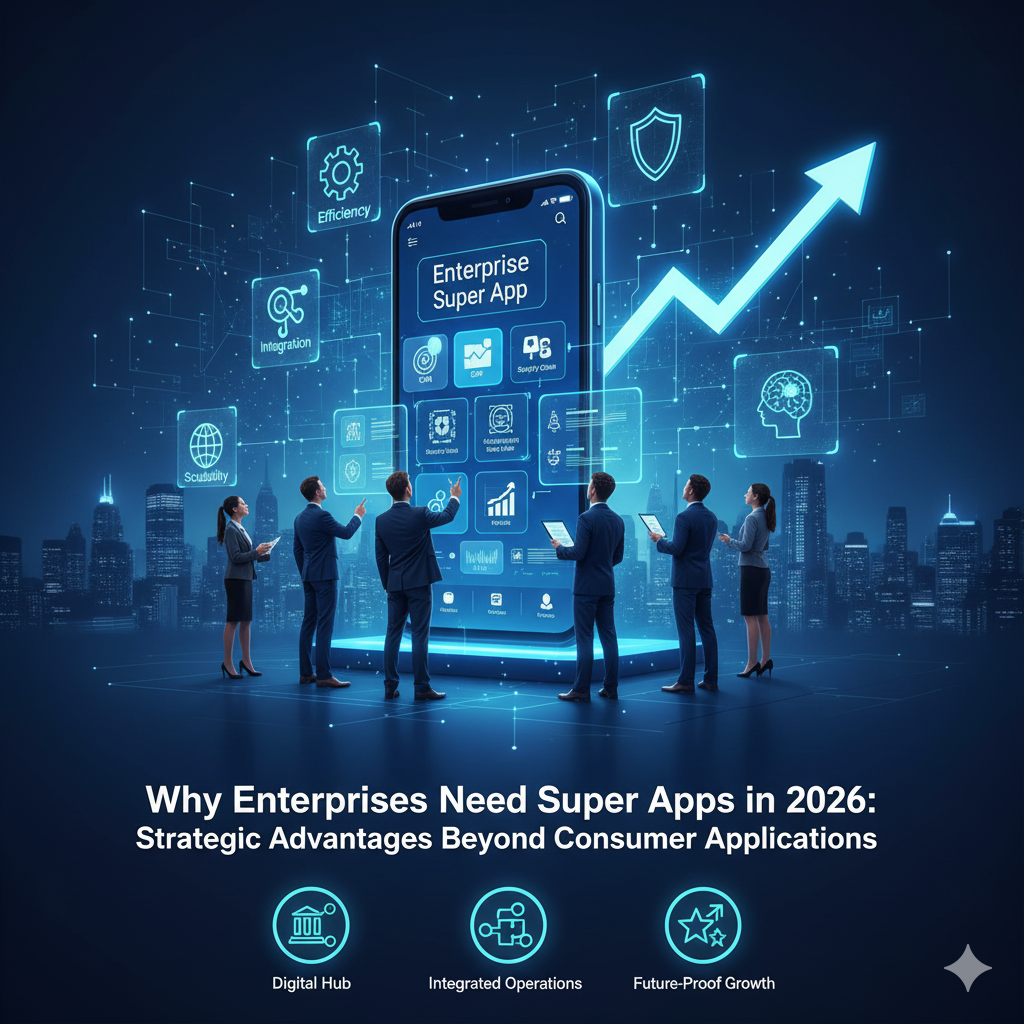
Addressing Enterprise Digital Fragmentation
Modern enterprises typically operate dozens or hundreds of separate applications for different functions: HR systems, CRM platforms, project management tools, communication apps, document management systems, and specialized departmental software. This fragmentation creates significant productivity drains: employees waste time switching contexts between applications, data remains siloed across incompatible systems, training requirements multiply with each new tool, and security vulnerabilities increase with every additional entry point. Studies indicate knowledge workers lose approximately 30% of their productive time to application switching and context recovery.
Super App architectures address this fragmentation through unified interfaces that consolidate functionality without requiring backend system consolidation. Rather than attempting the impossible task of migrating all enterprise systems to a single platform, Super Apps provide presentation-layer integration that connects disparate systems through standardized APIs and authentication mechanisms. Employees access all necessary tools through a single interface with consistent navigation patterns, search capabilities, and notification systems, while backend systems continue operating independently with their specialized functionalities intact.
The integration extends beyond mere interface consolidation to workflow automation. Super Apps can orchestrate processes that span multiple backend systems: for example, automatically creating project tasks when sales opportunities reach certain stages, generating HR onboarding checklists when offers are accepted, or triggering procurement workflows when inventory reaches threshold levels. These cross-system automations, impossible with siloed applications, eliminate manual handoffs and reduce process cycle times by 40-60% in documented implementations.
Security and compliance benefits emerge from consolidation. Instead of managing separate authentication systems, access controls, and audit trails for dozens of applications, enterprises implement centralized security policies, single sign-on, and unified monitoring. This reduces attack surfaces, simplifies compliance reporting, and enables consistent security enforcement across all digital tools. Particularly in regulated industries like finance and healthcare, this centralized control proves invaluable for meeting stringent regulatory requirements.
Accelerating Digital Service Delivery
Traditional enterprise application development follows lengthy cycles: requirements gathering, architecture design, development, testing, security review, and deployment often spanning 6-18 months for moderately complex applications. This pace cannot keep up with evolving business needs, particularly in competitive markets where agility determines success. Super App platforms with mini program architectures fundamentally accelerate this process by enabling rapid development and deployment of lightweight applications that integrate seamlessly with existing infrastructure.
Mini program development typically requires 70-80% less time than traditional enterprise applications because developers leverage existing platform capabilities: authentication, navigation, UI components, data storage, and API connectivity are provided by the Super App platform rather than built from scratch. This allows development teams to focus exclusively on business logic and user experience rather than infrastructure concerns. Documented cases show development cycles reduced from months to weeks, with some organizations deploying new mini programs in as little as 2-3 weeks versus 4-6 months for comparable traditional applications.
The modular nature of mini programs enables incremental enhancement rather than wholesale replacement. Enterprises can start with core functionality and add features progressively based on user feedback and evolving requirements. This reduces risk compared to big-bang application launches where all features must be perfect from day one. It also allows for A/B testing of different approaches and rapid iteration based on performance data—practices difficult or impossible with traditional enterprise application development.
Deployment and updates occur seamlessly through the Super App platform. Unlike traditional applications requiring manual updates or app store approvals, mini programs can be updated instantly for all users. This enables continuous improvement without disruption, rapid bug fixes, and feature experimentation. Hot update capabilities allow organizations to test new features with subsets of users before full rollout, reducing deployment risk while gathering valuable usage data to guide further development.
Enabling Ecosystem Expansion and Monetization
Enterprise Super Apps naturally extend beyond internal use cases to partner and customer ecosystems. The same platform that serves employees can securely expose selected functionality to external partners, suppliers, or customers with appropriate access controls and data isolation. This creates new revenue opportunities, strengthens partner relationships, and improves customer experiences through integrated service delivery.
B2B partner portals represent a natural extension: rather than building separate portals for different partner types, enterprises can provide partners with customized mini programs within the Super App ecosystem. Each partner sees only the functionality and data relevant to their relationship, while the enterprise maintains centralized control and consistency. This approach has proven particularly effective in supply chain management, where different suppliers, logistics providers, and distributors require different interfaces to the same underlying systems.
Customer-facing applications benefit from the Super App approach by providing more integrated experiences. Instead of forcing customers to download separate apps for different services (banking, insurance, investment, loyalty programs), enterprises can consolidate all customer touchpoints within a single Super App interface. This improves customer satisfaction through convenience while reducing support costs and increasing cross-selling opportunities. Financial institutions implementing this approach have documented 2.5x increases in in-app service adoption and 45% improvements in retention rates.
Monetization opportunities emerge through platform economics. Enterprises can create marketplaces where third-party developers build complementary mini programs, sharing revenue while expanding platform utility. This ecosystem approach has been particularly successful in retail and telecommunications, where platform operators capture 15-30% of third-party transaction revenue while providing customers with more comprehensive service offerings. The platform becomes not just a cost center but a revenue generator and strategic asset.
Getting Started with Enterprise Super App Implementation
Begin with a clear strategic assessment of pain points and opportunities. Identify the fragmentation costs in your organization: time lost to application switching, data silos preventing insights, security vulnerabilities from multiple entry points, and development bottlenecks slowing digital transformation. Quantify these costs to build business cases for Super App adoption, focusing on productivity gains, risk reduction, and revenue opportunities rather than just technical modernization.
Select an appropriate platform architecture based on organizational requirements. Consider factors like existing technology investments, security and compliance needs, user population characteristics, and integration requirements. Container-based approaches that work with existing applications often provide faster time-to-value than rebuilding entire platforms from scratch. In enterprise deployments using FinClip, organizations have achieved 80% faster integration and 60% cost reduction by adopting lightweight SDKs that integrate into existing applications in minutes.
Develop a phased implementation roadmap starting with high-impact, low-complexity use cases. Initial mini programs should address clear pain points with measurable outcomes, building momentum and demonstrating value before tackling more complex integrations. Common starting points include employee self-service portals, partner onboarding workflows, customer support interfaces, and departmental productivity tools that integrate multiple existing systems.
Establish governance frameworks for mini program development, security, and lifecycle management. Unlike traditional IT projects with centralized control, Super App ecosystems often involve distributed development across business units and partners. Clear standards for design, security, data handling, and performance ensure consistency while enabling innovation. Regular platform reviews and optimization cycles maintain quality as the ecosystem expands.
Explore FinClip ChatKit — open-source AI chat middleware. GitHub