WeChat's 2026 AI Mini-Program Initiative Reshapes Mobile Development Economics
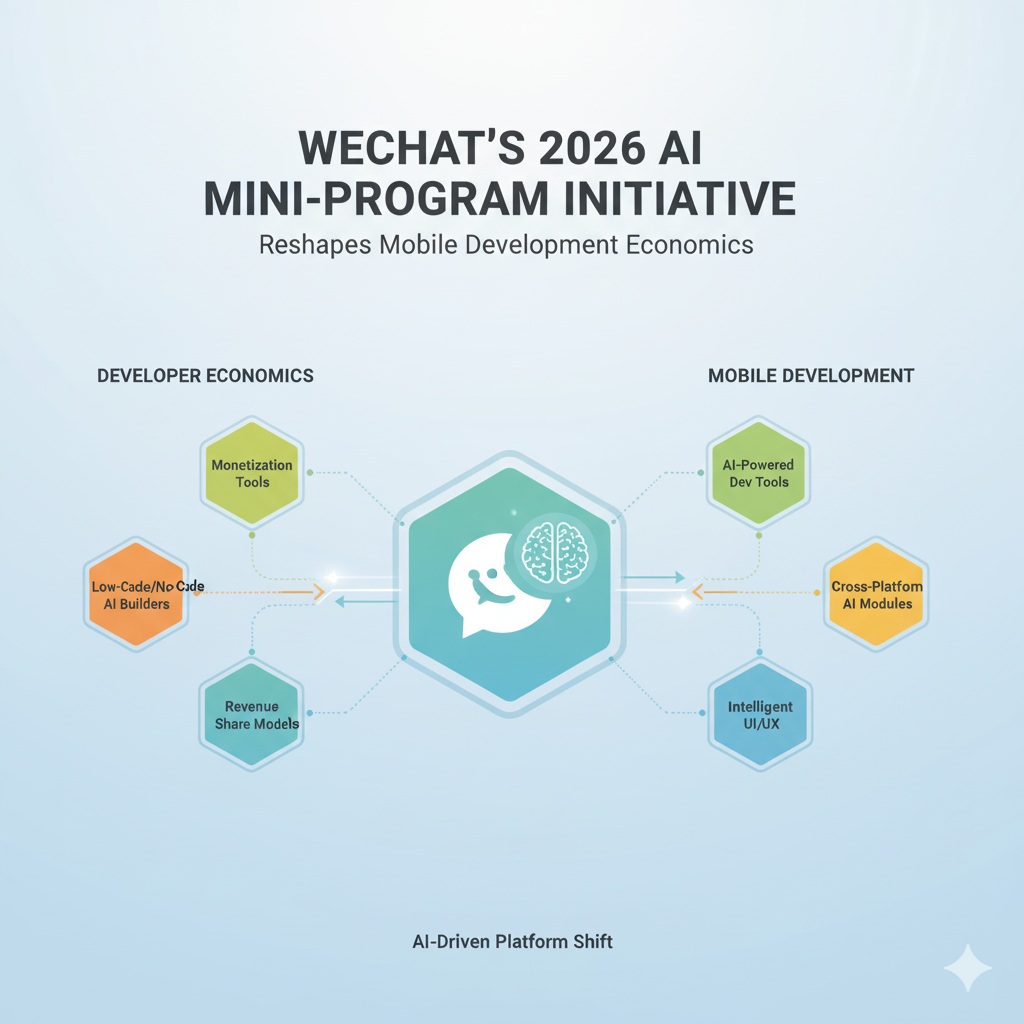
WeChat has launched its most ambitious developer initiative to date, providing 1 billion token credits for AI model access, free cloud development resources, and reduced transaction fees for mini-program creators throughout 2026. The program represents a strategic investment in democratizing AI application development, directly addressing historical barriers that have prevented smaller developers from competing with well-funded technology organizations. For mobile developers and product teams, this initiative fundamentally alters the cost structure and timeline for bringing AI-powered applications to market.
What Happened
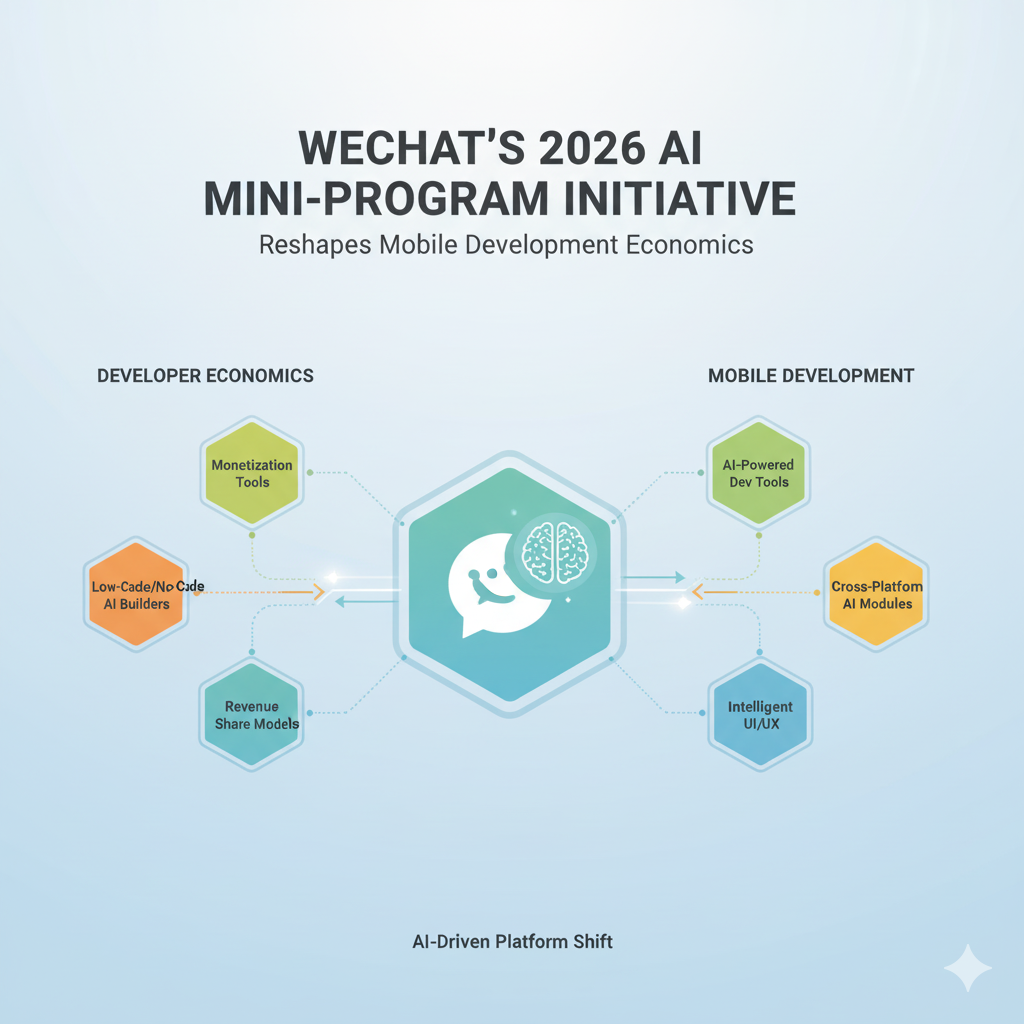
On January 5, 2026, WeChat officially announced its "AI Application and Online Tool Mini-Program Growth Plan," a year-long initiative providing comprehensive support for developers building AI-powered applications within the WeChat ecosystem. The program includes several unprecedented components that collectively reduce development costs and accelerate time-to-market for AI applications.
Central to the initiative is the provision of 1 billion token credits for Tencent's Hunyuan large language model (Hunyuan 2.0), along with 10,000 credits for the Hunyuan text-to-image model. This represents the first time a major platform has provided AI model access at this scale without direct cost to developers, effectively eliminating what was previously a significant barrier for startups and independent creators.
The program also includes six months of free cloud development resources for new developers through WeChat Cloud Development, with existing developers receiving substantial credit vouchers. WeChat Cloud Development provides backend capabilities including databases, cloud functions, and direct integration with AI models and agents, removing infrastructure management overhead.
Monetization barriers have been addressed through platform-wide support for virtual payments and subscription models across Android, iOS, and HarmonyOS devices, coupled with temporary reduced fee structures. Historically, iOS virtual payment restrictions created significant revenue limitations for tool and utility applications, but the 2026 changes establish a complete commercial loop within the WeChat environment.
Additional components include free access to We Analysis Professional for one year, providing sophisticated user behavior analytics, and dedicated traffic incentives through discovery page placements and public account integrations. The program runs from January 1 to December 31, 2026, with developers applying through the WeChat mini-program backend management interface.
Why This Matters for AI Application Development
WeChat's initiative addresses three fundamental challenges that have historically limited AI application development to well-resourced organizations, creating opportunities for a much broader range of creators and businesses.
First, the program dramatically reduces the financial barriers to AI experimentation and deployment. Access to large language models has typically required either significant engineering investment to run open-source models or substantial API costs for commercial services. The 1 billion token allocation represents approximately $20,000-30,000 in equivalent commercial API costs, sufficient for thousands of user interactions or extensive development testing. This resource allocation enables developers to prototype, iterate, and scale AI features without upfront financial commitment, fundamentally changing the risk profile for AI application development.
Second, the integrated development environment eliminates technical complexity that previously required specialized expertise. WeChat Cloud Development's pre-configured AI model integrations mean developers can implement conversational interfaces, content generation, or image analysis without managing model deployment, API authentication, or scaling infrastructure. This abstraction layer allows product-focused teams to concentrate on user experience and application logic rather than AI infrastructure, significantly accelerating development cycles.
Third, the program addresses the "last mile" problem of AI application distribution and monetization. Even well-executed AI applications often struggle to reach users and generate sustainable revenue due to discovery challenges and platform restrictions. WeChat's combination of traffic incentives, cross-platform payment support, and reduced fees creates a complete pathway from development to revenue generation within a single ecosystem. Successful applications like "Guess Salt," "Style Converter," and "Voiceover Master" demonstrate that AI-powered mini-programs can achieve substantial user adoption and commercial success when these distribution and monetization barriers are removed.
The Bigger Picture
WeChat's 2026 AI initiative occurs within a broader industry shift toward platform-driven AI democratization, but distinguishes itself through comprehensiveness and immediate practical impact. Several parallel developments highlight why this approach represents a significant evolution in how AI capabilities reach end users.
Telegram's expansion of mini-app capabilities with integrated TON payments and crypto checkout functionality demonstrates how messaging platforms evolve into comprehensive service ecosystems. Similarly, Apple's increasing focus on AI integration in iOS 26 and subsequent releases shows platform operators recognizing AI as a core differentiator. However, WeChat's approach uniquely combines AI resource provision with distribution and monetization support, creating a complete development-to-deployment pipeline.
The initiative also reflects a strategic response to changing competitive dynamics in the Chinese technology landscape. With ByteDance, Alibaba, and Baidu all advancing their own AI platforms and ecosystems, WeChat's developer-focused approach leverages its existing user base and mini-program infrastructure to maintain ecosystem vitality. By reducing barriers for innovative applications, the platform ensures a continuous stream of new functionality that keeps users engaged within the WeChat environment rather than seeking alternatives.
From a global perspective, the program demonstrates how super app ecosystems can accelerate AI adoption by addressing the complete value chain from model access to user distribution. This contrasts with Western approaches where AI model access, application development, and distribution typically involve separate providers and platforms, creating fragmentation that slows adoption and increases complexity for developers.
What Application Developers Should Do Now
The WeChat AI initiative creates immediate opportunities for developers and product teams to experiment with and deploy AI capabilities with unprecedented speed and reduced risk. Three strategic actions can maximize the benefits of this program.
First, prioritize rapid prototyping of AI features that address specific user needs within existing application contexts. The reduced cost and technical barriers mean teams can quickly test conversational interfaces, content generation, image processing, or personalized recommendations without extensive upfront investment. Focus on "minimum viable AI" implementations that deliver tangible user value with minimal complexity, using the provided token allocation for iterative refinement based on user feedback.
Second, leverage the integrated analytics capabilities to inform AI feature development and optimization. The free We Analysis Professional access provides detailed insights into user behavior, feature adoption, and engagement patterns that are typically expensive or complex to implement independently. Use this data to identify opportunities where AI can address user pain points, improve retention, or increase conversion rates, then measure the impact of AI implementations against these metrics.
Third, explore hybrid distribution strategies that combine mini-program deployment with alternative channels. While the WeChat ecosystem provides substantial reach, particularly in Chinese markets, container technologies enable the same applications to function across multiple platforms including standalone apps, other super apps, and web interfaces. This approach maximizes addressable audience while maintaining development efficiency through code reuse.
Developers seeking to expand their AI application reach beyond single platforms should investigate container solutions that enable consistent experiences across multiple distribution channels. These technologies maintain the development velocity benefits of integrated platforms while providing distribution flexibility and reducing platform dependency risks.
See how FinClip turns any app into a SuperApp. Book a 30-min demo