WeChat Mini Programs See 40% Overseas Transaction Growth, Signaling Global Super App Expansion
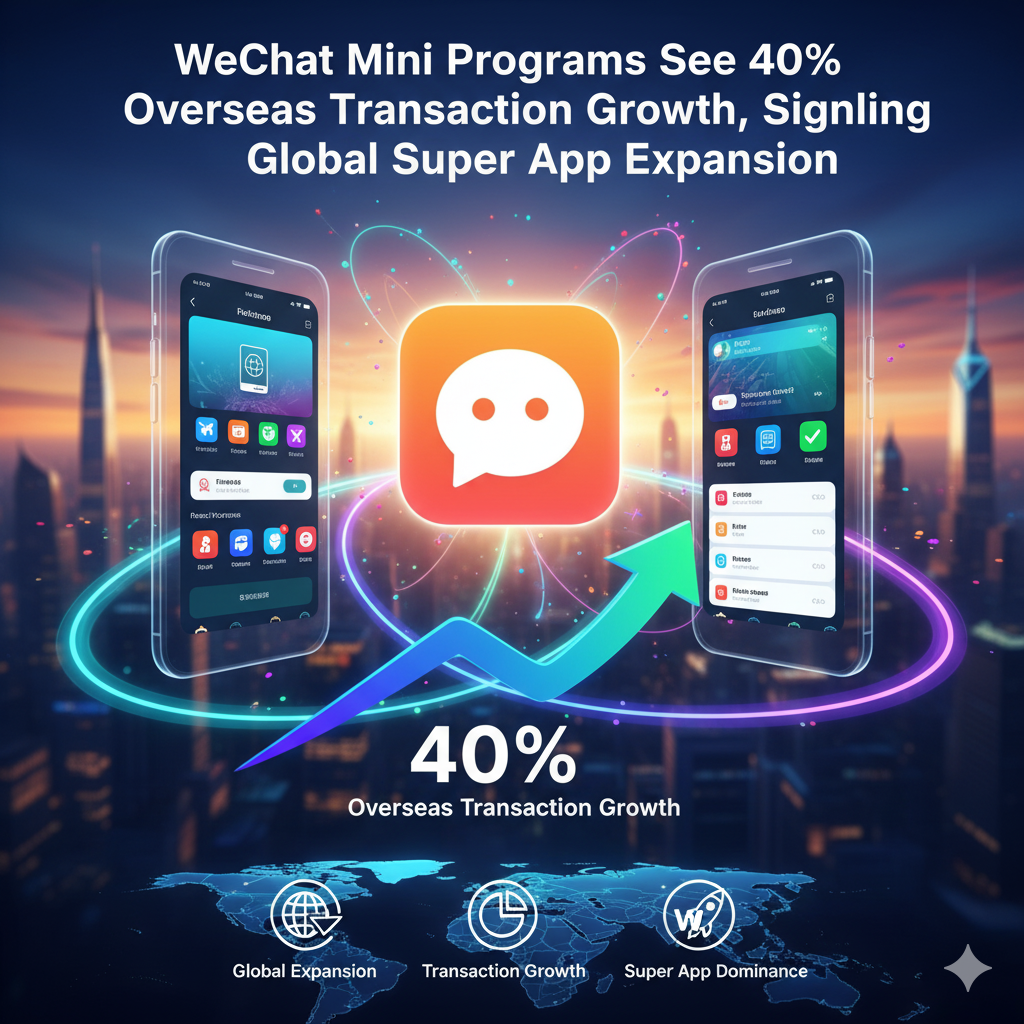
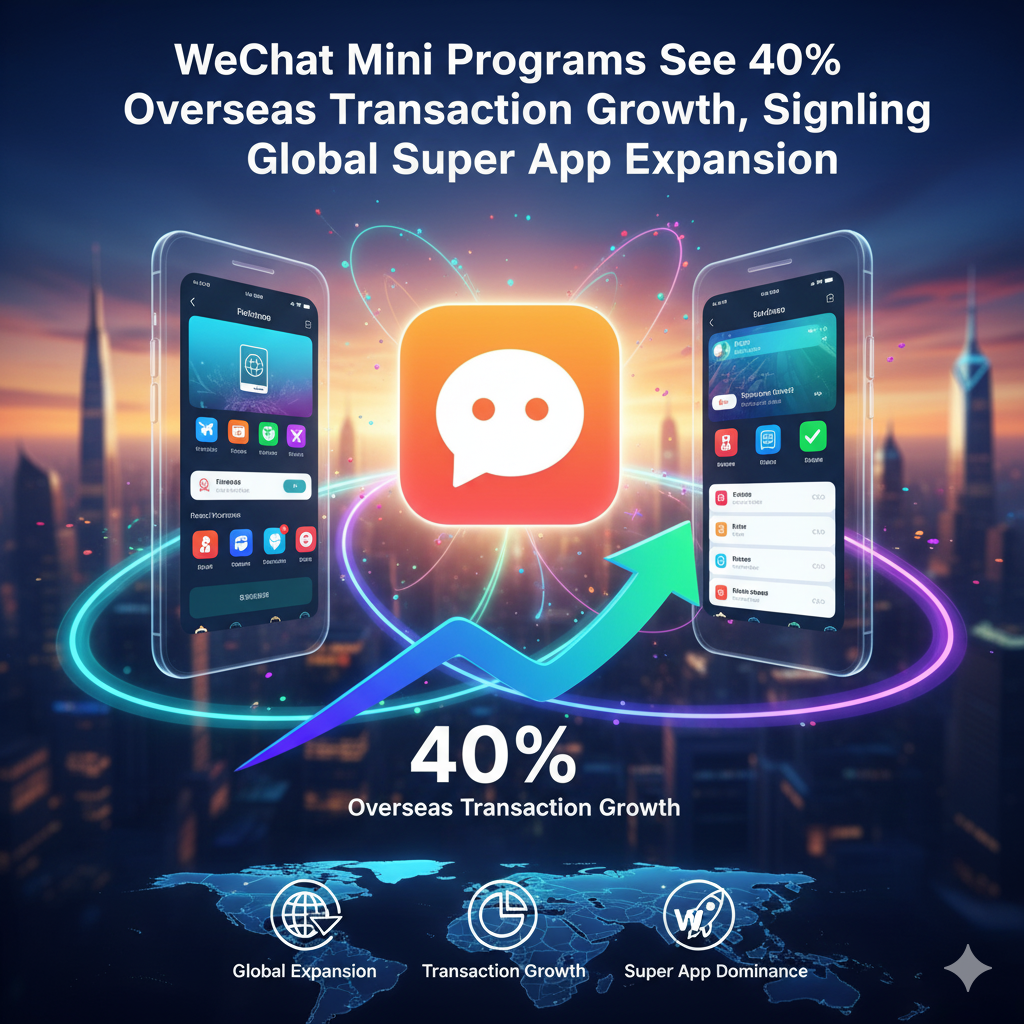
WeChat mini programs recorded over 40% year-on-year growth in overseas transaction volume during 2025, with cross-border usage sessions reaching 5 billion annually across more than 100 countries and regions. The data, presented at WeChat Open Class Pro 2026 in Guangzhou, reveals concentrated growth in sectors where Chinese users already transact, travel, and consume services abroad—particularly tourism, hospitality, mobility, and cross-border ecommerce. This expansion matters because it demonstrates how Super App ecosystems extend beyond their home markets through user mobility rather than local adoption, creating new patterns of global digital service delivery that bypass traditional app store distribution.
What Happened
During WeChat Open Class Pro 2026 held on January 15 in Guangzhou, Tencent disclosed that overseas mini program transaction volume grew by more than 40% year-on-year in 2025, with certain segments like global mobility recording substantially higher growth rates of 140%. The platform now supports active mini programs in over 100 countries and regions, generating 5 billion annual cross-border usage sessions. Alongside these usage trends, WeChat outlined a series of platform updates aimed at reducing friction for overseas users and entities, including expanded category eligibility to 108 supported sub-categories and improved onboarding workflows for non-mainland entities.
The growth is concentrated in three main user segments: outbound Chinese travelers (+60% YoY transaction volume), inbound travelers to China (+50% YoY transaction volume), and overseas Chinese communities (+70% YoY transaction volume). These figures reflect aggregate cross-border activity rather than a single industry, reinforcing the vision of overseas mini programs as a multi-sector transaction and service layer rather than a niche channel. The highest-grossing outbound markets for WeChat Pay are Hong Kong SAR, Japan, Macao SAR, South Korea, and Thailand, while the fastest-growing markets include Kazakhstan, Malaysia, Maldives, Indonesia, and Sweden.
Platform updates introduced a "green channel" for overseas entities—a structured onboarding path reflecting WeChat's recognition that overseas demand is now a material part of the mini program ecosystem. Key improvements include alternative documentation acceptance for overseas corporate entities, English-language onboarding flows, expanded category eligibility, support for overseas phone number login in 18 countries/regions, optimized SMS verification outside China, and enhanced mini program visibility through modules like pull-down recommendations and search results.
Why This Matters for Global Commerce
The 40% overseas growth rate signals a maturation phase for mini program ecosystems beyond their domestic strongholds. Unlike traditional international expansion that requires local user acquisition and market adaptation, WeChat's overseas growth leverages existing user behavior patterns: Chinese travelers and expatriates naturally seek familiar service interfaces when abroad. This creates a unique distribution advantage where platforms expand through user mobility rather than local marketing, reducing customer acquisition costs while maintaining service consistency.
For global brands targeting Chinese consumers, overseas mini programs have evolved from experimental channels to essential transaction layers. Uber's mini program launch in 2025 covering 1,000 cities in 20 different markets demonstrated this shift: rather than pushing app downloads to Chinese users unfamiliar with local interfaces, Uber reached customers where they already were—within WeChat. During Golden Week holiday, Uber's mini program saw 13x growth, validating the approach of meeting users within their preferred ecosystem rather than redirecting them to unfamiliar apps.
The structural advantages are becoming increasingly clear. Chinese outbound consumption is structurally WeChat-native: for Chinese users traveling or living abroad, WeChat remains the primary interface for payments, service discovery, account login and identity, and customer support communication. This shows brands targeting Chinese consumers overseas that reaching users within WeChat is often more effective than attempting to redirect them to unfamiliar apps or mobile websites, especially in high-friction scenarios such as first-time usage, short stays, or transaction-heavy interactions.
Mini programs themselves have evolved from "light apps" into comprehensive service hubs. Initially positioned as lightweight tools for specific tasks, today they commonly support end-to-end transaction flows, booking and service management, post-transaction support, and repeated multi-touch user journeys. This shift in development sophistication has enabled mini programs to operate as full-featured applications while maintaining the distribution and discovery advantages of the Super App ecosystem.
The Bigger Picture
The overseas mini program growth reflects broader shifts in global digital service delivery. Traditional app store distribution creates friction: users must discover, download, and authenticate across multiple applications, each with separate interfaces and login requirements. Mini programs reduce this friction by providing immediate access within an existing trusted environment, particularly valuable for transient interactions like travel services, event ticketing, or short-term retail engagements.
The platform's strategic adjustments reveal a calculated approach to global expansion. Rather than requiring brands to fully localize around China's structures before participating, mini programs can now be deployed where Chinese user demand already exists and scaled alongside cross-border usage. This "demand-first" expansion model contrasts with traditional platform globalization that typically requires establishing local entities, compliance frameworks, and user bases before launching services.
Payment infrastructure has kept pace with usage growth. WeChat Pay usage data highlights a clear distinction between revenue concentration and growth momentum: while Hong Kong, Japan, and South Korea represent the highest-grossing markets, Kazakhstan, Malaysia, and Indonesia show the fastest growth rates. This pattern suggests that mini program adoption follows Chinese user mobility patterns rather than local market development, creating opportunities in emerging markets that might otherwise lack sophisticated digital payment infrastructure.
The implications extend beyond Chinese users. As overseas mini programs mature, they create infrastructure that can potentially serve local populations as well. The platform improvements—like support for overseas phone numbers, optimized verification, and expanded language support—lower barriers for non-Chinese entities to participate. While the current growth is driven by Chinese outbound demand, the underlying platform capabilities could support broader globalization in the future.
What Global Brands Should Do Now
Brands with significant Chinese customer bases overseas should prioritize mini program development as a core channel rather than experimental initiative. The 40% growth rate and 5 billion annual sessions indicate sufficient scale to justify dedicated resources. Development should focus on high-frequency use cases where friction reduction matters most: hotel bookings, transportation services, retail purchases, and event ticketing. These scenarios benefit particularly from the immediate access and integrated payment features of mini programs.
For technical implementation, brands should leverage the platform's evolving tooling. The "green channel" reduces onboarding complexity, while features like overseas phone number login, built-in auto-translation supporting 18 languages, and free Tencent Maps overseas (with native map & location services) address common internationalization challenges. Payment integration should prioritize WeChat Pay (HK) and Weixin Pay (China) compatibility, recognizing that most transactions will originate from Chinese payment methods even for overseas services.
Platform selection requires careful consideration of architectural compatibility. Brands operating in markets with significant Chinese tourist or expatriate populations should evaluate container solutions that maintain WeChat mini program compatibility while allowing deployment across additional platforms. This approach ensures service consistency whether users access through WeChat, native apps, or other Super App environments.
Development teams should adopt component-based architectures that can deploy across multiple container environments. In enterprise deployments using FinClip, organizations maintaining WeChat mini program compatibility have achieved 60% cost reduction in cross-platform development by adopting syntax-compatible SDKs that require zero migration from existing WeChat mini program codebases. This approach allows brands to maintain a single codebase while reaching users across WeChat, native apps, and other Super App platforms.
See how FinClip turns any app into a SuperApp. Book a 30-min demo