WeChat Mini-Program Framework Updates: Technical Evolution of China's Dominant Super App Platform
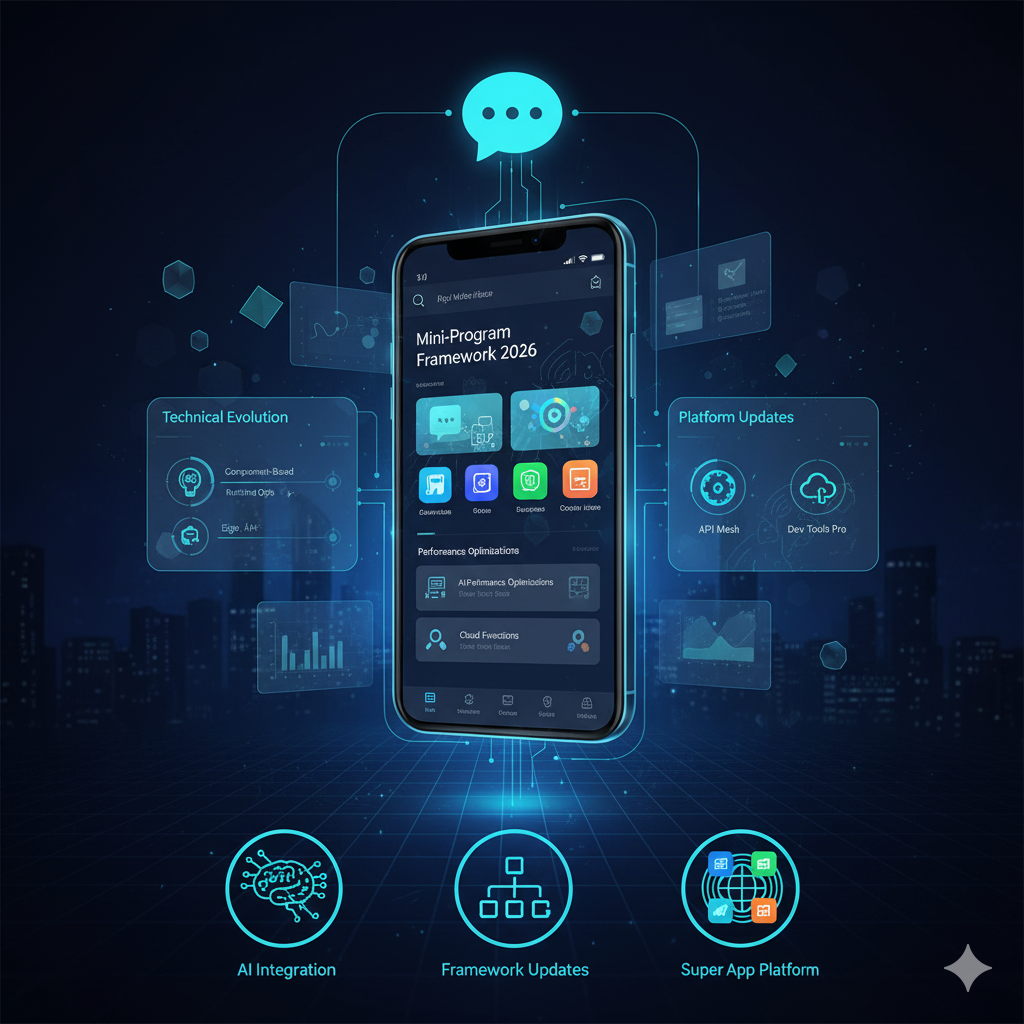
WeChat's mini-program framework undergoes continuous technical evolution through regular updates that enhance performance, security, developer capabilities, and user experience across China's dominant super app platform. With over 100 million mini-programs serving more than 1.2 billion monthly active users, these technical improvements represent more than feature additions—they demonstrate how platform infrastructure must evolve to support increasingly complex service ecosystems while maintaining the simplicity and reliability that made mini-programs successful. The framework's development reflects broader trends in containerized application architecture, cross-platform deployment, and ecosystem scalability that influence global super app development strategies.
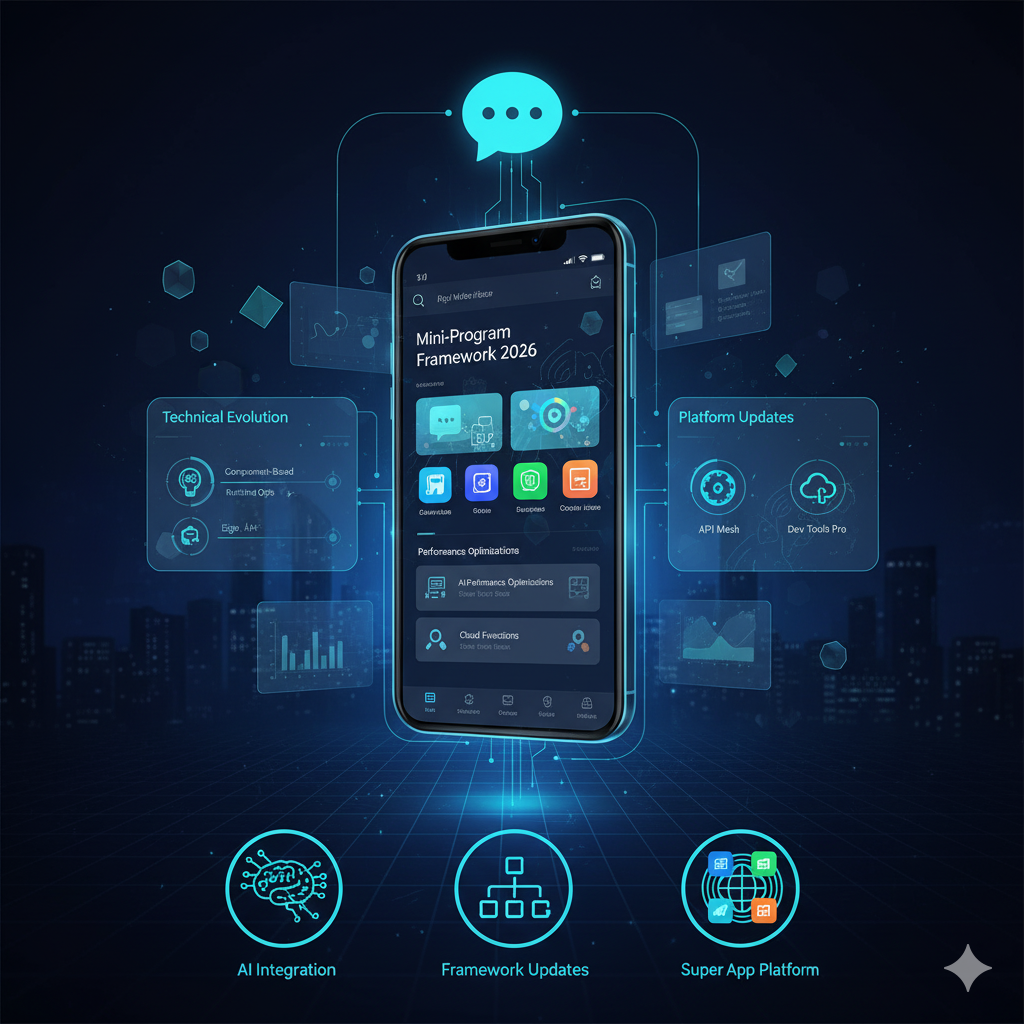
Framework Architecture and Performance Enhancements
WeChat's mini-program framework operates on a containerized architecture that separates mini-program execution from the core WeChat application, providing security isolation, resource management, and consistent user interface rendering across different device types and operating systems. Recent framework updates have focused on performance optimization through mechanisms like asynchronous subcontract downloading, codecache policy improvements, and rendering engine enhancements for the Skyline architecture. These optimizations address the fundamental challenge of mini-program ecosystems: maintaining fast startup times and smooth interactions as service complexity increases and user expectations evolve.
The framework's support for HarmonyOS represents a strategic expansion beyond traditional mobile operating systems, enabling "write once, run anywhere" deployment across Huawei's ecosystem of more than 7 billion devices spanning smartphones, tablets, smartwatches, smart screens, vehicle systems, and industrial equipment. This cross-platform capability addresses fragmentation challenges in the Internet of Things era, where applications must operate consistently across diverse device categories with varying computational resources, screen sizes, and interaction modalities. The technical implementation involves abstraction layers that translate mini-program code into platform-specific native components while maintaining consistent behavior and user experience standards.
Performance monitoring and optimization tools within the developer ecosystem have evolved to provide more granular insights into mini-program behavior, including real-time performance analysis, memory usage tracking, and rendering efficiency measurements. The introduction of experience scoring functionality helps developers identify and address performance bottlenecks, with automated analysis reports highlighting specific issues, their impact on user experience, and optimization recommendations. These tools reflect the maturation of mini-program development from experimental feature addition to professional software engineering discipline, with established best practices, performance benchmarks, and optimization methodologies.
Security and Privacy Framework Evolution
Security represents a continuous focus area in WeChat mini-program framework updates, with enhancements addressing container isolation, data protection, API access controls, and vulnerability management. The framework's security architecture employs multiple layers of protection including sandboxed JavaScript execution, network request filtering, storage encryption, and permission-based access to device capabilities and user data. Recent updates have strengthened these protections through improved isolation between mini-programs running within the same WeChat instance, enhanced encryption for locally stored data, and more granular control over cross-mini-program communication.
Privacy considerations have gained prominence in framework development, reflecting increased regulatory scrutiny and user awareness around data protection. Updates include more transparent permission requests, clearer data usage explanations, and improved user control over what information mini-programs can access and how they can use it. The framework implements privacy-by-design principles through data minimization (collecting only necessary information), purpose limitation (using data only for stated purposes), and storage limitation (retaining data only as long as needed). These approaches help mini-program developers comply with evolving privacy regulations while maintaining user trust—a critical factor in ecosystem sustainability.
API security has evolved through more sophisticated authentication mechanisms, request validation procedures, and rate limiting policies that prevent abuse while enabling legitimate functionality. The framework distinguishes between different API categories based on sensitivity, with highly sensitive APIs (like payment processing or biometric authentication) requiring additional verification steps and lower-level APIs (like UI rendering or basic device information) available with minimal restrictions. This graduated approach balances security requirements with developer convenience, enabling rapid innovation for non-sensitive functionality while maintaining robust protection for critical operations.
Developer security tools have expanded to include automated vulnerability scanning, code analysis for common security issues, and secure coding guidelines integrated into the development environment. These tools help prevent security vulnerabilities before they reach production, reducing the risk of data breaches, financial fraud, or other security incidents that could damage user trust in the mini-program ecosystem. The framework also provides security best practice documentation, reference implementations for common security patterns, and regular security bulletins highlighting newly discovered vulnerabilities and recommended mitigation strategies.
Developer Experience and Ecosystem Tools
WeChat's mini-program developer tools have evolved significantly since the platform's launch, with current versions offering integrated development environments, visual programming capabilities, cloud service integration, and comprehensive testing frameworks. The development workflow now supports collaborative features enabling multiple developers to work on the same mini-program simultaneously, version control integration with popular systems like Git, and continuous integration/continuous deployment pipelines that automate testing and publication processes. These improvements reduce development barriers for professional teams while maintaining accessibility for individual developers and small businesses.
Visual programming capabilities represent a notable advancement, allowing developers to create mini-programs through drag-and-drop interfaces that generate corresponding code, reducing the technical expertise required for basic functionality implementation. These tools target business users without programming backgrounds who want to create simple mini-programs for specific use cases like event registration, product showcases, or customer feedback collection. The visual approach complements traditional coding for more complex requirements, creating a spectrum of development options that matches different skill levels and project complexities.
Cloud service integration simplifies backend development by providing ready-to-use infrastructure for data storage, user authentication, file management, and serverless function execution. Developers can leverage these services without managing servers, databases, or scaling infrastructure, focusing instead on frontend implementation and business logic. The cloud platform offers tiered service levels matching different usage patterns and budget constraints, from free tiers for experimentation and low-volume usage to enterprise-grade offerings with service level agreements, dedicated support, and custom configuration options.
Testing frameworks have expanded to include automated unit testing, integration testing, performance testing, and compatibility testing across different device types, operating system versions, and network conditions. These tools help ensure mini-program quality before publication, reducing the risk of bugs, performance issues, or compatibility problems that could negatively impact user experience. The testing infrastructure integrates with development workflows, allowing developers to run tests automatically during development and receive immediate feedback on code changes—an approach that accelerates development cycles while maintaining quality standards.
Cross-Platform Deployment and Future Direction
WeChat's mini-program framework evolution points toward increased cross-platform deployment capabilities beyond traditional mobile devices, with expansion into desktop environments, automotive systems, wearable devices, and smart home appliances. The technical foundation for this expansion involves abstraction layers that translate mini-program components into native UI elements appropriate for each platform while maintaining consistent business logic and data handling. This approach enables developers to reach users across multiple touchpoints with a single codebase, reducing development costs and maintenance overhead compared to creating separate applications for each platform.
The framework's future development will likely focus on enhanced AI integration, with capabilities for natural language interfaces, intelligent recommendations, automated task completion, and predictive functionality based on user behavior patterns. These AI features will build upon the framework's existing data collection and processing capabilities while adding new interaction paradigms that reduce user effort and increase personalization. The technical implementation will involve standardized interfaces for AI model integration, consistent APIs for AI-powered features, and privacy-preserving approaches that enable intelligence without compromising user data protection.
Performance optimization will remain a continuous focus as mini-programs become more feature-rich and user expectations for speed and responsiveness increase. Future updates may include more sophisticated caching strategies, predictive loading of likely-needed resources, and adaptive quality adjustments based on device capabilities and network conditions. These optimizations will help maintain the instant-access experience that distinguishes mini-programs from traditional applications while supporting increasingly complex functionality that previously required standalone apps.
As mini-program ecosystems expand globally, framework development will address internationalization requirements including multi-language support, regional compliance variations, and cultural adaptation of user interface patterns. The technical implementation involves modular architecture that allows region-specific customization while maintaining core framework consistency, enabling global expansion without fragmenting the developer experience or creating incompatible mini-program variants. Download FinClip SDK and start running mini-programs today. Get SDK