WeChat Develops AI Agent to Integrate with Millions of Mini Programs, Testing Begins Mid-2026
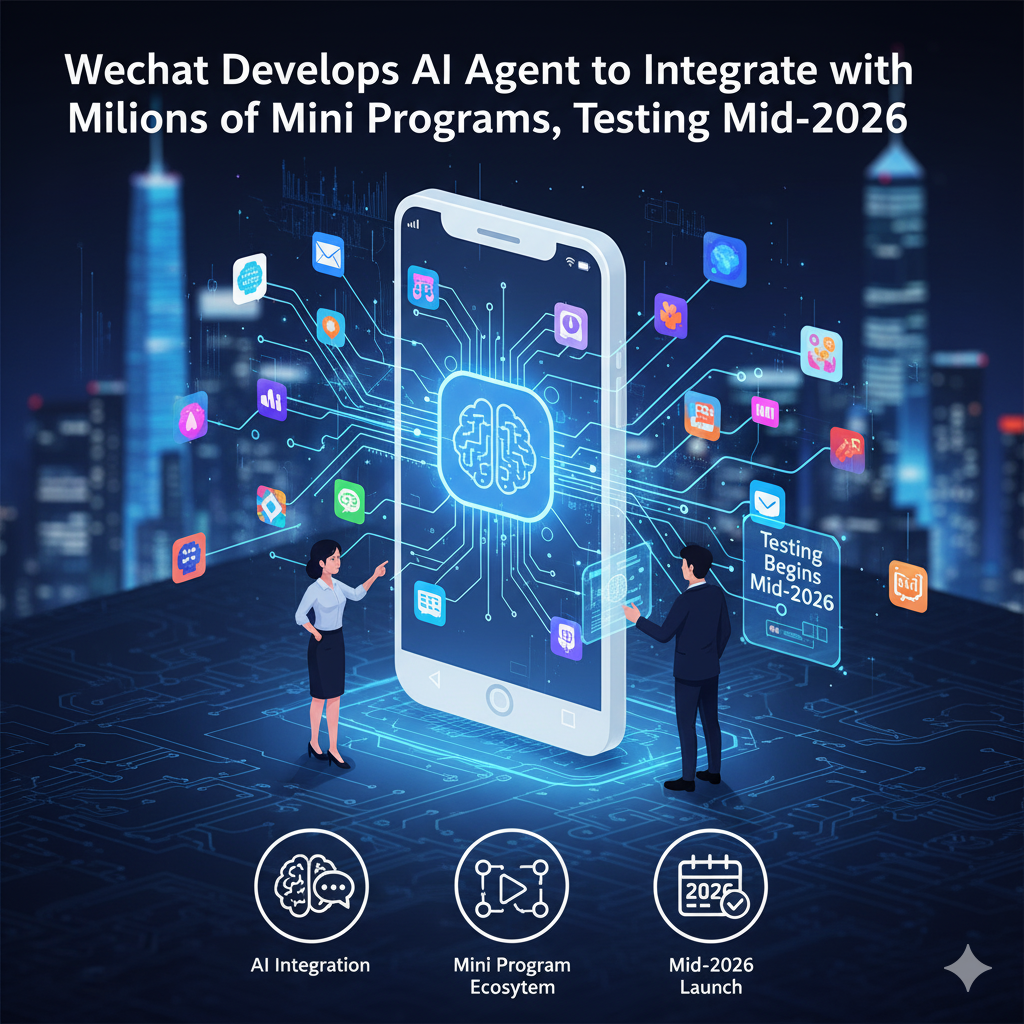
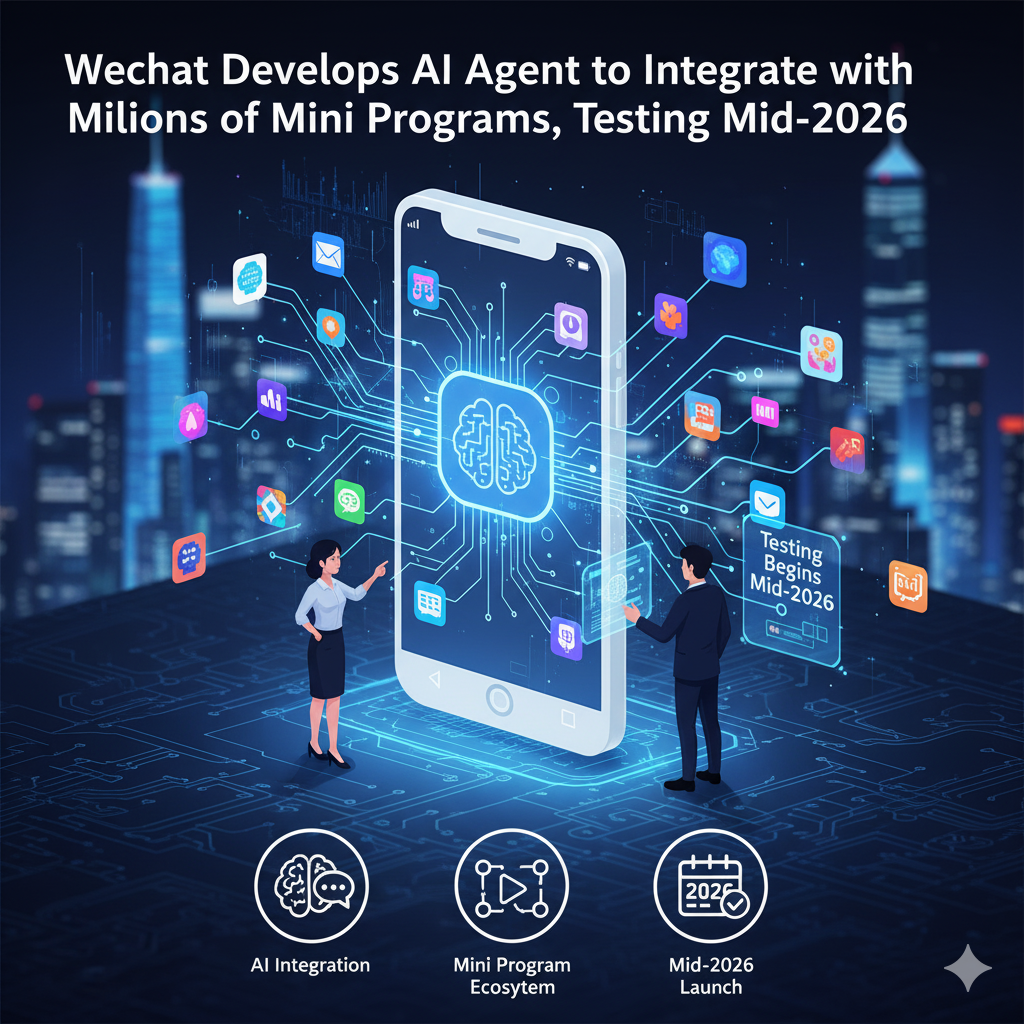
Tencent's WeChat team is developing a high-priority AI agent product designed for full integration with the platform's millions of mini-programs, according to multiple reports confirmed in March 2026. Led by technical director Zhou Hao reporting directly to Zhang Xiaolong, the project aims to transform WeChat from a "social entry point" to an "intelligent task center" where users can execute cross-application services through natural language commands. Scheduled for phased testing beginning mid-2026 with gradual expansion through the third quarter, the AI agent represents Tencent's most significant countermove in the AI application race, leveraging WeChat's 1.4 billion monthly active users and mature mini-program ecosystem against competitors like ByteDance's Doubaobao and Alibaba's Tongyi. This development matters because it shifts large model competition from conversational capabilities to practical execution, potentially establishing WeChat as China's dominant AI assistant platform.
What Happened
Multiple Chinese technology publications reported in March 2026 that Tencent's WeChat division has been secretly developing an AI intelligent agent product since early 2025, with phased testing scheduled to begin mid-2026. The project, led by WeChat technical director Zhou Hao with direct reporting to WeChat founder Zhang Xiaolong, represents one of Tencent's highest-priority AI initiatives despite the company's public emphasis on its Hunyuan large model system.
Core functionality focuses on cross-application task execution within WeChat's mini-program ecosystem. Users will invoke third-party services—including ride-hailing, food delivery, ticket booking, and payment processing—through natural language commands rather than navigating individual mini-program interfaces. The AI agent will understand complex, multi-step requests like "Order me lunch from the nearest Sichuan restaurant and schedule a DiDi to the office for 1:30 PM," coordinating between different service providers through standardized APIs.
Technical implementation follows a cautious, multi-model approach. Although Tencent recruited researcher Yao Shunyu from OpenAI to lead Hunyuan's development, the WeChat AI agent simultaneously tests external large models from Zhipu, Alibaba, and DeepSeek alongside smaller self-developed models. This strategy ensures stability for complex task execution while avoiding over-reliance on any single model provider. The architecture reportedly includes specialized modules for intent recognition, service discovery, parameter extraction, and execution monitoring.
Integration depth distinguishes WeChat's approach from standalone AI assistants. Rather than operating as a separate application, the AI agent embeds directly within WeChat's core interface, accessible through the existing search bar, voice input, or dedicated conversation entry points. This seamless integration leverages WeChat's established user behaviors while avoiding the adoption friction faced by new applications. Mini-program developers will receive updated SDKs and documentation for AI agent compatibility, though initial testing focuses on major service categories with established API standards.
The development timeline indicates substantial technical challenges. Beginning development in early 2025 with testing scheduled for mid-2026 suggests an 18-month development cycle for core functionality, with additional refinement expected before broader release. This contrasts with faster iteration cycles typical of consumer feature updates, reflecting the complexity of reliable cross-application coordination and the regulatory considerations surrounding financial transactions and personal data.
Why This Matters for AI-Powered Super Apps
WeChat's AI agent initiative represents the logical evolution of super app platforms from service aggregation to intelligent orchestration. Where mini-programs initially solved the problem of application discovery and lightweight installation, AI agents address the subsequent challenge of service coordination and multi-step task execution. This transition matters because it changes the fundamental value proposition from "access to many services" to "accomplishment of complex objectives with minimal effort."
The competitive landscape for AI assistants in China has intensified throughout 2025-2026. ByteDance's Doubaobao reached approximately 50 million monthly active users by early 2026 through aggressive marketing and TikTok integration. Alibaba's Tongyi leveraged the company's e-commerce and cloud infrastructure to establish enterprise credibility. Tencent's previous AI assistant "Yuanbao" struggled to gain similar traction despite the company's technical resources and social graph advantages. WeChat integration represents Tencent's most credible path to AI assistant leadership, transforming distribution weakness into overwhelming strength.
Technical implementation challenges reveal why few platforms attempt similar integration. Reliable cross-application execution requires standardized APIs across thousands of independent mini-program developers, consistent error handling for service failures, and sophisticated context maintenance during multi-turn conversations. WeChat's established developer ecosystem and review processes provide advantages unavailable to standalone AI assistant developers, but still require substantial coordination and technical standardization.
Privacy and data governance considerations introduce additional complexity. The AI agent must access personal information—location for ride-hailing, dietary preferences for food delivery, payment credentials for transactions—while maintaining appropriate isolation between service providers. WeChat's existing privacy framework and user trust provide foundations, but AI agent capabilities expand data collection and usage scenarios beyond current patterns. Regulatory approval processes, particularly for financial transactions, may influence rollout pacing and feature availability.
From a business perspective, the AI agent creates new monetization opportunities while reinforcing platform lock-in. Tencent could implement transaction fees for AI-mediated services, premium subscription tiers for advanced capabilities, or advertising placements within agent responses. More significantly, successful AI agent deployment makes WeChat increasingly indispensable for daily tasks, reducing user motivation to explore alternative platforms. This creates a virtuous cycle where more users attract more developers, whose services make the AI agent more capable, which in turn attracts more users.
The Bigger Picture
WeChat's AI agent development signals the next phase of platform competition: intelligence as a differentiator. Where previous platform wars focused on feature breadth, developer incentives, and user acquisition costs, the emerging battleground centers on which platform can most effectively understand user intent and coordinate complex task execution. This shift advantages integrated ecosystems over standalone applications, as coordination capabilities require deep platform integration and standardized APIs across diverse services.
The global implications extend beyond China's technology landscape. Western platforms observing WeChat's progress face strategic decisions about AI integration depth. Meta could enhance WhatsApp's business messaging with AI coordination capabilities. Google might deepen Assistant integration with Android applications. Apple could leverage its control over iOS to create similar ecosystem coordination. Each platform must balance the technical opportunity against privacy concerns, regulatory scrutiny, and developer relationship management.
Technical architecture decisions will influence long-term platform flexibility. WeChat reportedly maintains compatibility with multiple AI models rather than committing exclusively to Hunyuan, preserving optionality as model capabilities evolve. This approach acknowledges the rapid pace of AI advancement and avoids platform lock-in to any single provider's roadmap. The middleware layer between AI models and mini-program services creates abstraction that facilitates model switching and capability enhancement without disrupting developer integrations.
Developer ecosystem dynamics will evolve in response to AI agent capabilities. Mini-program developers may optimize their services for AI discoverability and execution reliability, potentially standardizing parameter formats and error responses. New developer tools could emerge for testing AI agent interactions, monitoring performance metrics, and optimizing service descriptions. The economic model may shift from user acquisition costs to AI agent referral quality, with developers competing for prominent placement within agent recommendations.
Looking forward, the most successful AI agents will balance capability with constraint. Unlimited flexibility risks unpredictable behavior and user confusion, while excessive restriction limits utility. WeChat's approach of focusing initially on established service categories with clear parameters represents a pragmatic middle ground. As the agent matures and user comfort increases, more complex and creative task execution may become feasible, potentially extending beyond transactional services to creative, analytical, and social coordination functions.
What Platform Developers Should Do Now
Technology platforms evaluating AI agent strategies should prioritize three areas: API standardization, developer education, and incremental deployment. Standardized interfaces for service discovery, parameter specification, and execution reporting enable reliable AI coordination across diverse applications. These standards should balance specificity for reliable execution with flexibility for service innovation, potentially adopting existing industry protocols where available.
Developer communities require education about AI agent capabilities and integration requirements. Technical documentation should explain how to make services discoverable and executable through natural language commands, including best practices for parameter naming, error handling, and context maintenance. Sample implementations and testing tools help developers validate their integrations before public release, reducing support burdens and improving user experiences.
Incremental deployment reduces risk while gathering valuable user feedback. Initial releases might focus on limited service categories or geographic regions, expanding based on performance metrics and user adoption. A/B testing different interaction models—voice versus text, proactive versus reactive suggestions, detailed versus concise responses—helps optimize the agent design before broader availability.
Organizations building mini-program ecosystems should consider container architectures that facilitate AI agent integration while maintaining security isolation. Lightweight SDKs enable existing applications to expose standardized APIs without complete rearchitecture, supporting gradual enhancement rather than disruptive replacement. In enterprise deployments using container solutions, organizations have achieved 126% user satisfaction improvements while reducing integration timelines by 70% compared to custom AI integration projects.
The container approach addresses critical challenges in AI agent deployment. Security sandboxes ensure AI-mediated transactions operate within protected environments, preventing unauthorized data access or financial manipulation. Cross-platform compatibility maintains consistent experiences across different devices and operating systems. Hot update capabilities support rapid iteration based on user feedback and emerging AI model capabilities.
See how FinClip turns any app into a SuperApp. Book a 30-min demo