Digital Construction Sites: Solving Connectivity and Complexity with Mini-Apps
Executive Summary: The Field-to-Office Disconnect
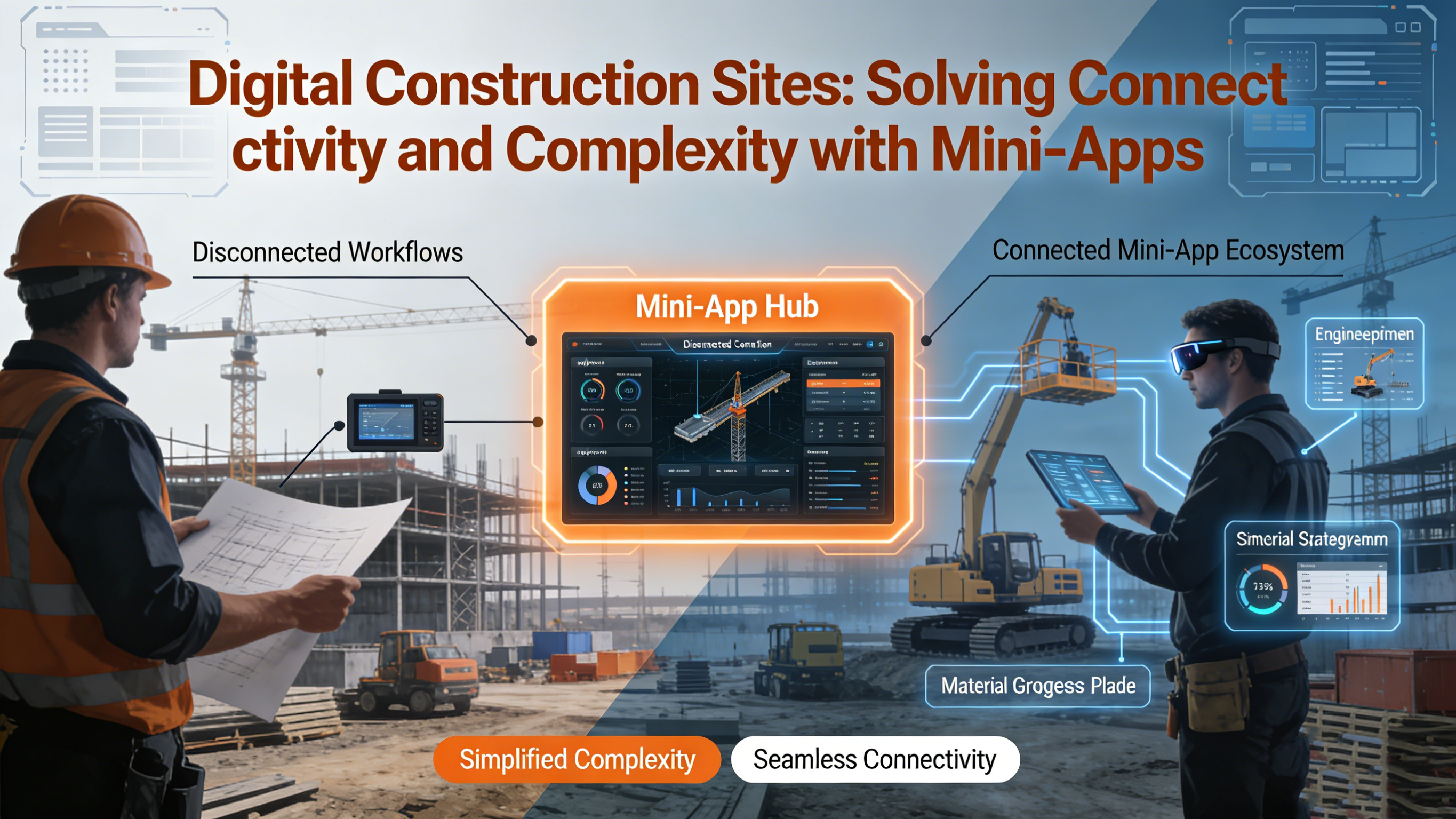
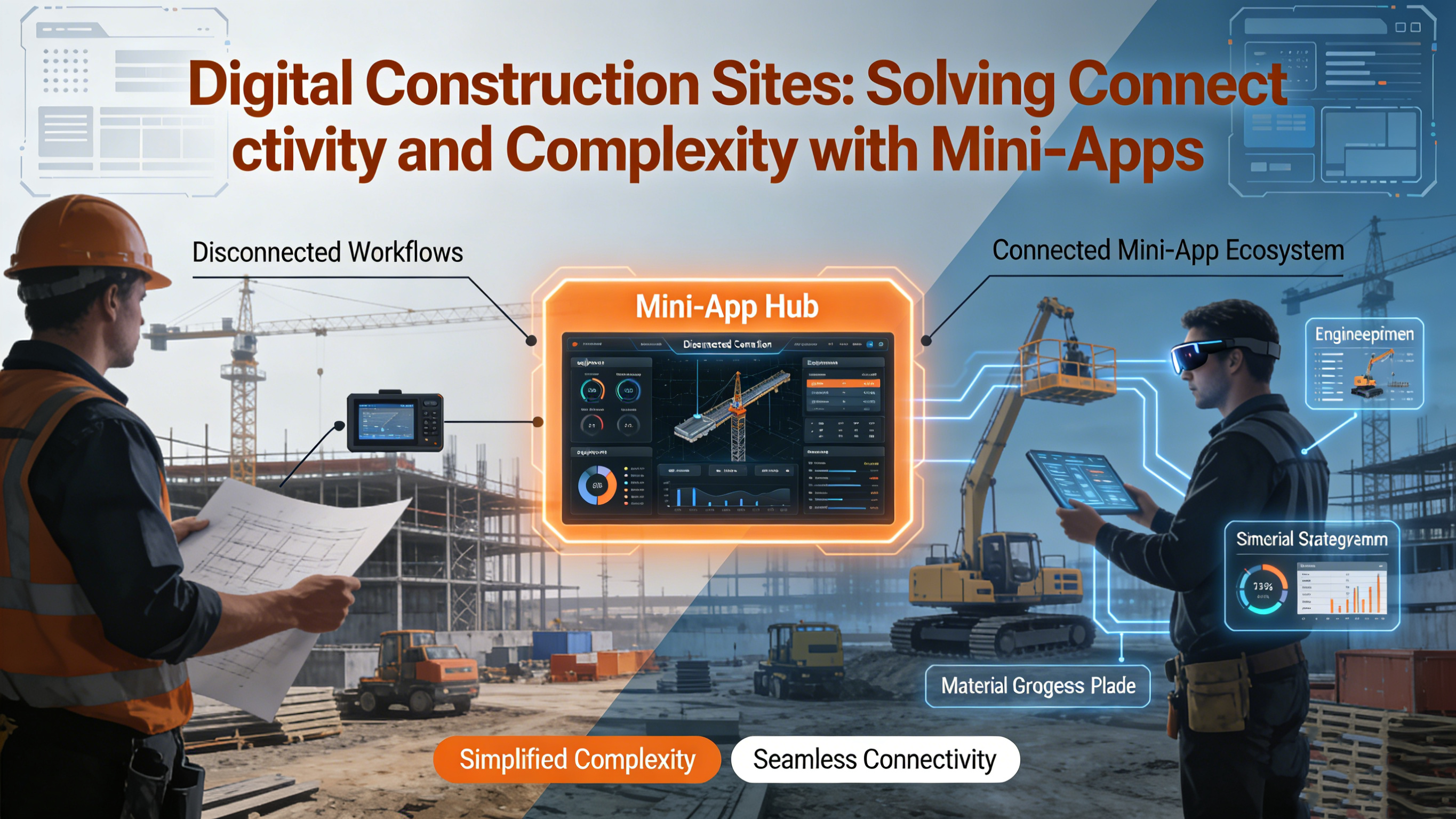
The construction industry faces a unique "Last Mile" problem. While the Head Office uses sophisticated BIM (Building Information Modeling) software and ERP systems, the reality on the job site—the "mud and concrete" layer—remains stubbornly analog.
Paper blueprints, clipboards, and WhatsApp groups still dominate the field. Why? Because traditional mobile apps fail in the harsh reality of a construction zone.
- The Connectivity Barrier: Basements, tunnels, and remote greenfield sites rarely have stable 4G/5G. Web-based apps (H5) stop working.
- The Workforce Complexity: A project involves dozens of subcontractors (electricians, plumbers, drywallers). They are transient. They refuse to download heavy, invasive corporate MDM (Mobile Device Management) apps on their personal phones.
- The Versioning Chaos: Ensuring every worker is looking at the latest version of a blueprint or safety protocol is a logistical nightmare.
To digitize the field effectively, Construction IT leaders need a new architecture. They need a "Site Super App"—a lightweight, offline-capable container that can provision tools to any worker, instantly. FinClip provides the infrastructure to build this.
1. Solving the Subcontractor Onboarding: Role-Based Provisioning
On a major project, the General Contractor (GC) is responsible for the site, but 80% of the work is done by Subcontractors.
"Subbies" are temporary. If an electrician is on-site for only three days, they will not go through a complex IT onboarding process to download a 200MB corporate app.
FinClip enables "Just-in-Time" App Delivery.
The GC provides a generic "Site Utility" shell app (or integrates FinClip into their existing safety app).
- The Workflow: When the electrician arrives at the site gate, they scan a QR Code for "Electrical Team."
- The Provisioning: FinClip instantly loads the "Electrical Task & Punch List" Mini-App into their shell.
- Role Isolation: The electrician sees only what they need: their specific tasks, the relevant floor plans, and the material request form. They do not see the master budget or the plumbing schedules.
This Role-Based Access Control (RBAC) happens at the mini-app level. It allows the GC to digitize the entire supply chain without managing thousands of user accounts in a monolithic system. When the job is done, the mini-app is removed.
2. The "Concrete Bunker" Problem: True Offline-First Architecture
The defining characteristic of a construction site is signal interference. Thick concrete walls and steel rebar turn basements into Faraday cages.
Standard mobile web apps (HTML5) rely on a constant server connection. If the signal drops while a Site Manager is filling out a non-conformance report (NCR), the screen freezes, and data is lost.
FinClip provides the "Offline-First" resilience required for the field.
Unlike a browser cache (which is unreliable), FinClip downloads the Mini-App package (code + assets) to the device's local storage.
- Local Logic: The business logic (e.g., form validation, safety checklists) runs on the device’s CPU, not the server. It works perfectly in Airplane Mode.
- Data Serialization: When a worker submits an "Inspection Report" while underground, the mini-app serializes the data and stores it in a secure local queue.
- Auto-Sync: As soon as the worker takes the elevator up to ground level and connects to 4G, the FinClip container detects the connection and automatically syncs the data payload to the cloud.
This capability is non-negotiable for ConTech. It ensures that the digital workflow does not stop just because the internet did.
3. Handling Heavy Assets: Vector Blueprints on Mobile
Construction documents are heavy. A PDF of a floor plan can be 50MB. A BIM slice can be larger.
Loading these in a standard mobile app is slow and eats up data plans.
FinClip allows for Specialized Rendering Mini-Apps.
Instead of trying to force a generic PDF viewer to work, IT teams can build specific mini-apps optimized for vector graphics.
- Incremental Loading: The mini-app can download only the specific "Layer" required (e.g., HVAC layer) rather than the whole building model.
- Local Caching: Once the "Level 3 Floor Plan" is accessed, it is cached locally in the sandbox. The Site Manager can zoom and pan through the drawing instantly the next day without re-downloading it.
This transforms the mobile device from a passive viewer into an active engineering tool, capable of handling the data density of modern construction.
4. Safety and Compliance: The Dynamic "Hot Update"
Safety regulations (OSHA/HSE) change frequently. Site risks change daily.
If the Safety Officer identifies a new hazard (e.g., "Exposed wiring on Zone B"), they need every worker to acknowledge it immediately.
In a native app world, updating the "Daily Safety Briefing" form requires an App Store update, which takes days.
In a FinClip world, the update is instantaneous.
- The Hot Update: The Safety Team updates the "Daily Briefing" mini-app in the cloud.
- Forced Refresh: The next time any worker opens the app to clock in, FinClip forces a download of the new mini-app version.
- Compliance: The worker cannot proceed without acknowledging the new specific hazard.
This speed saves lives. It ensures that the digital tools match the physical reality of the site in real-time.
5. ROI: The Data-Driven Job Site
By consolidating disparate tools (RFIs, Daily Logs, Safety, Timecards) into a single FinClip-powered Super App, construction firms gain a Unified Data View.
Instead of data being trapped in WhatsApp chats or paper folders, it is structured and digitized at the source.
- Project Managers get real-time visibility into progress.
- Quantity Surveyors get accurate material usage data.
- Legal Teams get an immutable audit trail of every inspection and approval.
Conclusion: Building the Digital Foundation
The construction industry is moving towards "Industrialized Construction," where efficiency is paramount. You cannot run a modern, lean construction site with archaic communication tools.
FinClip offers the bridge between the office and the field. It handles the complexity of device fragmentation, offline environments, and diverse user roles, allowing Construction IT to build a "Site Super App" that workers actually want to use.
Stop fighting the connectivity issues. Architect for the reality of the job site with FinClip.