The "Last Mile" of Low-Code: Deploying Citizen Development to a Unified Super App
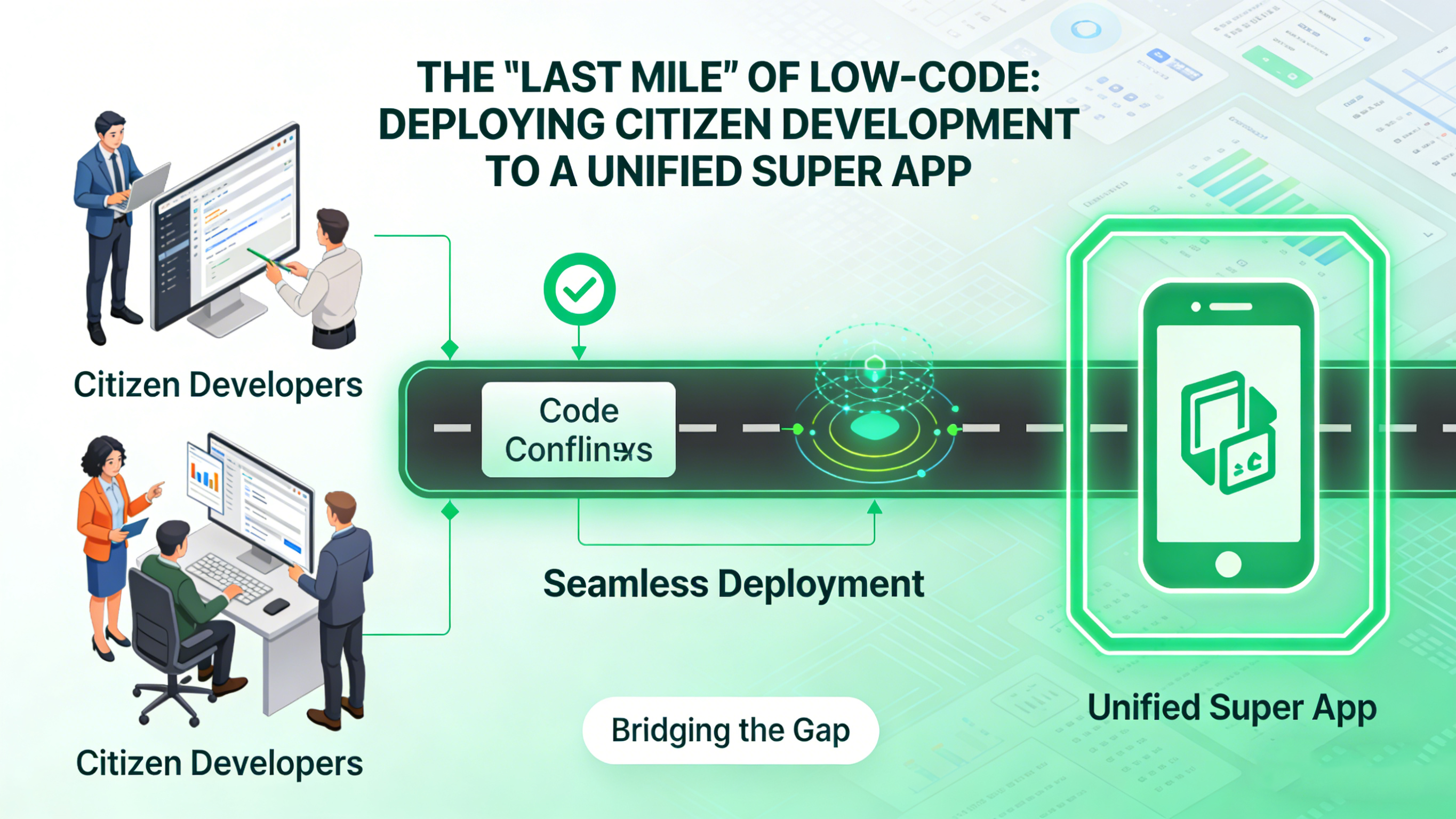
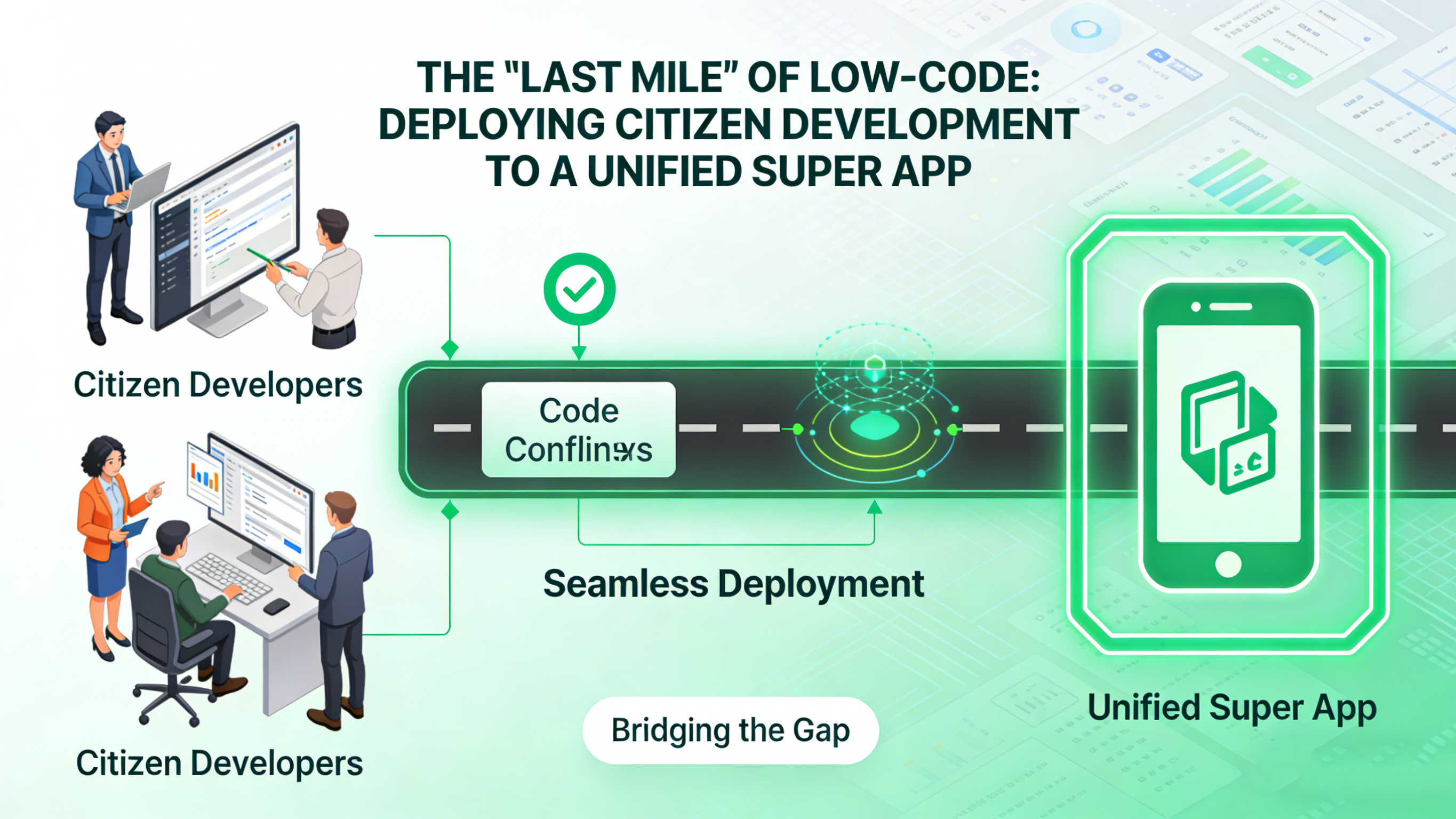
Executive Summary: The Paradox of Citizen Development
We are living in the golden age of Low-Code/No-Code (LCNC). Platforms like Mendix, OutSystems, and Microsoft PowerApps have empowered business units to solve their own problems. HR builds an "Onboarding App"; Finance builds an "Expense Tracker"; Sales builds a "Lead Capture Tool."
This is the rise of the Citizen Developer. It promises speed and agility.
However, for the CIO and IT Governance Team, it often results in "App Sprawl" (also known as Shadow IT).
- Fragmentation: Employees have to bookmark 15 different URLs or download 5 different "Player Apps" to do their jobs.
- Poor Mobile UX: Most low-code platforms output responsive web pages (H5). On a mobile device, they feel sluggish, lack smooth transitions, and cannot easily access hardware features like biometrics or NFC.
- Security Nightmares: Data is scattered across different clouds with inconsistent access controls.
The challenge is not building the apps; it is delivering them.
The solution is to treat these low-code outputs not as standalone websites, but as Mini-Apps aggregated inside a single, corporate Super App. FinClip provides the container technology to bridge this "Last Mile" gap.
1. The Architecture of Aggregation: One Portal to Rule Them All
The "Super App" concept—popularized by consumer giants like WeChat—is the perfect architectural pattern for the Enterprise.
Instead of asking employees to install "The HR App" and "The Finance App," the organization builds One Corporate Super App (The Host). This host contains the unified identity system (SSO), the security perimeter, and the FinClip SDK.
FinClip acts as the "Universal Player."
It is platform-agnostic. It does not care if the original app was built in React, Vue, Mendix, or OutSystems.
- The Wrapper Strategy: IT teams can take the web output from a Low-Code platform and wrap it into a FinClip Mini-App package.
- The Repository: These packages are uploaded to the enterprise's private FinClip Store.
- The Experience: When an employee opens the Super App, they see a unified dashboard. They tap "Expenses" (built in PowerApps) and it opens instantly. They tap "Leave Request" (built in Mendix) and it opens instantly.
To the user, it feels like one cohesive application. The underlying fragmentation of the tech stack is completely hidden.
2. Bridging the "Native Gap": Hardware Access
The biggest weakness of Low-Code web apps is their inability to interact deeply with the mobile device.
- Scenario: A "Warehouse Inventory" app built on a Low-Code platform needs to scan a QR code rapidly or connect to a Bluetooth printer.
- The Limit: Running this in a standard mobile browser is slow, buggy, and often impossible due to permission restrictions.
FinClip provides a "Native Shim" layer.
Because the Low-Code app is running inside the FinClip Container, it gains access to the FinClip JSBridge.
How it works:
- The Low-Code App: The citizen developer adds a simple JavaScript call: ft.scanCode().
- The FinClip Container: Intercepts this call and invokes the Native camera scanner of the iOS/Android device.
- The Result: The scan is instant, and the data is passed back to the web view.
This capabilities expansion allows enterprises to use Low-Code platforms for Mission-Critical Field Work (Scanning, GPS tracking, NFC reading) that was previously reserved for expensive native development.
3. Governance: Balancing Autonomy and Control
The fear of Shadow IT is that business units will publish insecure or broken apps without IT knowing.
However, if IT locks everything down, innovation stops.
FinClip enables a "Federated Governance" model that balances these needs.
The Workflow:
- Creation (Business Unit): The HR team builds their "Holiday Planner" using their preferred No-Code tool.
- Submission (Gateway): Instead of emailing a link to employees, they submit the package to the FinClip Management Console.
- Audit (Central IT): The IT team reviews the mini-app. They check: Does it use HTTPS? Is the branding correct? Does it ask for unnecessary permissions?
- Publishing (Control): Only IT has the button to push it live to the Corporate Super App.
This structure allows Business Units to innovate at their own speed, while Central IT acts as the "Gatekeeper," ensuring that nothing enters the employee ecosystem without a quality check.
4. Lifecycle Management: The "Disposable" App Strategy
One of the hidden benefits of Low-Code is the ability to build Ephemeral (Temporary) Apps.
- Example: A "Year-End Party Registration" app or a "COVID-19 Health Check" app.
In a native app environment, adding these temporary features is a pain. You have to update the app, waiting for App Store approval. When the event is over, you have to update it again to remove the code.
With FinClip, managing the lifecycle is effortless.
- Launch: Publish the "Party" mini-app on Monday.
- Promote: Push it to the top of the Super App dashboard.
- Retire: Unpublish it on Friday. It disappears from every employee's phone instantly.
This encourages a culture of experimentation. Teams can launch Micro-Apps for specific, short-term problems without worrying about long-term technical debt.
5. ROI: Adoption is the Only Metric
The most expensive software is the software nobody uses.
Enterprises spend millions on Low-Code licenses, but if employees refuse to use the clunky web interfaces, the ROI is zero.
By deploying these tools via FinClip, you improve the User Experience (UX).
- Single Sign-On (SSO): Login once to the Super App, access everything.
- Native Feel: Smooth transitions and offline caching.
- Convenience: Everything is in one place.
Higher adoption rates lead to better data, faster processes, and the realization of the Low-Code promise.
Conclusion: The Operating System for the Composable Enterprise
The future of enterprise software is Composable—building systems out of interchangeable blocks.
Low-Code platforms provide the blocks. FinClip provides the cement.
By adopting FinClip as your "Universal Container," you solve the Last Mile problem of application delivery. You empower your citizen developers to build freely, while providing your employees with a unified, secure, and powerful mobile experience.
Unify your digital workplace. Deploy your Low-Code apps with FinClip.