The "Hollow Core" Strategy: Modernizing Banking Channels Without Rewriting the Mainframe
Executive Summary: The Speed Mismatch
The modern banking institution is a paradox. On the surface, it tries to compete with agile Fintechs like Revolut or NuBank, promising intuitive apps and real-time features. Deep underground, however, it is powered by a Core Banking System (CBS) that was likely written in COBOL in the 1980s.
This creates a debilitating "Two-Speed IT" problem.
- The Channel Layer (Mobile/Web) demands weekly updates to meet customer expectations.
- The Core Layer (Mainframe) runs on quarterly release cycles because the risk of breakage is systemic failure.
For years, the industry solution was the "Big Bang Migration"—ripping out the legacy core and replacing it with a modern cloud-native system. But these projects have a notoriously high failure rate. They cost hundreds of millions of dollars, take 5-7 years, and often end in disaster (e.g., the TSB migration meltdown).
In 2026, smart banks are adopting a different strategy: "Hollowing the Core."
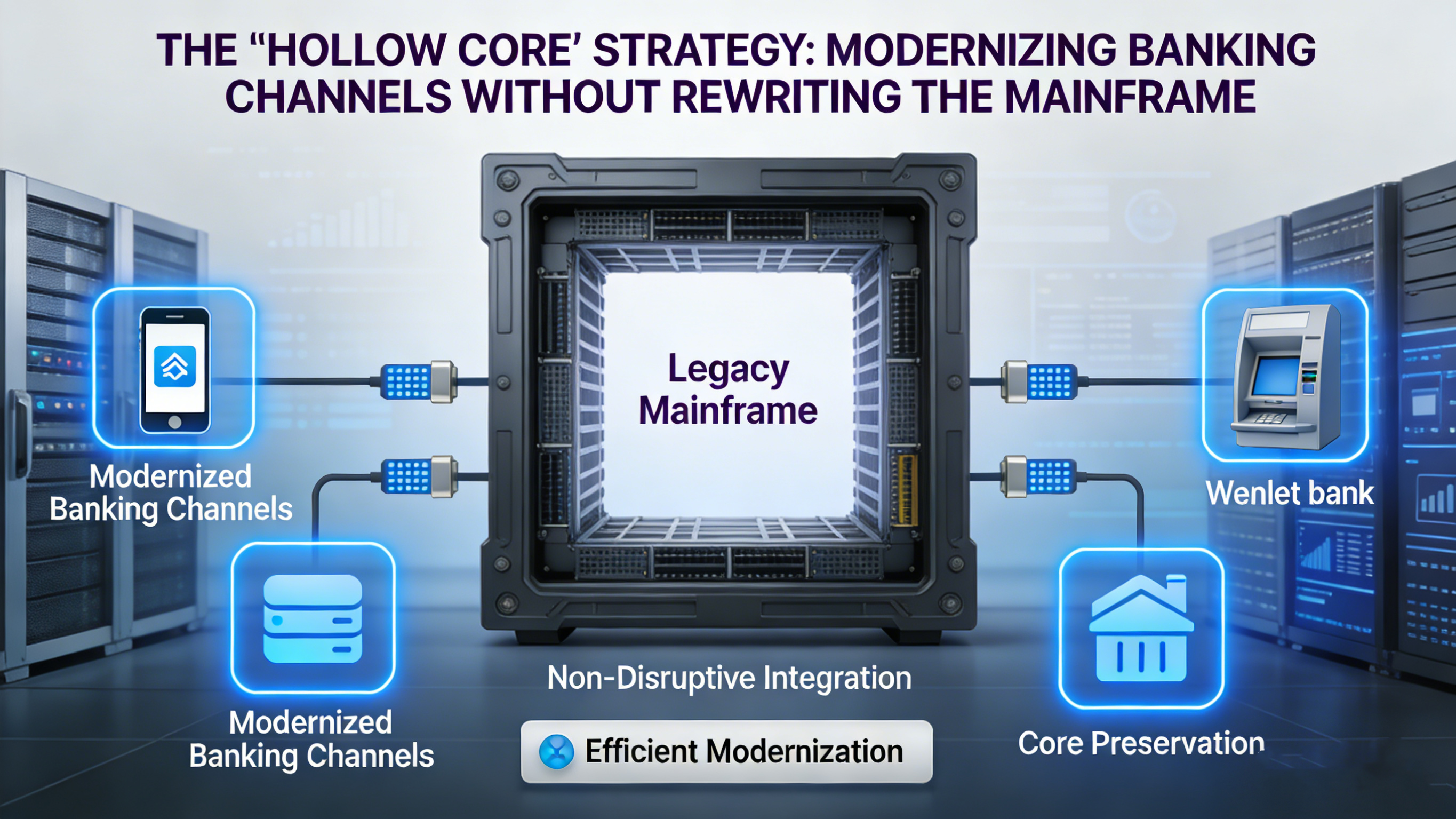
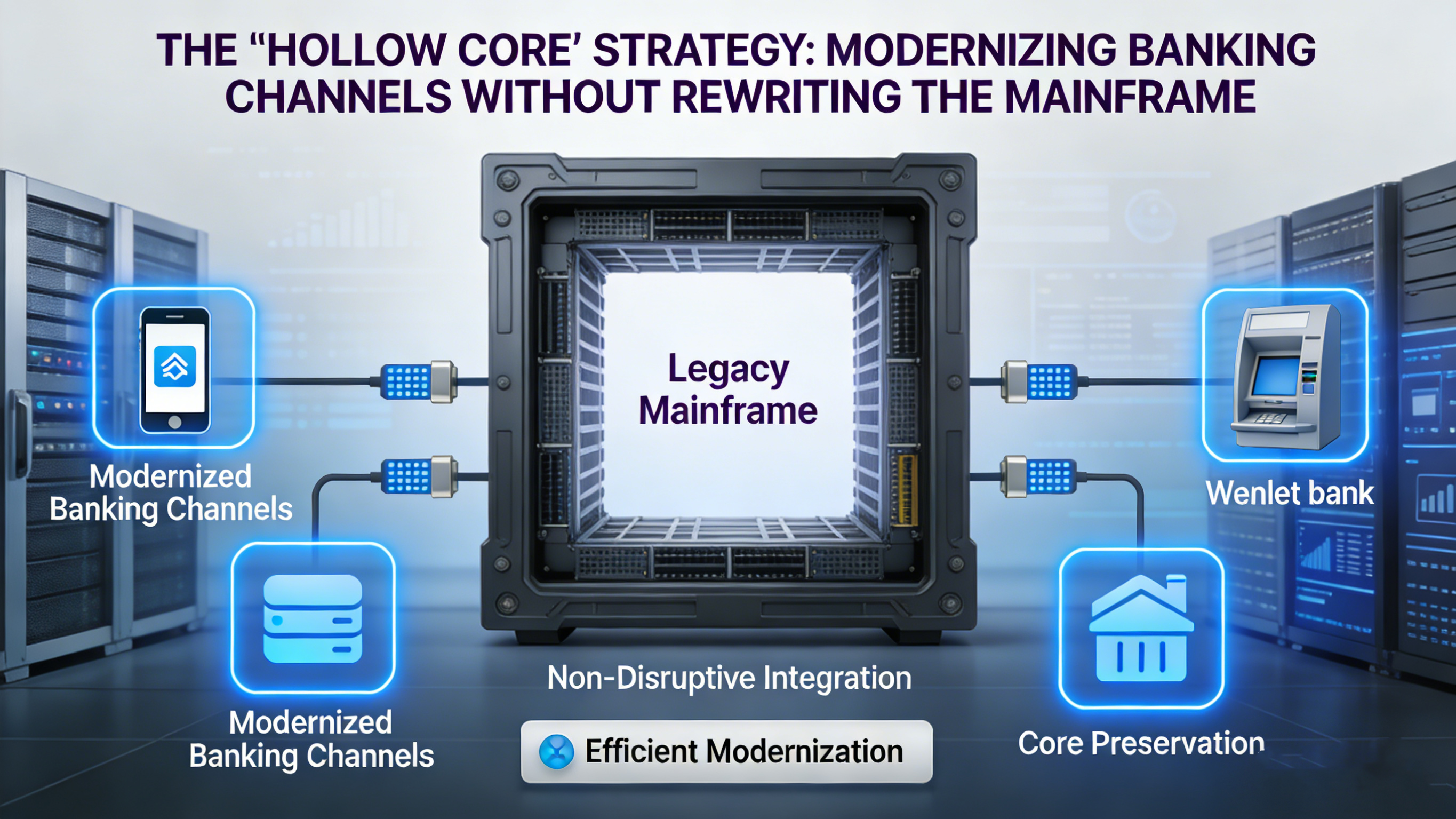
Instead of replacing the core immediately, they strip it of all non-essential logic, moving product innovation to an agile "Overlay Layer" powered by FinClip Mini-App Containers.
1. The Architecture of the "Agile Overlay"
The "Hollow Core" strategy accepts a fundamental truth: The Mainframe is excellent at being a Ledger (recording transactions), but it is terrible at being a Product Engine (managing user experience and business rules).
The goal is to stop asking the Core to do things it wasn't designed for.
The FinClip Solution:
Banks implement FinClip as a Client-Side Orchestration Layer.
- Legacy Model: The Mobile App is just a dumb terminal. The logic sits in a heavy Middleware (ESB) or the Core itself. Changing a UI flow requires backend code changes.
- FinClip Model: The Mobile App becomes a smart runtime. Business logic (KYC flows, Loan Calculators, Onboarding Wizards) is encapsulated in Mini-Apps.
This architecture effectively creates a "Buffer Zone." The Core system simply exposes basic APIs (Get Balance, Post Transaction), while the FinClip Mini-App handles the complexity of the user journey, validation, and presentation.
2. Decoupling: Moving Logic to the Edge
Why is this architectural shift critical for speed? Because it Decouples the frontend innovation from the backend release train.
Scenario: Launching a "Student Credit Card"
- Traditional Way:
- Update the Mainframe to recognize the new product code.
- Update the Middleware to handle the logic rules (Age < 25).
- Update the Native iOS App to show the new form.
- Update the Native Android App.
- Wait for App Store approval.
Time to Market: 6-9 months.
- The FinClip Way:
- The Mainframe exposes a generic "Create Account" API.
- The Digital Team builds a "Student Card Onboarding" Mini-App.
- The Mini-App contains all the business rules (validating student ID, checking age) in JavaScript.
- The Mini-App is published to the bank’s private FinClip Store.
Time to Market: 2-3 weeks.
The Core remains untouched. The "Innovation" happens entirely in the FinClip layer. The bank has successfully "hollowed out" the product logic from the core and moved it to the edge.
3. The "Strangler Fig" Pattern in Practice
Martin Fowler’s Strangler Fig Pattern describes migrating a legacy system by gradually replacing specific pieces of functionality with new applications and microservices until the old system is strangled.
FinClip is the perfect frontend vehicle for this pattern.
Phase 1: The Wrapper
You start by wrapping existing mobile web views (H5) into FinClip Mini-Apps. This gives you immediate control over the release cycle without rewriting code. The user sees no difference, but IT gains the ability to hot-patch the frontend.
Phase 2: The Slicing
You identify high-friction journeys, such as "Mortgage Application." You rebuild this specific flow as a high-performance, native-quality FinClip Mini-App. You leave the rest of the app alone.
Phase 3: The Sunset
As more features move to FinClip Mini-Apps, the legacy monolithic mobile app code becomes empty. Eventually, the Native App is just a "Super App Shell" containing the FinClip SDK and a Login screen. All features are dynamic.
This allows the bank to modernize the User Experience (UX) continuously, without the risk of a massive "Switch-Over Day."
4. Stability and Risk: The Sandbox Advantage
Banks are risk-averse for a reason. Stability is paramount.
A common fear is that moving logic to the client-side (JavaScript) makes the app unstable or insecure.
FinClip’s Enterprise Sandbox addresses this head-on.
- Isolation: If the "Student Card" mini-app has a bug and crashes, it does not crash the Host App. The user is simply returned to the main menu. The core banking functions (like viewing balance) remain operational.
- Rollback: If a deployment introduces an error, the Bank’s Ops team can roll back the mini-app version in the FinClip Console instantly. The next time the user opens the feature, they get the working version.
- Security: FinClip enforces strict domain allow-listing. The mini-app can only talk to the Bank’s API Gateway. It cannot make unauthorized calls to the open internet, preventing data exfiltration.
5. ROI: Extending the Life of the Core
The financial argument for the "Hollow Core" strategy is compelling.
Replacing a Core Banking System costs $100M+. Extending its life by 10 years costs a fraction of that.
By using FinClip to handle the modern digital demands, you reduce the pressure on the Core. You stop hacking the COBOL code to support modern mobile features. You let the Mainframe do what it does best (Ledger) and let FinClip do what it does best (Experience).
Conclusion: The Two-Speed Bank
The future of banking is not about having the newest Mainframe; it is about having the most agile Front-End.
The "Hollow Core" strategy, enabled by FinClip, allows banks to achieve Two-Speed IT:
- A stable, slow-moving Backend (Record of Truth).
- A fast, dynamic Frontend (System of Engagement).
This architecture bridges the decades. It allows a bank founded in 1826 to innovate like a startup founded in 2026.