The Global One-App Strategy: Mastering Regional Compliance and Localization with Mini-App Containers
Introduction: The "Code Fork" Nightmare of Global Expansion
For a multinational enterprise, launching a mobile application globally is the easy part. Maintaining it is the nightmare.
As you expand into Europe, Asia, and the Americas, you hit the invisible walls of Digital Borders.
- Regulatory Divergence: Europe has GDPR. China has PIPL. Brazil has LGPD. California has CCPA. Each requires different data storage rules, different consent pop-ups, and different "Right to be Forgotten" workflows.
- Cultural Divergence: Users in Southeast Asia prefer "Super App" style interfaces (dense, colorful, feature-rich). Users in Northern Europe prefer minimalist, single-purpose utilities.
The traditional engineering response is Code Forking. You create a "US Build," an "EU Build," and a "CN Build."
Suddenly, you are maintaining three separate codebases. Feature parity becomes impossible. Bug fixes have to be copy-pasted. Your engineering team triples in size, but your velocity slows to a crawl.
In 2026, the winning strategy is the "Global One-App" Model.
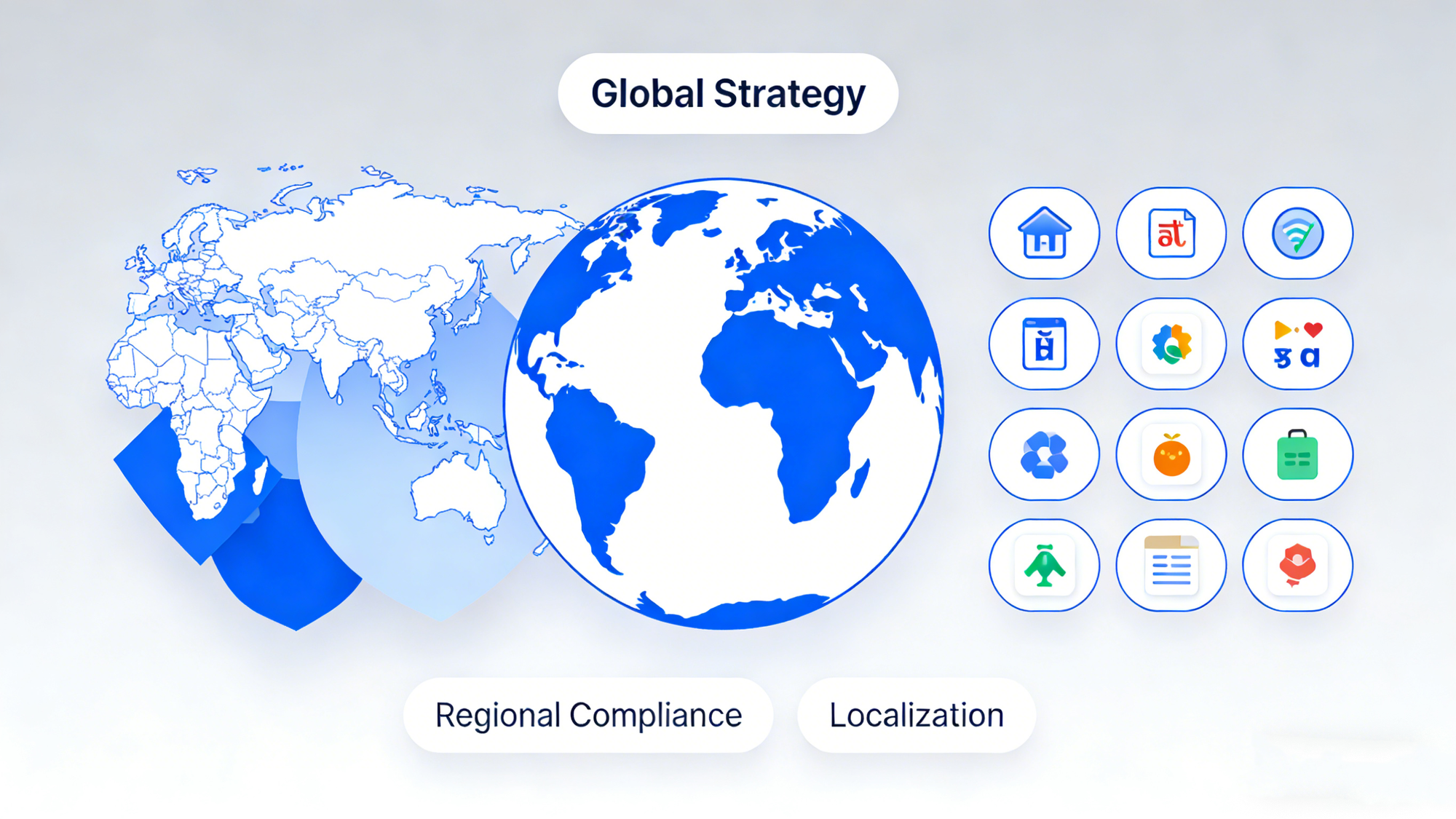
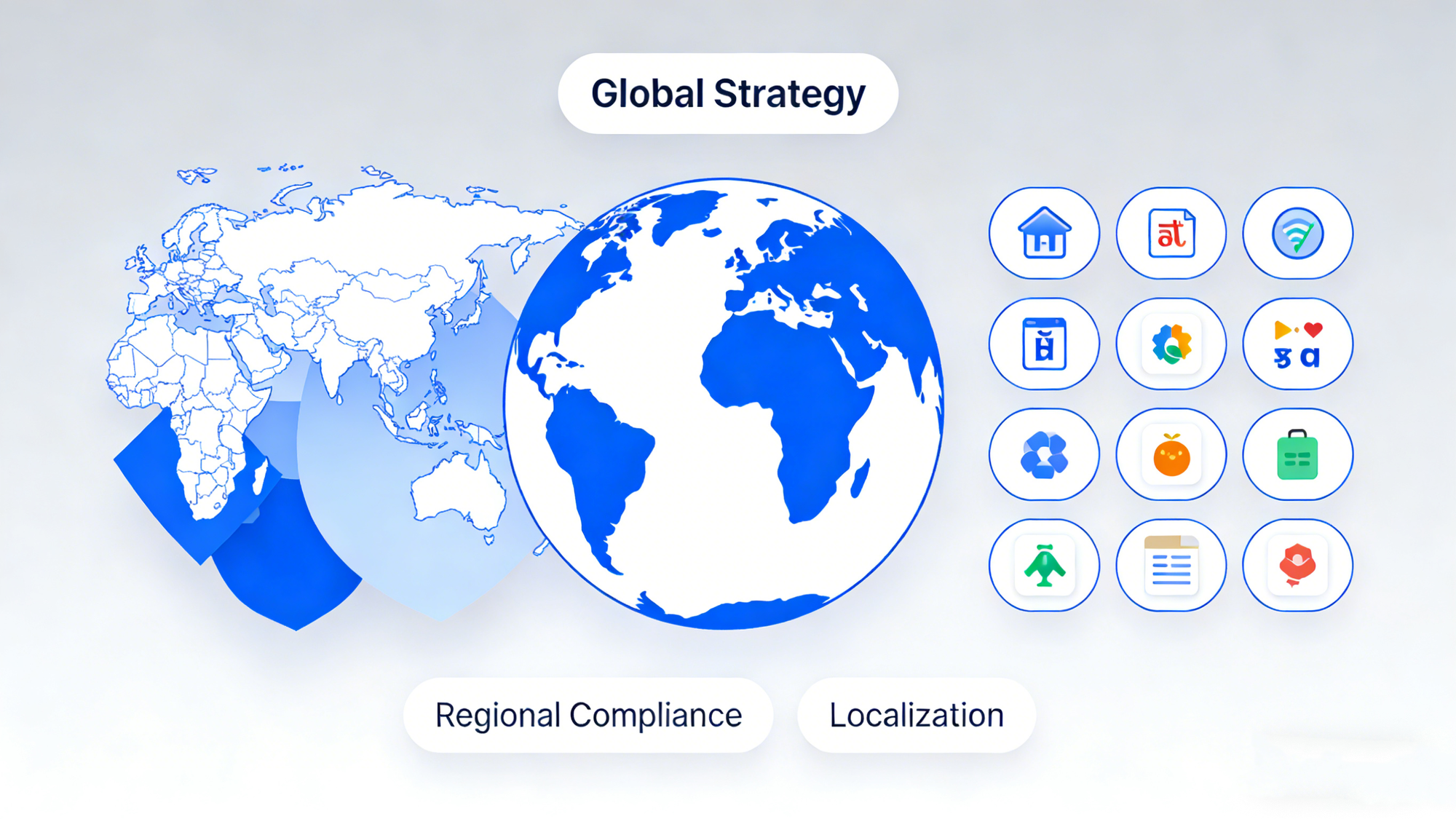
By utilizing FinClip Mini-App Containers, enterprises can maintain a single global Host App binary that dynamically transforms its behavior, logic, and compliance standards based on the user's location.
1. The Architecture: Global Shell, Local Core
The core philosophy of this architecture is Runtime Injection.
Instead of hard-coding regional logic into the app (e.g., if (region == 'DE') { showGDPR() }), you strip the business logic out of the native binary entirely.
- The Host App (Global Shell): This is a lightweight container published to the Apple App Store and Google Play globally. It contains only the bare essentials: the FinClip SDK, basic navigation, and a "Region Detection" module.
- The Mini-Apps (Local Core): The actual features (e.g., "Sign Up," "Wallet," "Shop") are built as separate Mini-Apps.
The Workflow:
- Launch: User opens the app in Berlin, Germany.
- Detection: The Host App detects the IP address or SIM country code (DE).
- Routing: The FinClip SDK queries the server: "Give me the 'Wallet' Mini-App for Region: EU."
- Delivery: The server delivers the GDPR-Compliant Version of the Wallet Mini-App.
- Experience: The user sees a German interface connected to a Frankfurt data center.
If a user opens the exact same app in New York, FinClip delivers the US-Compliant Version connected to a Virginia data center.
2. Solving Data Residency and Sovereignty
The biggest legal risk for global apps is Cross-Border Data Transfer. Under regulations like China's PIPL or the EU's GDPR, certain user data cannot leave the jurisdiction without massive legal friction.
FinClip’s Multi-Cluster Deployment capabilities solve this at the infrastructure level.
You do not need one central server. You can deploy independent FinClip Server Nodes in different AWS/Azure regions or local clouds.
- Node EU: Hosted in Frankfurt. Stores EU Mini-Apps and processes EU user logs.
- Node CN: Hosted in Shanghai. Stores CN Mini-Apps.
- Node US: Hosted in Ohio. Stores US Mini-Apps.
When the global Host App requests a mini-app, it is routed to the Local Node.
The data generated by the mini-app (e.g., form submissions, analytics) flows directly to that Local Node’s backend.
Result: The data physically never crosses the border. The compliance is architectural, not procedural. You don't need lawyers to verify every API call; the network topology guarantees sovereignty.
3. Hyper-Localization: Adapting UI to Culture
Compliance keeps you out of jail; Localization keeps you in business.
Translating text (i18n) is not enough. True localization requires changing the User Experience (UX).
Case Study: The E-Commerce Giant
- In Brazil: Users love "Gamified Shopping," flash sales, and vibrant banners.
- In Japan: Users prefer information density, detailed specs, and high-trust layouts.
With a monolithic app, supporting both UI styles is messy.
With FinClip, you build Two Different Mini-Apps: shop-brazil and shop-japan.
They might share the same backend product database, but the Frontend Logic is completely different.
- The Brazilian mini-app includes a "Spin the Wheel" game module.
- The Japanese mini-app includes a "QR Code Scanner" for physical catalog integration.
You are not forcing one UI on the world. You are serving the culturally correct interface to each market, maximizing conversion rates globally.
4. Agility: The Compliance Hot-Fix
Laws change faster than App Store review cycles.
Imagine the UK passes a new "Digital Cookie Law" effective immediately on Tuesday.
- Traditional App: You rush to code the change, build a new binary, submit to Apple, and pray they approve it by Tuesday. If users don't update the app, you are non-compliant.
- FinClip Strategy: You update the "Consent Manager" Mini-App. You publish it to the FinClip UK Node.
- Instant Effect: The next time any user in the UK opens the app, they download the new logic automatically. You achieve 100% compliance saturation in minutes, without user action.
5. Managing the Global Supply Chain
For large conglomerates, different regions operate like different companies. The "Asia Team" wants to move fast; the "Europe Team" is cautious.
FinClip’s Federated Management Console supports this organizational complexity.
- Global Admin: Sees high-level metrics across all regions.
- Regional Admin (e.g., EU Head of Digital): Only has permission to publish/approve mini-apps for the EU Region.
This prevents the "US Team" from accidentally breaking the "France App." It empowers regional teams to innovate at their own speed while maintaining a unified global platform brand.
Conclusion: Think Global, Code Local
The "One Codebase to Rule Them All" dream is dead. The world is too fragmented legally and culturally.
However, the "One Platform" dream is alive.
By adopting FinClip, you decouple your Global Brand (The Host App) from your Local Execution (The Mini-Apps). You gain the efficiency of a centralized tech stack with the flexibility of decentralized compliance and design.
In the global arena, the winner is not the biggest app; it is the most adaptable one.