Super App vs Single App: Architectural Trade-offs for Modern Digital Strategy
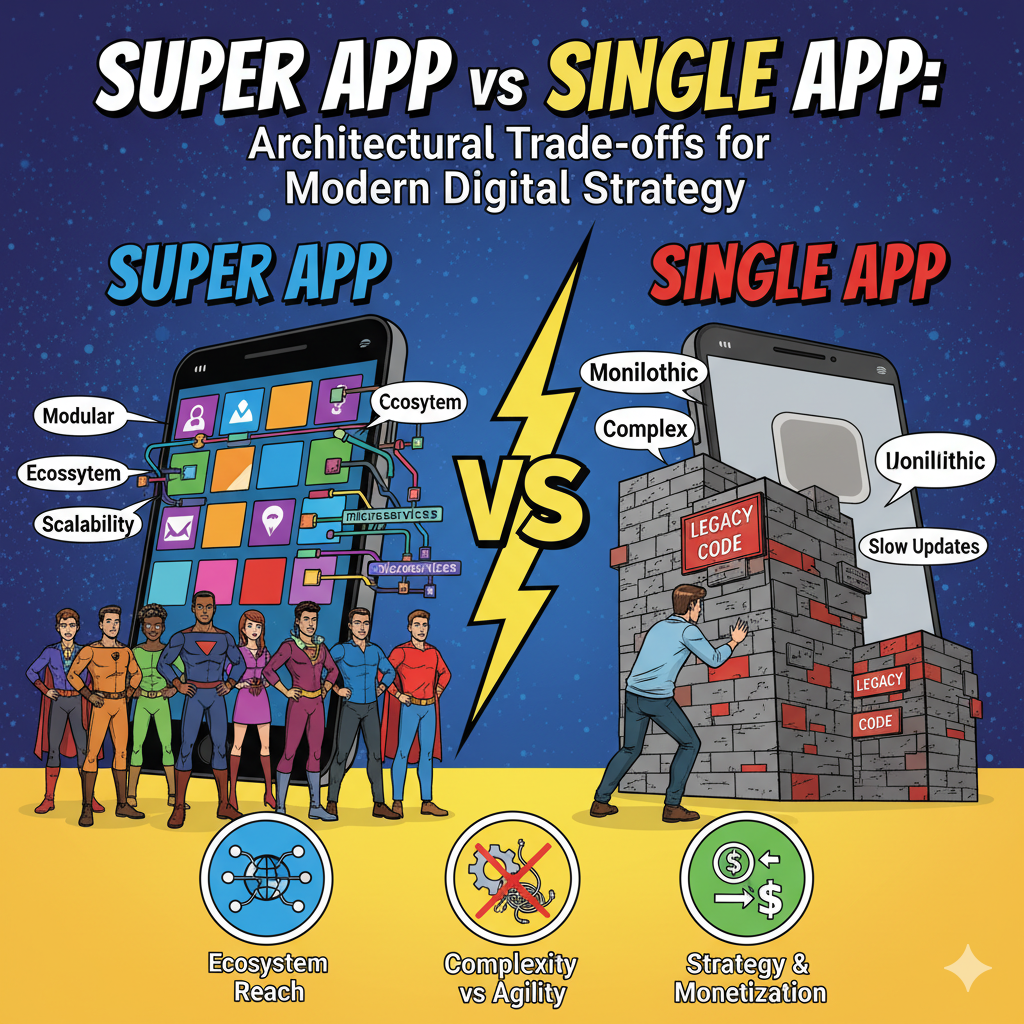
The choice between building a super app ecosystem or developing single-purpose applications represents a fundamental architectural decision with far-reaching implications for user experience, development velocity, business model flexibility, and competitive positioning. Super apps integrate multiple services within cohesive containerized environments, while single apps focus on specific use cases with optimized functionality. Neither approach universally dominates—the optimal selection depends on organizational capabilities, target market characteristics, and strategic objectives that extend beyond immediate feature requirements to encompass long-term platform evolution.
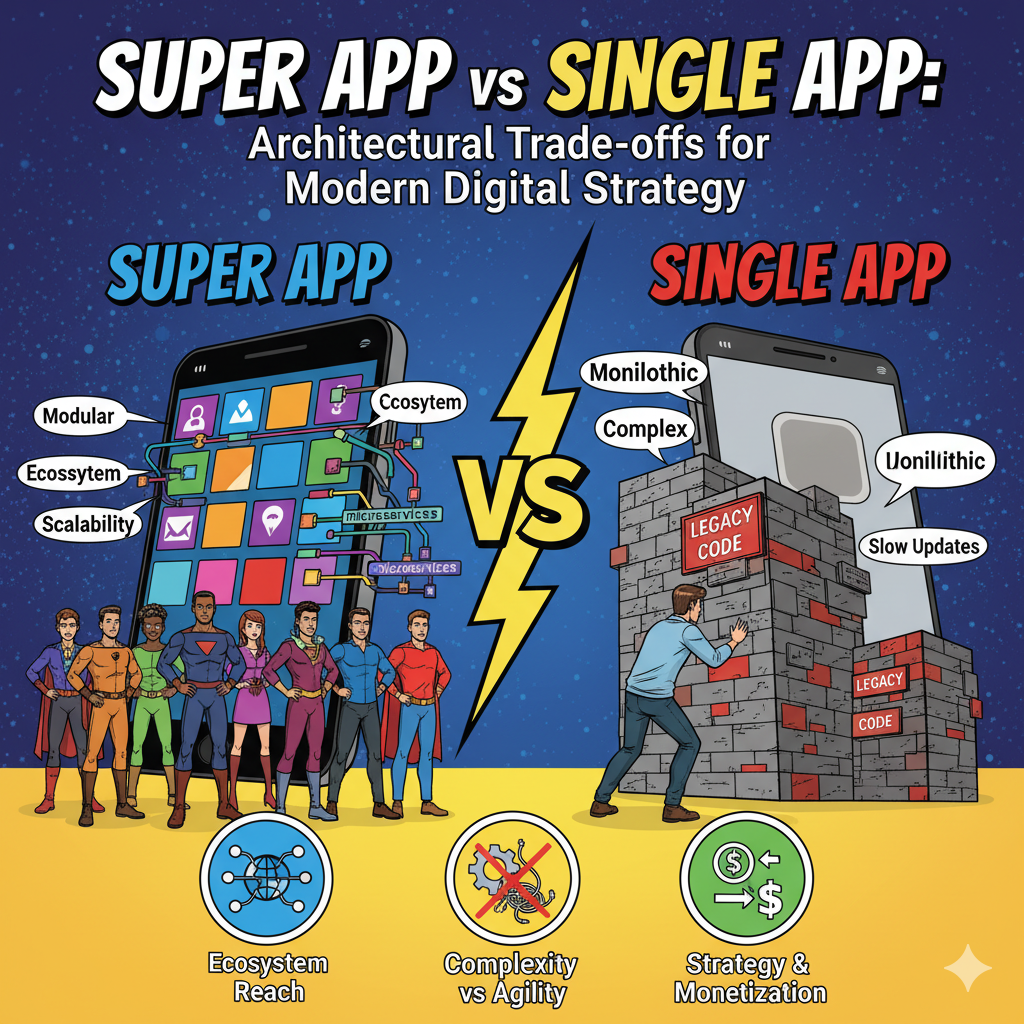
Technical Architecture Comparison
Super app architecture centers on containerization technology that enables multiple mini-applications to operate within a single host application. The container provides shared infrastructure—user authentication, payment processing, notification systems, and analytics—while mini programs deliver specific functionality through standardized interfaces. This separation creates what system architects describe as "platform independence with runtime integration," where mini programs can update independently of the container while maintaining seamless user experience continuity.
Single app architecture follows traditional monolithic or modular patterns where all functionality resides within a single codebase distributed through app stores. Updates require complete application redeployment, with users controlling update timing through store interactions. While modern single apps often incorporate modular design patterns like micro-frontends or feature flags, the fundamental distribution model remains app-store dependent with inherent delays between development completion and user availability.
Technical complexity differs substantially between approaches. Super app containers must manage multi-tenancy, security isolation, resource allocation, and version compatibility across potentially hundreds of mini programs. This infrastructure complexity requires sophisticated engineering but creates economies of scale once established. Single apps face less infrastructure complexity but must implement all required functionality internally, leading to codebase growth that eventually challenges maintainability.
Performance characteristics reveal another trade-off. Super apps typically exhibit faster initial load times for new services because mini programs share pre-loaded container resources. However, container overhead introduces marginal performance costs for each additional mini program. Single apps optimize specifically for their designated functionality but require separate downloads for each service category. User studies show contextual preferences—users prefer super app convenience for related service clusters but dedicated apps for specialized, high-frequency tasks.
Development velocity patterns diverge based on architectural approach. Super app ecosystems enable parallel development across independent teams once the container platform stabilizes. Mini program teams can deploy updates continuously without coordinating with other services or waiting for container releases. Single app teams face coordination challenges as codebases grow, with feature integration requiring careful merging and regression testing. The difference becomes most pronounced in organizations scaling beyond approximately 50 developers or 20 distinct feature areas.
Business Model Implications
Business model flexibility represents a critical differentiator between architectural approaches. Super apps naturally support platform business models where the container owner monetizes through transaction fees, subscription sharing, advertising, or data insights generated across the ecosystem. Single apps typically rely on direct monetization—app purchases, in-app purchases, subscriptions, or advertising—within their specific functional domain.
Revenue diversification opportunities expand with super app architectures. Platform owners can capture value from multiple service categories without developing each service internally. This creates what economists describe as "ecosystem leverage"—the ability to monetize complementary services through network effects rather than direct investment. Single apps achieve revenue concentration but miss adjacent opportunity capture unless they expand functionality, which risks diluting core value propositions.
Customer acquisition costs and lifetime value calculations differ substantially. Super apps benefit from cross-service promotion—users discovering one service naturally encounter others within the same container. This reduces marginal acquisition costs for additional services once the platform establishes user base. Single apps must acquire users independently for each functional area, though they may achieve higher engagement within their specialized domains. Banking organizations implementing super app approaches report 80% faster integration of new financial services with 60% cost reduction compared to standalone app development.
Data asset development follows different trajectories. Super apps accumulate comprehensive user behavior data across multiple service categories, enabling sophisticated personalization and recommendation systems. This data breadth creates competitive advantages in understanding complete user journeys rather than isolated interactions. Single apps develop deep data within specific domains but lack cross-category insights unless they expand functionality or establish data partnerships.
Strategic optionality—the ability to pivot direction based on market feedback—varies between approaches. Super app containers can add or remove mini programs rapidly in response to user demand or competitive pressures. This modularity creates what strategists call "real options" for platform evolution. Single apps face more substantial rearchitecture requirements when expanding beyond original design parameters, though they maintain clearer brand positioning and user expectations.
Market defensibility mechanisms differ. Super apps create switching costs through ecosystem integration—users accumulate history, preferences, and relationships across multiple services within the container. Single apps defend through functional excellence and user habit formation within specific domains. The defensibility approach should align with competitive landscape—super apps excel in markets with natural service clusters, while single apps thrive in domains requiring deep specialization.
User Experience and Adoption Patterns
User experience design principles diverge between architectural paradigms. Super apps emphasize consistency, discovery, and workflow continuity across related services. Design systems establish shared patterns for navigation, information architecture, and interaction models that mini programs must follow. This consistency reduces learning curves for new services but may constrain innovative interface approaches that deviate from platform conventions.
Single apps optimize for task completion efficiency within specific domains. Without platform constraints, designers can create interfaces perfectly tailored to use case requirements. This specialization often produces superior experiences for core functionality but may sacrifice discoverability of related capabilities that users might value. The trade-off resembles specialized tools versus Swiss Army knives—each excels in different usage contexts.
Adoption patterns reveal cultural and regional variations. Asian markets, particularly China and Southeast Asia, demonstrate strong super app adoption driven by mobile-first internet access, platform consolidation trends, and user preferences for integrated experiences. Western markets show more fragmented adoption with users maintaining separate apps for different needs, though super app traction increases in specific verticals like financial services and retail.
User onboarding and education requirements differ. Super apps typically introduce users to platform capabilities gradually through contextual prompts and progressive disclosure. The container manages identity, preferences, and permissions centrally, reducing repetitive setup across services. Single apps require separate onboarding for each application but can tailor introductions specifically to their functionality. Research indicates super app approaches reduce abandonment during multi-service workflows by approximately 40% compared to app-switching scenarios.
Retention mechanisms operate at different levels. Super apps retain users through ecosystem breadth—even if interest in one service diminishes, other services maintain engagement. This creates what product managers call "retention resilience" where platform usage persists despite individual service volatility. Single apps must maintain engagement through continuous value delivery within their domain, facing higher churn risk if user needs evolve beyond their specialization.
Accessibility and inclusion considerations present both challenges and opportunities. Super apps can implement comprehensive accessibility features at container level that benefit all mini programs, creating consistent experiences for users with disabilities. However, container constraints may limit mini program flexibility to address specific accessibility needs. Single apps can tailor accessibility approaches precisely to their functionality but must implement them independently for each application.
Implementation Strategy Recommendations
Organizations evaluating architectural direction should begin with user journey mapping across their service portfolio. Identify natural clusters where users frequently transition between related capabilities. These clusters represent candidate mini programs within a super app approach. Services with infrequent cross-usage or highly specialized requirements may remain better suited as single apps even within super app ecosystems.
Technical readiness assessment should evaluate existing infrastructure, development capabilities, and operational maturity. Super app implementation requires container engineering expertise, DevOps automation for continuous deployment, and sophisticated monitoring across distributed components. Organizations lacking these capabilities might begin with single app approaches while developing necessary platform skills through controlled experiments.
Gradual migration strategies often prove most effective for established organizations with existing applications. Begin by containerizing non-critical services to build platform capabilities and team experience. Maintain single apps for core functionality during transition, migrating components as confidence grows. This incremental approach manages risk while demonstrating value through measurable improvements in deployment frequency, user engagement, or development efficiency.
Partner ecosystem development represents a critical success factor for super app platforms. While single apps typically focus on internal development, super apps thrive through third-party mini program integration. Establish clear developer guidelines, API standards, and revenue sharing models early to attract complementary services. The platform's value proposition to developers should emphasize distribution reach, shared infrastructure, and monetization opportunities rather than technical capabilities alone.
Performance measurement frameworks must adapt to architectural differences. Super app success metrics should emphasize ecosystem health—mini program diversity, cross-service usage, developer satisfaction, and platform stability—alongside traditional engagement and revenue indicators. Single app metrics focus more narrowly on functional performance, user satisfaction within domain, and competitive positioning against specialized alternatives.
For organizations pursuing super app strategies, app-in-app architecture provides a practical implementation pathway. This approach enables multiple independent mini-applications to operate within a single host container, creating cohesive user experiences while maintaining technical separation between components. The architectural pattern supports incremental modernization rather than risky wholesale replacements, reducing technical debt while accelerating feature delivery by 300-400% in enterprise deployments using containerized approaches.
Explore FinClip ChatKit—open-source AI chat middleware. GitHub