Super App vs Single App: Architectural Trade-offs and Business Implications
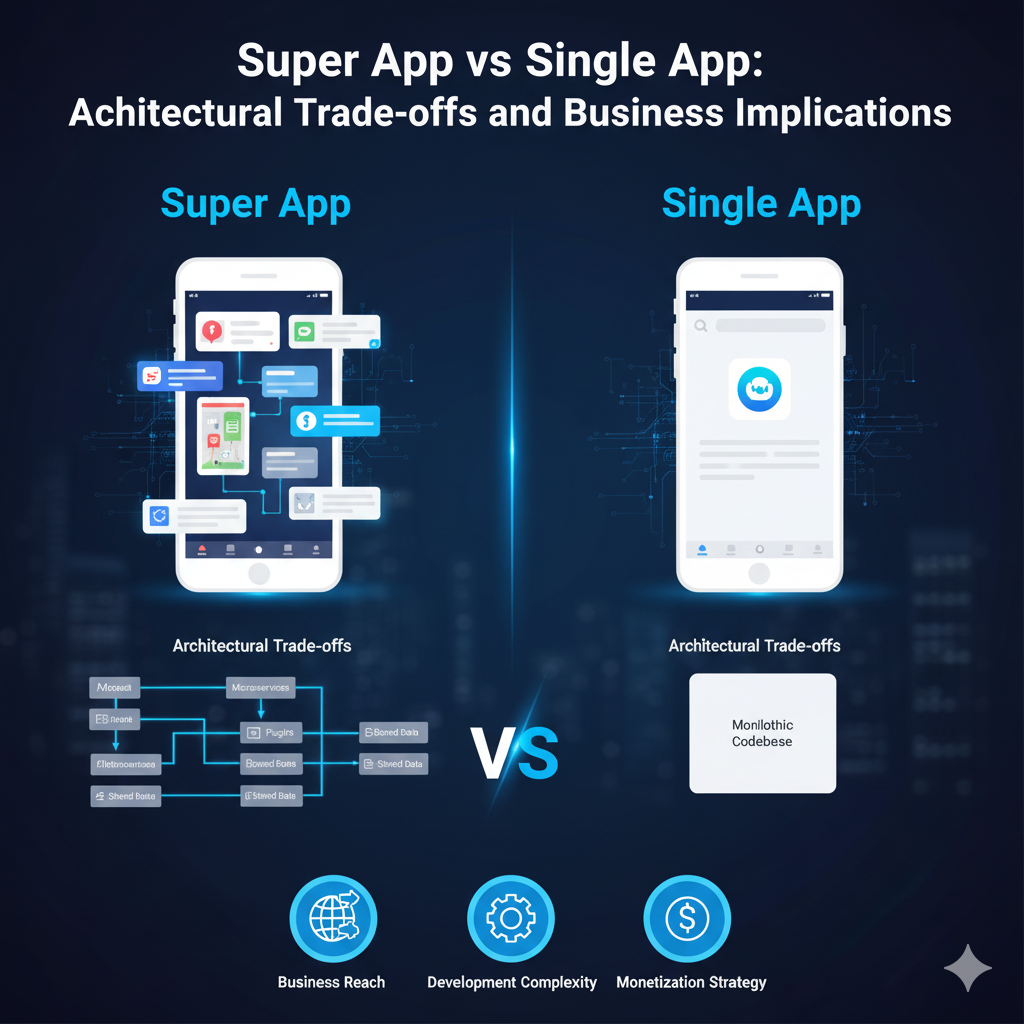
The architectural decision between building a super app platform or developing single-purpose applications represents one of the most consequential choices in mobile strategy, involving technical trade-offs, business model implications, and user experience considerations that vary significantly across markets, audiences, and organizational capabilities. Understanding these differences requires examining not just technical implementation but also market dynamics, user behavior patterns, and organizational readiness for platform-scale operations.
The distinction matters because each approach creates different competitive advantages, development challenges, and growth trajectories. Single-purpose applications excel at delivering focused experiences with optimized performance for specific use cases, while super app platforms create network effects through service integration and user lock-in through convenience. The appropriate choice depends on multiple factors including target market maturity, competitive landscape, organizational resources, and long-term strategic objectives.
Technical Architecture Comparison
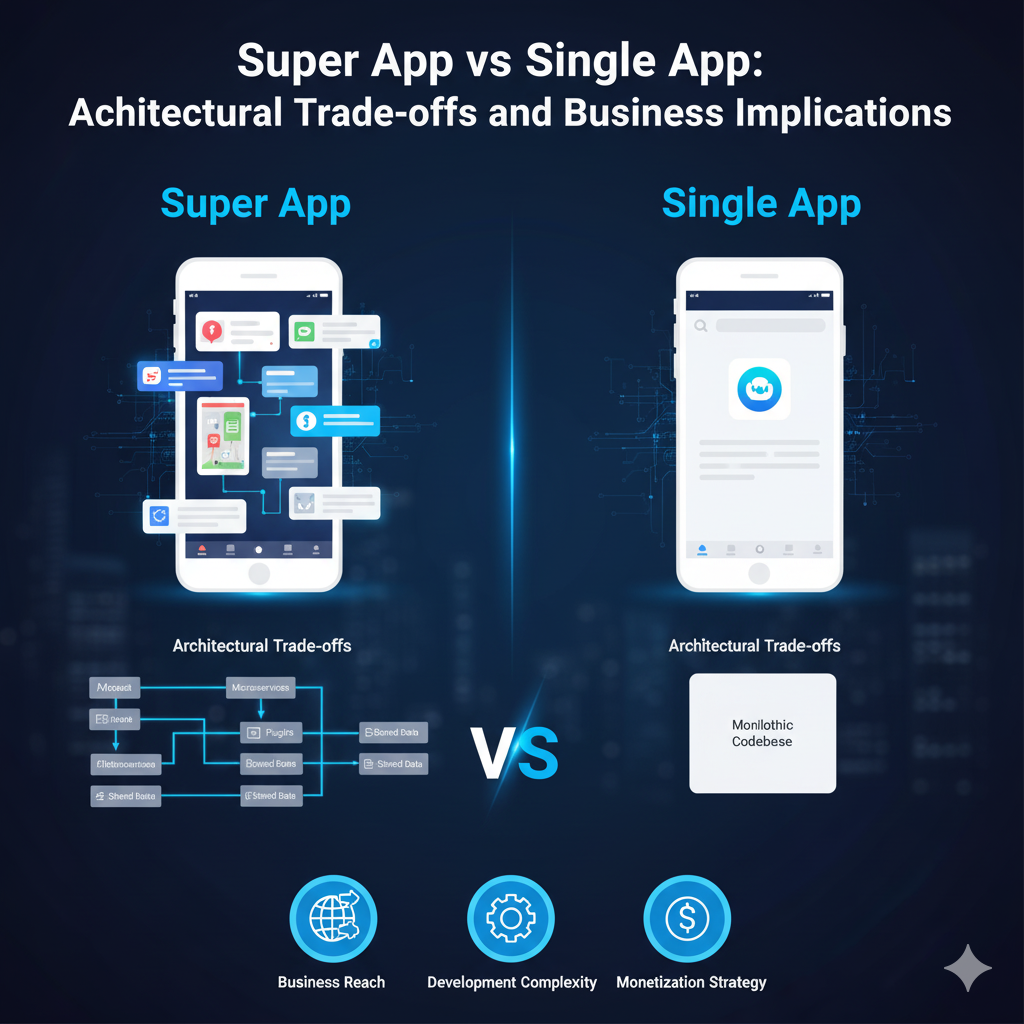
Super app and single app architectures differ fundamentally in their technical implementation, scaling approaches, and development workflows. These differences create distinct advantages and challenges that influence total cost of ownership, time to market, and long-term maintainability.
Super app architectures typically implement container-based approaches where lightweight mini-applications operate within a shared host platform. The host provides common services including authentication, payment processing, notification systems, and user management, while mini-apps deliver specific functionality. This separation enables independent development cycles for different services, with mini-apps potentially built by different teams or even third-party developers. The technical challenge lies in maintaining consistent performance, security, and user experience across diverse mini-apps while managing the complexity of container orchestration, version compatibility, and resource allocation.
Single app architectures focus on delivering cohesive experiences through monolithic or modular codebases optimized for specific functionality. All features share common code, design systems, and deployment cycles, creating tighter integration but requiring coordinated development across all teams. Performance optimization can be more straightforward since the entire application operates within a single technical context, but scaling becomes challenging as feature sets expand and codebases grow. The architectural decision often involves choosing between native development for each platform or cross-platform frameworks that sacrifice some platform optimization for development efficiency.
Deployment and update mechanisms differ substantially between the approaches. Super apps can update individual mini-apps independently, enabling rapid iteration on specific features without requiring full application updates. This capability supports A/B testing, gradual feature rollouts, and hotfix deployments that address issues in specific services without affecting the entire platform. Single apps typically require complete updates for any change, creating coordination challenges and potential user experience fragmentation when different features evolve at different paces.
Performance characteristics vary based on architectural choices. Super apps face the challenge of container overhead—the additional processing required to manage isolation, communication, and resource allocation between mini-apps. Well-implemented containers minimize this overhead through optimized runtime environments and efficient communication mechanisms, but some performance penalty typically remains compared to tightly integrated single apps. Single apps benefit from direct platform access and optimized integration but may suffer from codebase bloat as features accumulate over time.
Security models present different trade-offs. Super apps must enforce isolation between potentially untrusted mini-apps while maintaining platform integrity—a complex challenge that requires sophisticated sandboxing, capability controls, and runtime monitoring. Single apps face simpler security requirements focused on protecting user data and preventing unauthorized access, though they must still address standard mobile security concerns including secure storage, network communication protection, and proper permission management.
Business Model Implications
The architectural choice between super app and single app approaches directly influences revenue models, user acquisition strategies, and competitive positioning. Each approach creates different opportunities for monetization, growth, and market defense.
Super apps excel at creating platform ecosystems where multiple services reinforce each other through shared users, data, and transactions. The business model typically involves taking a percentage of transactions processed through the platform, selling advertising or promotion within discovery mechanisms, or charging subscription fees for premium platform access. The platform owner benefits from network effects: more services attract more users, which attracts more services, creating a virtuous cycle that becomes increasingly difficult for competitors to disrupt. However, building this ecosystem requires significant upfront investment and patience as network effects accumulate gradually.
Single apps focus on specific value propositions with clearer monetization paths tied directly to the functionality provided. Revenue models include one-time purchases, subscriptions for ongoing value, in-app purchases for additional features, or advertising within the application context. User acquisition typically targets specific needs or interests, with marketing messages focused on the core functionality rather than platform breadth. This approach can achieve profitability more quickly with focused investment, but faces challenges expanding beyond the initial use case without diluting the core value proposition.
User acquisition costs and lifetime value calculations differ significantly. Super apps benefit from cross-promotion between services, reducing acquisition costs for new services introduced to existing users. A user who initially joins for messaging might later use payment services, then food delivery, then transportation—each new service activation requires minimal additional acquisition cost. Single apps must acquire users separately for each functionality, though they can potentially achieve higher conversion rates by targeting users with specific, immediate needs.
Competitive defense mechanisms vary between the approaches. Super apps create switching costs through convenience integration: users become reluctant to leave a platform that provides multiple daily services even if individual alternatives might offer slightly better experiences for specific functions. Single apps must defend through superior functionality, brand loyalty, or network effects within their specific domain. The defense challenge becomes particularly acute when super apps expand into adjacent services, potentially eroding single app market positions through convenience rather than functional superiority.
Market expansion strategies follow different patterns. Super apps typically expand geographically or into adjacent service categories, leveraging their existing user base and technical infrastructure. Single apps more often expand through functional depth within their domain or through partnerships that extend their capabilities without requiring platform development. The expansion approach influences resource allocation, partnership strategies, and competitive response planning.
Organizational Requirements and Development Culture
Implementing super app versus single app architectures requires different organizational structures, development processes, and cultural norms. These differences affect hiring, team coordination, decision-making processes, and operational maturity.
Super app development demands platform thinking across the organization. Teams must coordinate around shared standards, APIs, and user experience guidelines while maintaining autonomy for specific service development. This requires sophisticated technical leadership to establish and enforce architectural patterns, product management to balance platform coherence with individual service innovation, and operations to manage the complexity of multiple independent deployment cycles. Organizations successful with super apps typically implement platform engineering teams responsible for core infrastructure, developer experience teams supporting mini-app development, and governance processes ensuring quality and consistency across the ecosystem.
Single app development focuses on cohesive team structures aligned around specific functionality. All team members—designers, developers, testers, product managers—share responsibility for the complete application experience. This enables faster decision-making, tighter integration between features, and clearer accountability for outcomes. However, as applications grow, teams may struggle with coordination overhead, technical debt accumulation, and the challenge of maintaining consistent quality across an expanding codebase managed by growing teams.
Development workflows and tooling requirements differ substantially. Super app development typically involves multiple code repositories, independent build pipelines, and sophisticated testing strategies that verify both individual mini-app functionality and platform integration. Deployment requires orchestration systems that manage version compatibility, gradual rollouts, and rollback capabilities for individual components. Single app development uses more unified workflows with single codebases, integrated testing strategies, and simpler deployment processes that update the complete application simultaneously.
Cultural alignment around platform versus product mindset influences success. Super app teams must embrace shared ownership of platform success alongside individual service excellence—a cultural challenge when compensation, recognition, and career progression traditionally reward individual or team accomplishments rather than platform contributions. Single app cultures more naturally align around shared product goals, though they may struggle with siloed thinking as applications expand into multiple functional areas managed by separate teams.
Operational maturity requirements vary significantly. Super apps demand sophisticated monitoring, incident response, and capacity planning systems that track performance across diverse services and identify issues spanning multiple components. Single apps face simpler operational challenges focused on application availability and performance, though they still require robust systems as user bases grow and feature complexity increases.
User Experience and Design Considerations
The architectural choice between super app and single app approaches creates different user experience challenges and design opportunities. Each approach enables specific interaction patterns while constraining others, influencing user satisfaction, engagement metrics, and long-term retention.
Super apps excel at task switching and service discovery within a cohesive environment. Users can move seamlessly between different functions—messaging to payments to transportation to food delivery—without leaving the application context or re-authenticating. This convenience creates powerful user lock-in but requires sophisticated navigation design that balances access to numerous services against interface complexity. Successful super apps implement intelligent personalization that surfaces relevant services based on context, usage patterns, and time of day, reducing the cognitive load of navigating extensive functionality.
Single apps focus on optimized experiences for specific tasks, with interfaces tailored to particular use cases and user mental models. This specialization enables deeper functionality, faster task completion for experienced users, and clearer value propositions. However, users must switch between applications for different needs, creating friction that super apps eliminate. Single apps must therefore deliver sufficient value in their specific domain to justify the standalone installation and regular usage despite this switching cost.
Onboarding and learning curves differ substantially. Super apps require more extensive initial onboarding to introduce platform capabilities and navigation patterns, potentially increasing abandonment rates during first-time use. However, once users understand the platform model, learning new services becomes easier as they apply familiar navigation patterns and interaction conventions. Single apps can provide faster initial value with focused onboarding but require separate learning processes for each new application users adopt.
Design system implementation presents different challenges. Super apps must maintain visual and interaction consistency across diverse services potentially developed by different teams or third parties. This requires robust design systems, comprehensive component libraries, and strict governance processes. Single apps have more control over their complete experience but may struggle with design consistency as features accumulate over time without the structural constraints of a platform model.
Performance perception varies based on architectural choices. Super apps face the challenge of container initialization overhead when switching between services, potentially creating perceptible delays that single apps avoid through preloading and optimized transitions. However, super apps can implement intelligent prefetching and background loading that anticipates user movements between services, potentially reducing perceived latency for common usage patterns.
Market-Specific Considerations and Regional Variations
The appropriate choice between super app and single app approaches depends heavily on market characteristics including technological infrastructure, user behavior patterns, competitive landscape, and regulatory environment. These factors vary significantly across regions, creating different optimal strategies for different markets.
Asian markets, particularly China and Southeast Asia, have demonstrated strong super app adoption driven by several factors: later smartphone adoption that skipped the PC era, creating different user expectations; concentrated internet ecosystems with dominant platforms; and cultural preferences for comprehensive digital solutions within trusted environments. In these markets, super apps often represent the default approach for major digital services, with single apps struggling against platform convenience except in specialized verticals.
Western markets, particularly North America and Europe, have historically favored single app approaches due to earlier smartphone adoption patterns that mirrored PC usage, more fragmented digital ecosystems, and different privacy expectations. However, super app concepts are gaining traction through specific use cases like financial services aggregation, workplace productivity tools, and specialized vertical platforms. The transition reflects changing user expectations and technological capabilities rather than direct replication of Asian models.
Emerging markets present hybrid opportunities where both approaches can succeed depending on specific conditions. Limited device storage and data costs favor super app approaches that reduce installation requirements, while varying digital literacy levels may favor simpler single apps with focused functionality. Successful strategies in these markets often involve phased approaches: starting with single apps to establish trust and demonstrate value, then expanding into platform models as user bases grow and organizational capabilities mature.
Regulatory environments influence architectural choices through data privacy requirements, competition policies, and financial service regulations. Super apps that aggregate multiple services face heightened regulatory scrutiny around data sharing between services, market dominance concerns, and financial service compliance requirements. Single apps typically face simpler regulatory profiles focused on their specific functionality, though they must still comply with general data protection and consumer protection regulations.
Implementation Strategies and Migration Paths
Organizations considering architectural transitions between single app and super app approaches can implement several strategies to manage technical complexity, organizational change, and user experience continuity. These strategies balance immediate needs with long-term objectives, reducing risk while enabling architectural evolution.
Gradual containerization represents a common migration path from single apps to super app architectures. This approach identifies specific functionality that can be extracted into mini-app containers while maintaining the existing application as the host platform. The migration proceeds incrementally, containerizing non-core features first to build technical capability and organizational experience before addressing critical functionality. This reduces risk by maintaining familiar user experiences while gradually introducing platform capabilities.
Platform extension strategies enable single apps to evolve toward super app functionality without complete architectural overhaul. This involves adding lightweight integration points that connect to external services through standardized APIs or embedded web views, creating platform-like experiences without implementing full container architectures. While less capable than true container approaches, this strategy provides interim platform benefits while building toward more sophisticated architectures.
Reverse migration from super app to focused single apps occurs when organizations determine platform complexity outweighs benefits for specific user segments or use cases. This involves extracting specific functionality into standalone applications while maintaining integration with the broader platform where valuable. The approach recognizes that different user needs may be better served by different architectural approaches, with the platform serving as an integration hub rather than the exclusive delivery mechanism.
Hybrid architectures combine elements of both approaches, using super app containers for some functionality while implementing critical features natively within the host application. This balances the development efficiency and deployment flexibility of containers with the performance and integration advantages of native implementation. Successful hybrid approaches require clear architectural guidelines about which functionality belongs in each layer and sophisticated coordination between development workflows.
Technical evaluation should consider how lightweight SDKs can facilitate architectural transitions. The 3MB container SDK enables organizations to experiment with container architectures without committing to complete platform rewrites, implementing specific features in containers while maintaining existing code for other functionality. This non-intrusive integration approach reduces migration risk while providing immediate benefits from container capabilities including independent updates, A/B testing, and security isolation.
The architectural decision fundamentally influences how organizations deliver digital experiences, with container-based approaches reducing development coordination overhead by 40-50% in enterprise deployments using lightweight SDKs. These implementations demonstrate that the choice between super app and single app architectures involves continuous evaluation rather than permanent commitment, with technical capabilities enabling organizations to adapt their approaches as market conditions, user expectations, and organizational capabilities evolve.
Read the FinClip developer docs to get started. View docs