Super App Monetization Strategies: Revenue Models for Integrated Platform Ecosystems
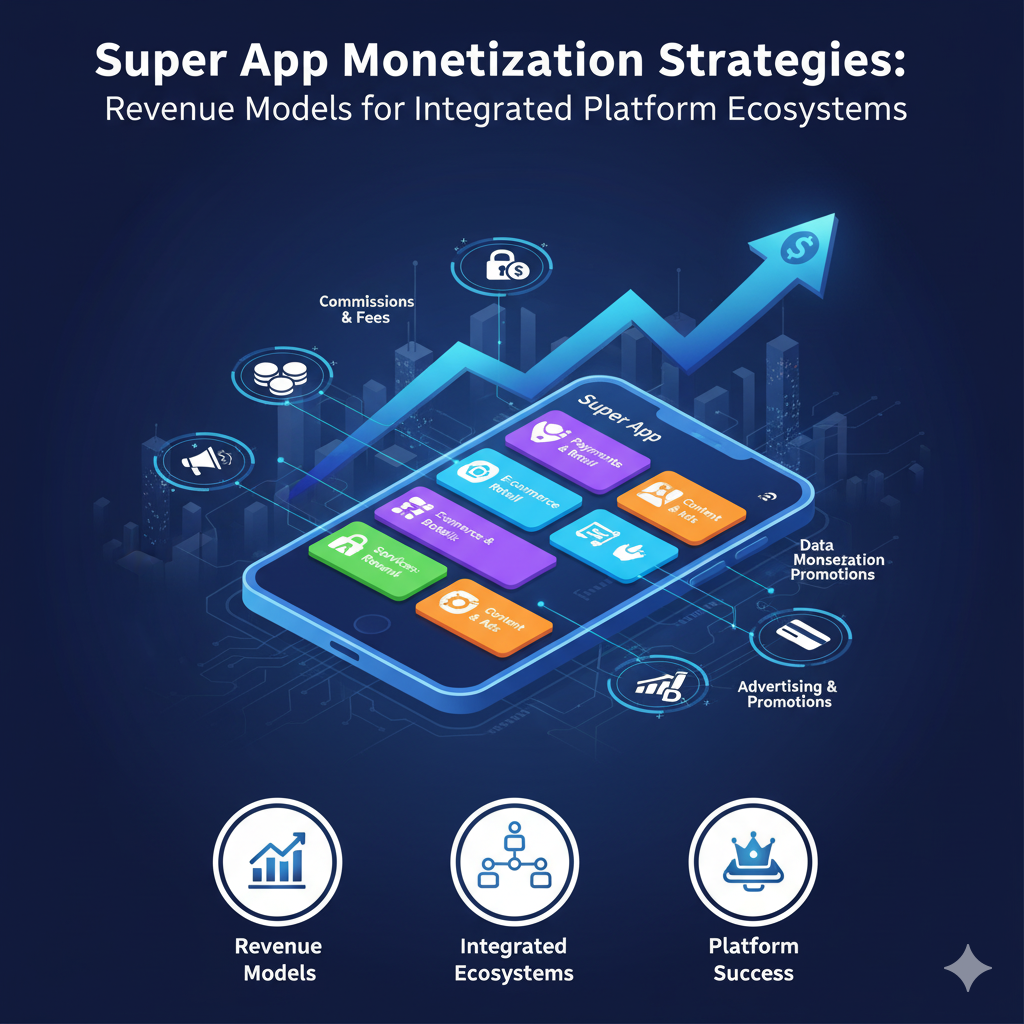
Super app monetization represents one of the most complex challenges in platform economics, requiring careful balance between multiple revenue streams, user experience preservation, and sustainable ecosystem growth. Unlike single-purpose applications with straightforward monetization models, super apps integrate diverse services that create interconnected revenue opportunities while introducing coordination challenges across different business units and partner relationships. Successful monetization strategies evolve from understanding how different revenue models interact within integrated ecosystems, how user behavior changes as platforms expand service offerings, and how value capture mechanisms align with user perception of platform utility.
Transaction-Based Revenue Models
Transaction fees represent the most direct monetization approach for super apps, particularly those with strong payment and commerce components. These models typically involve taking a percentage of transaction value for payments processed, goods sold, or services delivered through the platform. The percentage varies significantly based on service type, competitive landscape, and value proposition—ranging from 0.5-1% for basic payment processing to 15-30% for specialized marketplace transactions or digital goods sales. Transaction-based models benefit from clear value alignment: platforms earn more when users transact more, creating incentives to improve transaction efficiency, reduce friction, and expand service availability.
The effectiveness of transaction fees depends on several factors including transaction volume, average transaction value, competitive fee structures, and user sensitivity to pricing changes. Super apps with high-frequency, low-value transactions (like ride-hailing or food delivery) often employ lower percentage fees but benefit from massive transaction volumes, while platforms with lower-frequency, higher-value transactions (like travel booking or financial services) can sustain higher percentage fees but face more user price sensitivity. Successful implementations often involve tiered fee structures that reward high-volume users or partners with reduced rates, creating incentives for increased platform engagement while maintaining revenue from casual users.
Payment processing represents a particularly valuable transaction revenue stream because it serves as the gateway to all other transactions within the ecosystem. By controlling the payment infrastructure, super apps capture fees on every transaction regardless of which service category generates the activity. This position creates powerful network effects: as more services integrate with the payment system, user convenience increases, driving more transactions and creating stronger barriers to competitor entry. The technical implementation of payment systems within super apps benefits from standardized APIs and containerized execution environments that ensure security and reliability while enabling rapid merchant onboarding—approaches that have demonstrated 70% faster service rollout in telecommunications deployments.
Cross-service transaction incentives represent an advanced monetization strategy where revenue from one service category subsidizes user acquisition or retention in another. For example, a super app might offer discounted ride-hailing to users who maintain minimum balances in financial services products, or provide free food delivery to subscribers of premium content services. These cross-subsidization strategies leverage the integrated nature of super apps to create value propositions impossible for single-service applications, but require sophisticated tracking of user lifetime value across different service categories and careful management of internal transfer pricing between business units.
Advertising and Promotion Revenue Streams
Advertising represents a significant revenue source for super apps with large, engaged user bases and detailed behavioral data enabling targeted promotion. Unlike traditional digital advertising focused primarily on content consumption contexts, super app advertising integrates across multiple service touchpoints including search results, service discovery interfaces, transaction confirmation screens, and personalized recommendation feeds. This multi-context approach increases advertising inventory while creating more natural integration points where promotions align with user intent—for example, showing restaurant promotions when users search for food delivery or displaying financial product offers when users check account balances.
The effectiveness of super app advertising depends on several unique characteristics of the platform environment. First, the integrated service ecosystem provides comprehensive user behavior data across different activity types (communication, commerce, mobility, entertainment), enabling more accurate targeting than single-context platforms. Second, the transactional nature of many super app interactions creates clear conversion pathways from advertisement to action, with measurable return on investment for advertisers. Third, the platform's control over user experience enables innovative ad formats that integrate seamlessly with native interface patterns rather than appearing as disruptive intrusions.
Data-driven advertising represents a particularly sophisticated approach where super apps leverage their comprehensive user understanding to create highly personalized promotion strategies. By analyzing patterns across different service categories, platforms can identify user needs before explicit expression and present relevant offers at optimal moments. For example, a user who frequently orders food delivery, uses ride-hailing services, and recently searched for travel destinations might receive targeted promotions for restaurant reservations, airport transportation, or hotel bookings at appropriate times. This predictive capability increases advertising effectiveness while reducing user perception of irrelevant promotions.
Sponsored placements and priority visibility represent additional advertising revenue streams where businesses pay for enhanced positioning within service discovery interfaces. These models work particularly well in categories with many comparable options, such as restaurant delivery, local services, or retail shopping. By offering paid placement alongside organic results, super apps create revenue opportunities while maintaining user choice—businesses willing to pay for visibility gain advantage, while users still access comprehensive options. The technical implementation involves clear labeling of sponsored content, transparent ranking algorithms, and controls to prevent overwhelming organic results with paid placements.
Subscription and Premium Service Models
Subscription models provide recurring revenue streams while offering users enhanced features, exclusive content, or reduced transaction fees in exchange for regular payments. Super apps employ several subscription approaches including tiered service levels (basic, premium, enterprise), category-specific subscriptions (unlimited ride-hailing, ad-free entertainment, premium financial tools), and bundled packages combining multiple services at discounted rates. The integrated nature of super apps enables sophisticated bundling strategies that would be impossible for single-service applications, creating value propositions that increase user retention while maximizing revenue per subscriber.
The success of subscription models depends on clearly communicated value differentiation between free and paid tiers, with premium features justifying ongoing payments rather than one-time purchases. Super apps advantageously position subscription offerings around convenience and time savings—for example, eliminating transaction fees across multiple services, providing priority access to popular merchants, or offering personalized concierge assistance for complex tasks. These value propositions resonate particularly well with busy urban professionals who value time efficiency and are willing to pay for simplified management of multiple service needs through a single platform.
Family and group subscription plans represent an expansion strategy that leverages super apps' multi-user capabilities, allowing primary account holders to extend benefits to household members or small teams. These plans increase subscriber numbers while reducing per-user acquisition costs and improving retention through network effects within social circles. The technical implementation involves careful management of permission boundaries, usage tracking across different users, and flexible billing options that accommodate varying group sizes and composition changes over time.
Enterprise subscription tiers target business users with features like centralized billing, administrative controls, usage analytics, and integration with corporate systems. These offerings transform super apps from consumer tools into business productivity platforms, creating new revenue streams while deepening engagement with professionally active user segments. Enterprise deployments often involve customized implementations addressing specific industry requirements, regulatory compliance needs, and integration with existing corporate infrastructure—capabilities that command premium pricing while creating strong switching costs that improve long-term retention.
Data Monetization and Financial Services Integration
Data monetization represents a sophisticated revenue stream where super apps leverage their comprehensive user understanding to create insights, analytics, or targeted offerings for third parties. Unlike raw data sales that raise privacy concerns and regulatory issues, value-added data services involve processed insights that preserve individual anonymity while delivering business intelligence. Examples include market trend analysis based on aggregated transaction patterns, location-based foot traffic predictions for retail planning, or demographic segmentation for product development. These services create revenue while maintaining user trust through transparent data handling practices and clear value exchange.
Financial services integration represents one of the most promising monetization avenues for super apps, leveraging transaction data and user relationships to offer lending, insurance, investment, and wealth management products. By analyzing user behavior across the platform, super apps can assess creditworthiness more accurately than traditional financial institutions relying on limited data sources, enabling risk-based pricing that expands access while maintaining profitability. This embedded finance approach has demonstrated significant success in enterprise deployments, with digital wallet implementations achieving 2.5x increases in in-app service adoption and 45% improvements in retention rates.
The revenue potential of financial services extends beyond direct product fees to include interest rate spreads on deposit accounts, management fees on investment products, and insurance premium margins. Super apps particularly advantageously position these offerings through seamless integration with existing user behaviors—for example, offering instant loans during checkout processes, suggesting insurance coverage when booking travel services, or providing investment recommendations based on spending patterns. This contextual relevance increases conversion rates while reducing customer acquisition costs compared to standalone financial services marketing.
Partnership revenue sharing represents another monetization approach where super apps earn commissions for directing users to third-party services or products. These arrangements work particularly well for specialized services that complement rather than compete with platform offerings, such as insurance providers, professional service directories, or niche product marketplaces. By carefully curating partner ecosystems, super apps extend their service range without significant development investment while earning revenue from successful referrals. The technical implementation involves standardized partnership APIs, clear attribution tracking, and performance-based compensation models that align partner incentives with platform growth objectives.
Implementation Considerations and Platform Evolution
Successful super app monetization requires careful attention to several implementation considerations that balance revenue generation with user experience preservation. First, monetization strategies must align with platform positioning and user expectations—a utility-focused super app might prioritize transaction efficiency with minimal advertising, while an entertainment-focused platform might emphasize subscription content with targeted promotions. Second, revenue models should complement rather than conflict with each other, avoiding situations where aggressive advertising undermines subscription value or high transaction fees discourage platform usage.
Third, monetization approaches must evolve with platform maturity, starting with simple models that establish user value before introducing more sophisticated revenue streams. Early-stage super apps often focus on transaction fees and basic advertising to fund growth, gradually adding subscription tiers and financial services as user bases expand and engagement deepens. Fourth, international expansion requires adaptation to regional differences in payment preferences, regulatory environments, and competitive landscapes—strategies successful in one market may require significant modification for effective deployment elsewhere.
Technical infrastructure plays a crucial role in monetization implementation, with containerized architectures enabling rapid testing and iteration of different revenue models across service categories. Lightweight SDKs that support mini-program deployment allow platforms to experiment with monetization approaches for specific services without affecting core application stability, reducing risk while accelerating learning. These architectural patterns have demonstrated effectiveness in retail platform deployments, achieving 3x faster feature launch cycles and 40% increases in merchant onboarding through well-implemented container strategies.
As super app ecosystems continue evolving, monetization strategies will increasingly leverage artificial intelligence for dynamic pricing, personalized offering optimization, and predictive revenue management. Machine learning algorithms can analyze user behavior patterns to identify optimal pricing points, timing for promotional offers, and bundling combinations that maximize both user value and platform revenue. This data-driven approach represents the next phase in super app monetization, moving beyond static models to adaptive systems that respond to individual user characteristics and broader market conditions. Learn how enterprises build SuperApps using mini-program architecture: https://super-apps.ai