Retail Super App Strategy: Consolidating Commerce, Loyalty, and Services in Mobile Experiences
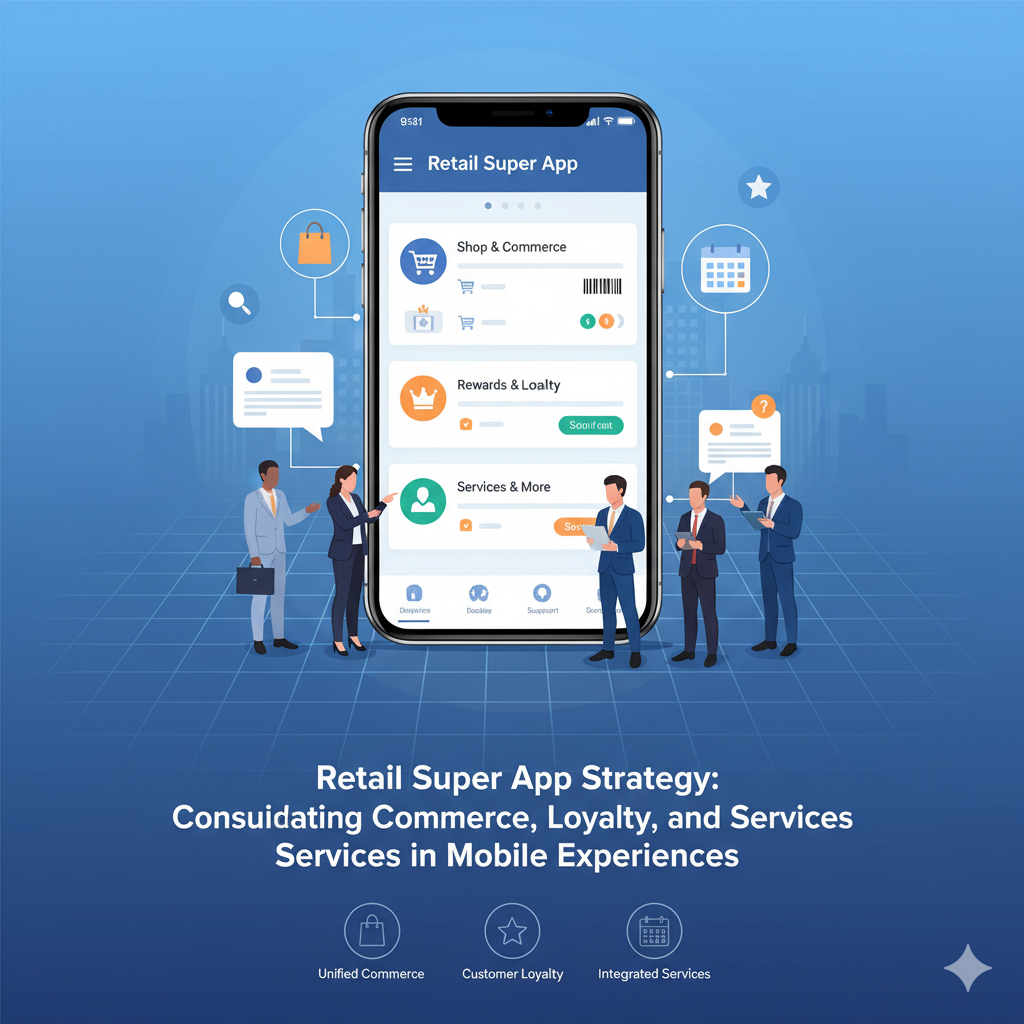
Retail super apps represent a strategic response to mobile commerce fragmentation, integrating previously separate shopping, payment, loyalty, and service functions within cohesive containerized platforms that deliver personalized experiences while reducing operational complexity. Unlike traditional retail applications that focus primarily on product discovery and transaction completion, retail super apps encompass the complete customer journey—from inspiration and research through purchase, delivery, support, and re-engagement. This comprehensive approach addresses fundamental challenges in retail mobile strategy: app proliferation fatigue, inconsistent cross-channel experiences, and inefficient customer data utilization that limit personalization and loyalty program effectiveness.
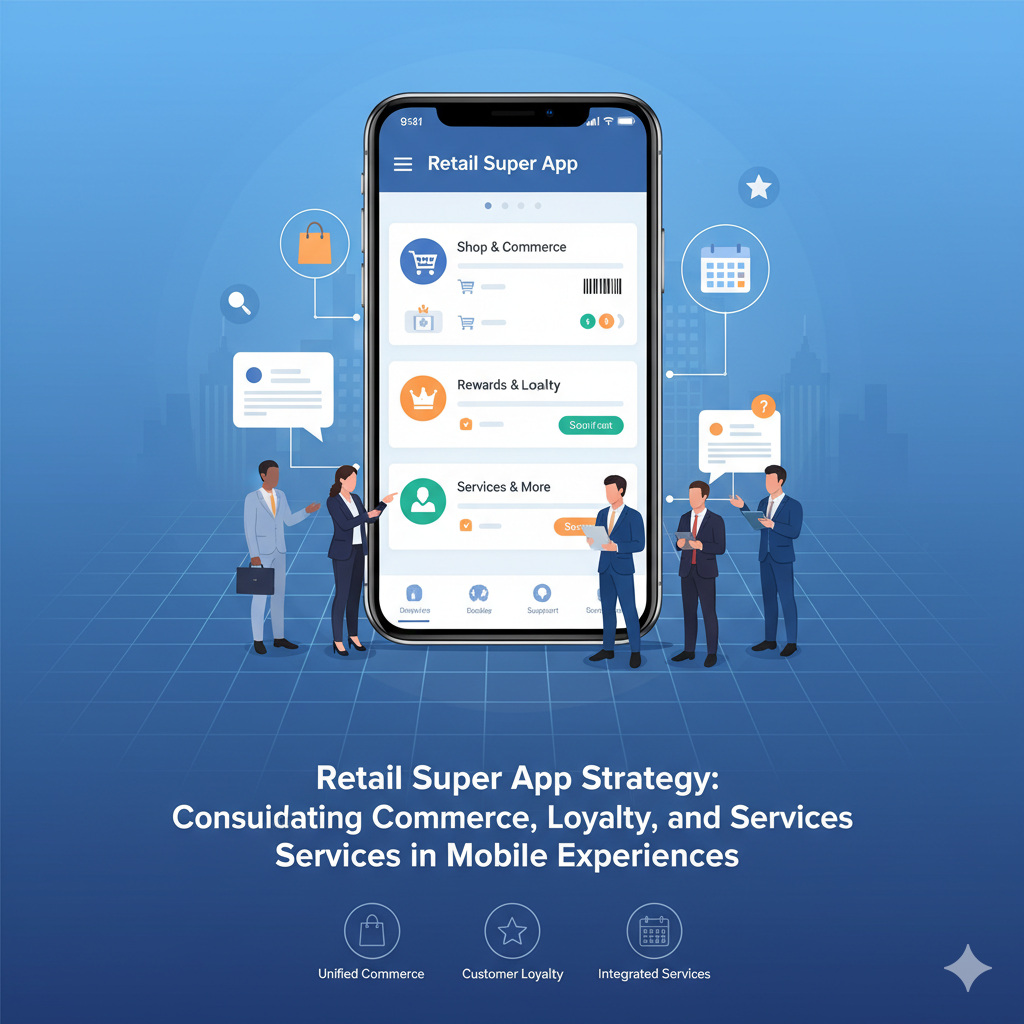
Core Components of Retail Super Apps
Retail super apps typically organize around several interconnected functional domains unified through shared infrastructure and consistent design patterns. Product commerce forms the foundational layer, encompassing search, browsing, product detail, cart management, and checkout functionality. However, unlike standalone shopping apps, retail super apps integrate these capabilities with adjacent services that enhance the core transaction experience.
Payment and financial services represent a critical integration point. Beyond basic credit card processing, retail super apps incorporate digital wallets, buy-now-pay-later options, gift card management, and personalized financing offers. This financial layer transforms transactions from isolated events into relationship-building opportunities, capturing payment preference data that informs future personalization while reducing friction at checkout points. Retail platforms implementing integrated payment approaches report 40% increases in average order values compared to standalone shopping applications.
Loyalty and reward systems transition from peripheral programs to central engagement drivers within super app architectures. Instead of separate loyalty apps or card-based programs, super apps embed point accumulation, reward redemption, and tier benefits directly into shopping workflows. Real-time point display during product browsing, automatic application of relevant rewards at checkout, and personalized bonus opportunities based on purchase history create seamless value recognition that strengthens brand attachment. The integrated approach increases redemption rates by approximately 60% compared to traditional loyalty programs requiring manual point tracking and separate redemption processes.
Customer service and support functionality shifts from reactive problem resolution to proactive relationship management. In-app messaging with automated and human agents, augmented reality product visualization, virtual try-on capabilities, and appointment scheduling for in-store services create comprehensive support ecosystems. These services reduce call center volume while improving resolution satisfaction—retailers report 30% reductions in support costs alongside 25% increases in customer satisfaction scores when migrating from traditional support channels to integrated super app approaches.
Community and social features extend the retail experience beyond transactional boundaries. User-generated content sharing, product reviews with visual verification, shoppable social feeds, and group buying opportunities create engagement layers that drive discovery and validation. These social elements prove particularly valuable for categories requiring high-involvement decision making like fashion, electronics, and home furnishings, where peer recommendations significantly influence purchase decisions.
Technical Implementation Architecture
Retail super app implementation relies on containerized architecture that balances platform control with development flexibility. The host application provides core infrastructure—user identity management, payment processing, notification systems, and analytics collection—while specialized mini programs deliver domain-specific functionality. This separation enables rapid iteration within functional areas without destabilizing core platform capabilities.
Container design for retail environments must address several unique requirements. Session persistence across mini program boundaries ensures users maintain shopping carts, preferences, and authentication states as they move between different service areas. Performance optimization for product imagery and video content requires sophisticated caching strategies that balance freshness with load times. Offline functionality for key workflows—product browsing, cart management, and loyalty point viewing—maintains usability in environments with unreliable connectivity, a common challenge for mobile retail applications.
Integration with existing retail systems presents substantial technical complexity. Super apps typically connect to multiple backend systems: product information management for catalog data, order management for transaction processing, customer relationship management for personalized experiences, inventory management for availability information, and legacy point-of-sale systems for in-store integration. API gateways and event-driven architectures help manage these connections while maintaining system independence and resilience.
Personalization engine implementation represents both technical challenge and competitive advantage. Effective retail super apps analyze user behavior across all integrated services to generate relevant recommendations, promotions, and content. Machine learning models processing purchase history, browsing patterns, loyalty engagement, service interactions, and even external factors like location and weather create multidimensional customer understanding that drives increasingly accurate personalization over time.
Security architecture must address retail-specific threats including payment fraud, account takeover attempts, and inventory manipulation. Multi-layered approaches combine device fingerprinting, behavioral analytics, transaction pattern recognition, and real-time risk scoring to identify suspicious activity. The containerized architecture provides natural isolation boundaries that contain potential security breaches within affected mini programs rather than compromising the entire platform.
Business Impact and Metrics
Retail super app adoption transforms key business metrics across customer acquisition, engagement, conversion, and retention dimensions. Customer acquisition costs typically decrease as integrated platforms leverage existing user bases for new service discovery. Instead of marketing each service independently, retailers can promote additional capabilities to already-engaged users through contextual prompts and cross-service recommendations. This organic growth channel proves particularly valuable for services with naturally complementary relationships to core shopping functionality.
Engagement metrics improve through reduced app switching friction and increased functionality density. Users accessing multiple services within a single application demonstrate higher session frequency, longer dwell times, and more complete journey completion compared to scenarios requiring separate applications. The convenience factor—having all retail-related capabilities in one place—proves compelling for time-constrained consumers who prioritize efficiency in mobile interactions.
Conversion optimization benefits from personalized pathways that guide users from inspiration to purchase. Super apps can analyze behavior across service boundaries to identify intent signals that might be invisible within isolated applications. A user browsing product reviews, checking loyalty point balances, and viewing delivery options within a single session presents stronger purchase intent than someone performing these actions across separate applications. This cross-service visibility enables more effective remarketing, personalized promotions, and timing optimization for conversion interventions.
Customer lifetime value increases through several mechanisms. Reduced churn results from ecosystem lock-in—users invested in multiple services within a platform face higher switching costs. Increased purchase frequency emerges from simplified reordering and subscription management capabilities. Expanded share of wallet occurs as users consolidate retail spending within platforms offering comprehensive functionality. Retail organizations report 3x faster feature launch cycles for new commerce capabilities when adopting containerized architectures, with corresponding improvements in revenue growth from rapid experimentation and iteration.
Operational efficiency gains materialize through several channels. Development team productivity improves as specialized mini program teams can innovate independently within their domains while relying on shared platform infrastructure. Marketing efficiency increases through unified customer profiles that enable coordinated campaigns across service categories. Support cost reduction occurs as self-service capabilities within the super app resolve common inquiries without agent intervention. Data analytics effectiveness improves through comprehensive behavioral datasets that reveal patterns invisible within siloed application data.
Implementation Roadmap Considerations
Organizations pursuing retail super app strategies should begin with careful assessment of existing mobile capabilities and customer behavior patterns. Identify natural service clusters where users frequently transition between related functions—these represent logical starting points for initial mini program development. Common retail clusters include product discovery and purchasing, loyalty engagement and redemption, post-purchase support and returns, and in-store integration for omnichannel experiences.
Phased implementation approaches typically prove most successful for established retailers with existing applications. Begin by containerizing non-critical functionality to build platform expertise and demonstrate value through measurable improvements. Common starting points include loyalty programs, store locators, or product review systems—services with clear value propositions that benefit from integration with core shopping functionality but don't risk disrupting primary revenue streams if implementation challenges arise.
Technical platform selection should balance immediate requirements with long-term flexibility. Container solutions vary in capabilities, integration complexity, and ecosystem support. Key evaluation criteria include performance characteristics for retail workloads, security features for payment processing, developer experience for internal and third-party teams, and management tools for monitoring distributed components. Organizations should prioritize solutions with proven retail implementations and comprehensive documentation for common integration scenarios.
Change management represents a critical success factor often underestimated in technical planning. Retail super apps transform how teams organize, develop, and operate mobile capabilities. Development teams transition from application-centric to platform-centric mindsets, with corresponding adjustments to planning processes, success metrics, and collaboration patterns. Marketing teams adapt to integrated customer journeys rather than channel-specific campaigns. Support teams learn new tools and processes for managing issues across service boundaries. Proactive change management addressing these transitions smooths adoption and accelerates value realization.
Measurement framework establishment should precede full-scale implementation. Define key performance indicators that reflect super app strategic objectives: cross-service adoption rates, integrated journey completion percentages, customer lifetime value changes, and operational efficiency improvements. Establish baseline measurements from existing separate applications to enable meaningful comparison post-implementation. Implement instrumentation that tracks user flows across mini program boundaries to identify friction points and optimization opportunities.
Ecosystem development planning should consider both internal and external expansion. While initial implementations typically focus on internal retail services, long-term success often involves integrating third-party capabilities that enhance platform value. Common retail ecosystem extensions include delivery services, installation providers, financing partners, and complementary product marketplaces. Establish clear integration standards, revenue sharing models, and quality requirements early to facilitate productive partnership development.
For retailers building super app capabilities, mini program marketplaces provide structured approaches to ecosystem development. These marketplaces enable third-party developers to create complementary services that integrate with the retail platform, expanding functionality without requiring internal development resources. The marketplace model creates network effects where additional services attract more users, which in turn attracts more developers—a virtuous cycle that strengthens platform competitiveness over time. Retail organizations using this approach achieve more consistent daily engagement through diversified service offerings while reducing seasonality exposure from core shopping patterns.
Learn how enterprises build SuperApps using mini-program architecture: https://super-apps.ai