OpenClaw Reshapes the Software Industry Landscape, Finogeeks Builds Enterprise-Grade Claw
OpenClaw Sweeps the Globe, Enterprise-Grade Solution Arrives: Finogeeks' Enterprise Claw is Officially Launched
Recently, the sharp drop in software stocks in the U.S. stock market was largely due to OpenClaw, an open-source AI tool marked by a lobster, which transformed AI from "just chatting" to "actually getting things done." In simple terms, OpenClaw is an open-source AI agent gateway that for the first time enables "personal-level, multi-channel, executable" Agent experiences to be deployable and extensible. It can complete tasks like writing code, running scripts, checking documents, and sending messages all within a single conversation. Innovation is exploding in the personal AI assistant space and continuously evolving towards lightweight solutions.
At the enterprise level, building a "secure and controllable enterprise-grade OpenClaw" has become an unavoidable ultimate proposition for companies across various industries. However, enterprises have to "do the heavy lifting," encompassing security risks, compliance requirements, and more. Enterprises need the capabilities represented by Claw, but the engineering complexity at the enterprise level far exceeds the personal and geek scenarios that OpenClaw targets.
It is precisely against this backdrop that Finogeeks, by "doing the heavy lifting" with its ChatKit Middleware enterprise AI middleware, launched Enterprise Claw. It transforms multi-tenancy, permissions, auditing, compliance, and a controllable skill ecosystem into an intelligent agent platform that enterprises can truly implement and put into production.
From "AI Chatting" to "AI Getting Things Done," the End of the ChatGPT Era Begins
"OpenAI merging with OpenClaw marks the end of the ChatGPT era." The iteration speed of the AI industry far exceeds imagination, and this core turning point is a fundamental leap from "hearing its words" to "seeing its actions."
ChatGPT represents the "conversational intelligence era," solving information generation, content comprehension, and language expression. However, it did not truly solve task execution, cross-system operations, and long-flow autonomy. The emergence of OpenClaw signifies AI moving from "talking" to truly "doing things." This means a shift: the core interface of AI is no longer a chat window, but an agent system. If ChatGPT is the "browser of AI," then OpenClaw is the "prototype of an AI operating system."
Why Did OpenClaw Become So Popular? Because It's a "Super Personal Tool"
Why did OpenClaw ignite developers' interest? Precisely because it has almost no enterprise-level constraints. Users are responsible for the permissions they grant to agents, but this logic is often unsuitable in an enterprise environment. OpenClaw is the first agent framework to truly capture developers' attention, but open-source experimentation does not equate to enterprise deployment. OpenClaw's power comes from "breaking boundaries." However, enterprises are most concerned with: permission models, data sovereignty, audit trails, accountability, security sandboxes, multi-tenant isolation, and other factors.
The open-source world can "grow wildly," but the enterprise world must "evolve controllably." The chasm between the two is vast.
What Enterprises Truly Need Is Not "Lightness," But "Heaviness"
"Heaviness" means that the technical architecture must be robust, and technical means must be handled cautiously. Claw in an enterprise environment must possess:
|
Capability Dimension |
Enterprise-Level Requirements |
|
Users and Organizations |
Multi-user system, roles and permissions
(RBAC), organizational structure binding |
|
Compliance and Auditing |
Audit logs, compliance policies,
accountability traceability |
|
Execution and Security |
Sandbox execution layer, data sovereignty
isolation, private deployment |
|
Skill Governance |
Skill store with approval mechanism, risk
control module |
These are not problems that "lightweight tools" can solve; they are middleware-level engineering problems. Therefore, Finogeeks goes against the trend, committed to solving enterprise implementation issues: based on ChatKit Middleware—an AI middleware for enterprises—it has built "Enterprise Claw."
The enterprise's tenet is: an Agent should not be a personal script, but an enterprise-grade middleware capability. Its direction is:
- Multi-tenant architecture: The same set of services supports massive users and organizations.
- Enterprise identity integration: SSO/IAM, integrated with existing account and permission systems.
- Skill governance framework: Unified management, approval, and grayscale release of skills.
- Traceable auditing: Every invocation and every tool execution can be audited.
- Local and private deployment: Data stays within the boundary, meeting data sovereignty requirements.
- Pluggable skill ecosystem: Extendable capabilities under controlled conditions.
- Compliance-first design: Meeting industry and regulatory requirements at the architectural level.
- Embeddable enterprise systems: Integrated with existing business systems via standard APIs.
Finogeeks provides its localized Skills Hub (enterprise skill center): unified registration, approval, and grayscale release of skills; data remains within the enterprise, without relying on public skill stores.
The agent's identity and persona descriptions adopt the AIEOS.org specification (AI Entity Object Specification), while also being compatible with OpenClaw's SOUL.md system, allowing enterprises to adopt existing conventions or smoothly migrate without having to start from scratch.
Furthermore, enterprises can configure different assistant personas for various roles, departments, or scenarios. Through role templates (Character Template) and persona configurations (e.g., SOUL.md / IDENTITY content), the assistant's tone, responsibility boundaries, and callable skills and tools can be defined. This achieves a personalized "an assistant for everyone" experience while maintaining unified governance of personas and risks, ensuring consistency and auditability for assistants across every employee or product line.
Enterprise Edition Claw's Application Scenarios
- Enterprise Virtual Employees
AI agents act as "virtual employees" to handle standardized, clearly defined processes: ticket processing, knowledge Q&A, report aggregation, approval assistance, etc., integrating with existing OA, ERP, and customer service systems. - Every Employee Has an Assistant
Provide a dedicated AI assistant for each employee, under unified permissions and auditing, to handle daily office tasks such as writing emails, checking documents, scheduling, and filling out forms, while strictly adhering to enterprise data and compliance policies. - Vertical and Regulated Industries: Taking the Securities Industry as an Example
In heavily regulated industries like securities, Finogeeks has built an AI investment advisory platform: providing research assistance, customer service, suitability management, and speech and behavior logging within a compliance framework, meeting regulatory requirements for traceability, auditability, and permission stratification.
Technical Comparison: Why Can't OpenClaw Be Directly Used for Enterprises?
Why is OpenClaw difficult to directly meet enterprise needs? How does Enterprise Claw (based on ChatKit Middleware) specifically address these issues?
1. Deployment and Operations: Per-Person VM vs. Multi-Tenant Service
|
Dimension |
OpenClaw / Lightweight Derivative |
Enterprise Claw (ChatKit Middleware) |
|
Deployment Form |
One VM or Docker per person |
Unified service, multi-tenant sharing |
|
User Object |
Technical staff self-build and use |
General enterprise employees use through
a unified portal and configured channels |
|
Extension Method |
Horizontal instance replication |
Horizontal scaling + tenant/session
isolation |
Enterprises cannot require every employee to maintain their own VM or container; what they need is "out-of-the-box, unified operations" SaaS or private services.
2. Task Scheduling: Personal Cron vs. Enterprise-Grade Workflow
|
Dimension |
OpenClaw / Lightweight Solution |
Enterprise Claw |
|
Scheduling Model |
Lightweight scheduled based on Cron |
High-concurrency, high-throughput
enterprise-grade workflow engine |
|
Scale |
Single user, small number of tasks |
Thousands of users, workflow concurrency |
|
Capabilities |
Primarily time-triggered |
Complex DAG, retries, compensation,
auditing |
Enterprises need high-concurrency, observable, and retryable task and workflow scheduling, not single-machine Cron.
3. Architectural Essence: Single-User Application vs. Multi-User System
OpenClaw is essentially a "single-user application": single session, single identity, local storage. What enterprises need is:
- Multi-user, multi-session, multi-tenant
- Unified identity, unified permissions, unified auditing
- Session and state persistence and isolation on the server side.
This is an architectural difference, not just a configuration issue.
4. Skills and Tools: Arbitrary Installation vs. Unified Management
Enterprises cannot allow users to arbitrarily install skills and tools for agents. It must be ensured that:
- Skills/tools are uniformly registered and approved by administrators or through governance processes.
- Strategy control is implemented by role, tenant, and scenario.
- Sensitive tools (such as production releases, databases) require secondary confirmation or disabling.
Enterprise Claw provides a skill governance framework and strategy engine to achieve a "pluggable but controllable" skill ecosystem.
5. Security and Permissions: Borderless vs. Fine-Grained with "God's Eye View"
Enterprises require fine-grained control over "who can use which tools, access which networks, and call which business systems," and centralized strategies and auditing from an administrator's perspective. OpenClaw and lightweight derivatives lack:
- Administrator and tenant-level strategies
- Tool-level / network-level / resource-level permission models
- Deep integration with IAM, RBAC
Enterprise Claw designs permissions, strategies, and auditing as first-class citizens, supporting integration with existing IAM/SSO.
6. Compliance and Guardrails: Missing vs. Built-in
The lack of compliance governance and security guardrails prevents enterprises from enabling it in formal business operations. Enterprise Claw is designed with:
- Strategy engine (preflight / postflight)
- Content and behavior guardrails
- Audit logs and traceability
- Interoperability with industry regulations (e.g., securities suitability)
7. Identity and Permissions: Personal Identity vs. Enterprise Identity System
How the agent's permissions relate to enterprise-level personnel authentication and layered permission management is a complex issue. Enterprise Claw integrates "single sign-on, consistent permissions across platforms" with existing enterprise identity systems through Identity Service, JWT, OIDC, Jurisdiction, and other multi-tenant identity and permission models.
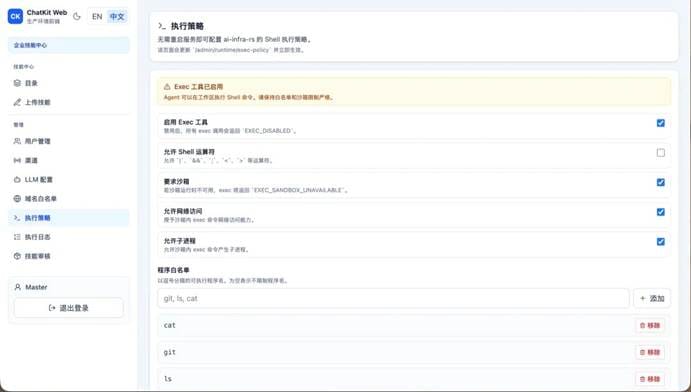
Enterprise Claw's Platform-Level Capabilities
In terms of core Agent capabilities, Finogeeks, OpenClaw, and ZeroClaw are not simply comparable. Instead, Enterprise Claw features enhancements and differentiations for enterprise scenarios at the fundamental architectural layer, algorithmic strategies, security strategies, and runtime. In essence, neither the specific architectural design nor the code implementation utilizes any source code from these open-source technologies.
1. Agent Loop and Termination Strategy
|
Capability |
OpenClaw/Nanobot |
Enterprise Claw (ai-infra-rs /
ai-infra-lite) |
|
Multi-step Loop |
Supported |
Supported |
|
Termination Conditions |
Timeout, disconnection, etc. |
Explicit stop_reason: max_iterations, timeout, budget, no_progress, policy_block,
etc. |
|
Context and Pruning |
Compression and retry |
Soft pruning + hard clear + overflow
retry |
|
No Progress Detection |
None |
Prevent idling |
|
Budget and Strategy Interception |
None |
budget_exceeded, policy_block, etc. |
It provides observable and controllable termination and budget strategies, facilitating cost and risk control for enterprises.
2. Security and Isolation Strategies
|
Capability |
OpenClaw/ZeroClaw |
Enterprise Claw |
|
Workspace Isolation |
Single-user sandbox |
Workspace isolation
by user_id/session_id, path normalization, and traversal protection |
|
Execution Sandbox |
Partial capabilities |
OpenSkills runtime: macOS Seatbelt, Linux
Landlock/seccomp, WASM |
|
Network and Egress |
No unified strategy |
Default deny + whitelist, prohibit access
to metadata endpoints |
|
Sensitive Paths and Secrets |
Manual configuration dependent |
Sensitive path protection, secrets not
logged, pre-audit anonymization |
|
Tool Strategy |
Config-level |
X-Tool-Policy, capability gating, rollout
switch |
Enterprise Claw treats isolation and security as first-class citizens, meeting enterprise demands for "auditable, switchable, and degradable" operations.
3. OpenSkills and Skill Runtime
Finogeeks' independently developed and open-sourced OpenSkills, as the skill and runtime layer, differs from OpenClaw's "skill-as-prompt + local script" approach:
|
Capability |
OpenClaw |
Enterprise Claw (OpenSkills) |
|
Skill Format |
SKILL.md + prompt injection |
SKILL.md (compatible)
+ allowedTools strategies |
|
Execution Method |
Relies mainly on existing tools + scripts |
WASM + sandboxed Shell
(Seatbelt/Landlock) |
|
Permissions and Auditing |
No independent model |
Permissions configured per skill and
timeout, executable and auditable |
|
Progressive Loading |
Summary + read_file |
listSkills → activateSkill and
other structured interfaces |
Under the premise of "skill-as-capability," Finogeeks places greater emphasis on secure execution and governance, rather than "unguarded flexibility."
4. Skills Hub, Identity Specification, and Assistant Persona
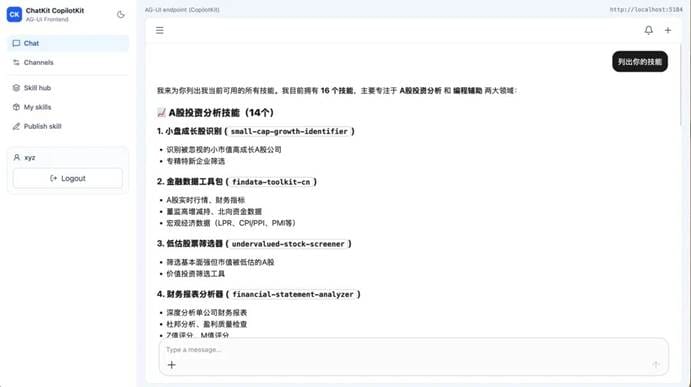
Enterprise Claw has a built-in proprietary skill center that does not rely on public marketplaces. Administrators can register, approve, enable, or disable skills within the center; regular users can browse and "use" skills from the enterprise-approved directory, with skill content and usage records stored on the enterprise side, meeting data sovereignty and compliance traceability requirements. The overall form is closer to enterprise-level application marketplaces (like Salesforce AppExchange): the entire process is completed on the server side, with no local installation or CLI required.
Enterprises adopt AIEOS.org (AI Entity Object Specification) as the main specification for agent identity and persona: structuring who the agent is, what it can do, and its boundaries, facilitating consistent strategies and auditing across multiple tenants. At the same time, it is compatible with OpenClaw's SOUL.md system, allowing enterprises that have already adopted SOUL.md / IDENTITY.md conventions to seamlessly connect or gradually migrate without having to start from scratch.
Additionally, enterprises can configure different assistant personas for various roles, departments, or scenarios. Through role templates (Character Template) and persona configurations (e.g., SOUL.md / IDENTITY content), the assistant's tone, responsibility boundaries, and callable skills and tools can be defined. This achieves a personalized "an assistant for everyone" experience while maintaining unified governance of personas and risks, ensuring consistency and auditability for assistants across every employee or product line.
5. Multi-tenancy and Contractualization
Enterprise Claw is built on ChatKit Middleware:
- Contract-first: OpenAPI contracts drive service boundaries and type safety.
- Multi-tenancy: Jurisdiction, Identity, and session state are isolated by tenant and user.
- Orchestration and Workflow: Orchestrator driven by YAML workflows, facilitating integration with existing business flows.
- Observability: Unified logs, auditing, and optional SLO metrics.
These capabilities are platform-level features not possessed by OpenClaw and its lightweight derivatives.
Conclusion: We Solve the "Heavy and Cumbersome" Engineering Problems
OpenClaw demonstrated the direction of "AI that gets things done," but Finogeek's Enterprise Claw, built on ChatKit Middleware, aims to solve the "heavy and dirty" engineering problems.
This competition's true difficulty lies not in model parameter scale, but in who can solve the "heavy and complex" engineering realities. Enterprises will not deploy Agents just because it's a trend; they will deploy Agents because they are controllable, reliable, and scalable.
Finogeeks is not building the lightest tool, but the most stable foundation. The Agent era has arrived, and the enterprise-grade Agent era has just begun.