Mini Program Hot Updates: Bypassing App Store Reviews for Faster Feature Deployment
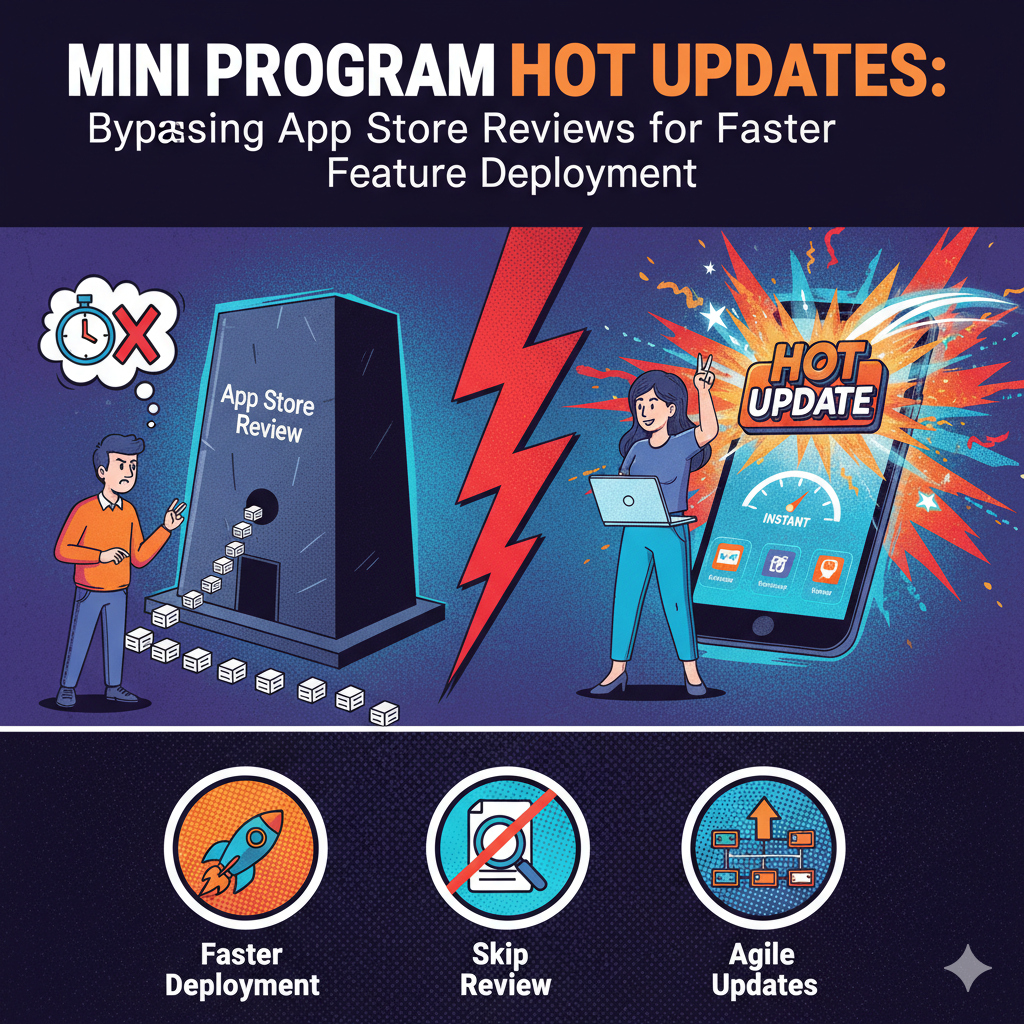
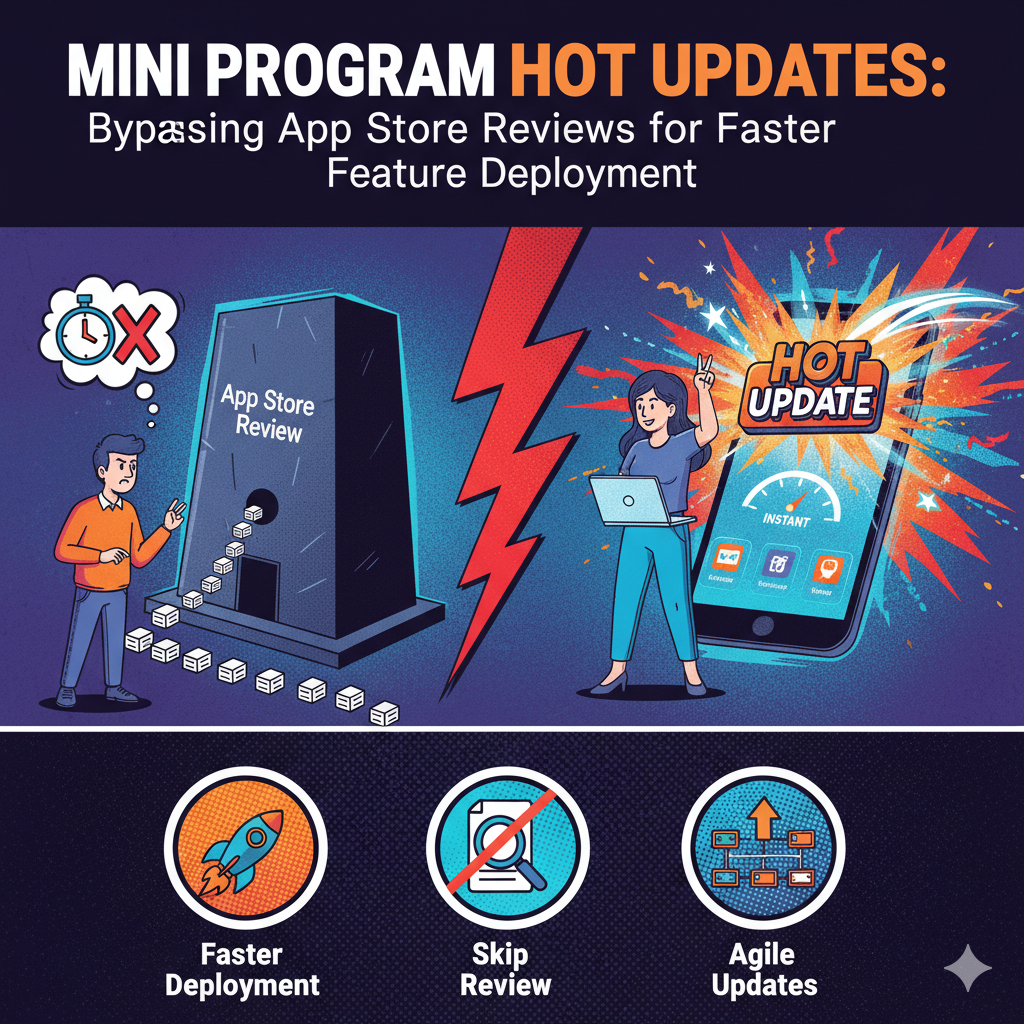
Mini program hot updates represent a fundamental architectural advantage over traditional native applications, enabling instant feature deployment without app store review cycles while maintaining platform security standards. Unlike native apps that require submission to Apple App Store or Google Play Store for every update—a process that typically takes 24-72 hours—mini programs update instantly when users access them, allowing businesses to respond to market changes, fix critical bugs, and deploy A/B tests with unprecedented speed. This capability transforms development velocity from constraint to competitive advantage, particularly for services requiring frequent updates or rapid experimentation.
How Hot Updates Work Technically
Mini program hot updates operate through a combination of container architecture, differential updating, and secure execution environments. When a user launches a host application containing a mini program container, the container checks for updated mini program packages from a content delivery network (CDN) rather than relying on app store distribution. If updates exist, the container downloads only the changed components—typically JavaScript, CSS, and template files—while preserving user data and persistent storage.
The technical implementation relies on separation between the container runtime (distributed through app stores) and the mini program code (delivered through CDNs). The container provides stable APIs for hardware access, user interface rendering, and security enforcement, while mini programs contain business logic and presentation layers that can change independently. This separation enables the container to validate mini program updates against security policies and compatibility requirements before execution, maintaining platform control while granting development flexibility.
Security enforcement occurs at multiple levels during hot updates. Container runtimes typically implement code signing verification to ensure updates originate from authorized developers. Sandbox isolation prevents mini programs from accessing sensitive device resources or user data without explicit permission. Content security policies restrict network requests and script execution to prevent malicious behavior. These controls combine to create what security researchers describe as "verified dynamic execution"—the ability to run updated code safely because the execution environment maintains strict boundaries around what that code can do.
Performance optimization for hot updates involves sophisticated differential algorithms that minimize download sizes. Instead of replacing entire mini program packages, update systems identify changed files at granular levels—sometimes down to individual function modifications within JavaScript files. Compression techniques further reduce transfer sizes, with typical updates measuring kilobytes rather than megabytes. This efficiency enables frequent updates even on unreliable mobile networks or data-restricted connections, removing bandwidth as a constraint on deployment frequency.
Business Impact of Instant Deployment
The business implications of hot update capability extend far beyond technical convenience to fundamentally reshape how organizations approach digital service development and deployment. Development teams transition from quarterly or monthly release cycles to continuous deployment models where features can reach users within hours of completion. This acceleration creates competitive advantages in responsiveness to user feedback, market trends, and emerging opportunities.
A/B testing and experimentation become practical at scale with hot update technology. Instead of requiring separate app variants through app store channels—a process that limits audience size and increases complexity—teams can deploy different experiences to user segments through configuration changes delivered via hot updates. This enables data-driven decision making based on actual user behavior rather than assumptions or small-scale tests. Retail organizations using this approach have reported 3x faster feature launch cycles compared to traditional native app development, with 40% increases in merchant onboarding efficiency through iterative interface improvements.
Critical bug resolution transforms from days-long emergencies to minutes-long procedures. When security vulnerabilities or functional defects emerge in production, development teams can deploy fixes immediately rather than waiting for app store approval. This capability proves particularly valuable for financial services, healthcare applications, and other domains where software defects can have serious consequences. The reduced risk profile enables more aggressive innovation while maintaining operational stability—a combination previously difficult to achieve in mobile development.
Feature flagging and gradual rollout capabilities inherent in hot update systems allow teams to manage deployment risk systematically. New functionality can be enabled for internal testers, then beta users, then percentage-based production audiences—all without additional app store submissions. If issues emerge at any stage, the feature can be disabled instantly through configuration changes. This controlled approach to innovation reduces the "big bang" risk associated with traditional app updates where all users receive changes simultaneously.
User experience benefits emerge through more responsive service evolution. Instead of encountering outdated interfaces or missing features between app updates, users always access the latest version when they launch mini programs. This consistency improves user satisfaction and reduces support requests related to version discrepancies. Telecommunications providers implementing mini program architectures have reported 70% faster service rollout times with 50% lower development maintenance costs, attributing these improvements partly to hot update capabilities that eliminate coordination overhead between development and distribution channels.
Implementation Considerations and Best Practices
Successful hot update implementation requires attention to backward compatibility, user experience continuity, and update management strategy. Unlike traditional app updates where users control timing through app store interactions, hot updates typically occur automatically when users access services. This automated approach demands careful design to prevent disruptive changes or confusing transitions.
Backward compatibility represents a critical technical consideration. Mini program containers must maintain support for older mini program versions during transition periods, as users may have cached previous versions or experience network interruptions preventing immediate updates. API versioning, feature detection, and graceful degradation patterns enable smooth transitions between versions without breaking existing functionality. Container developers should implement comprehensive testing suites that verify compatibility across version combinations to prevent regression issues.
User experience during updates requires thoughtful design. While some updates can occur transparently in the background, significant interface changes or new feature introductions may benefit from user education. In-app messaging, tutorial overlays, and change logs help users understand modifications without disrupting workflow. The optimal approach balances seamless updating for minor changes with appropriate communication for substantial revisions—a balance that varies by application domain and user sophistication.
Update management strategy should consider frequency, size, and dependency implications. While hot updates enable continuous deployment, excessive update frequency can condition users to ignore update notifications or experience update fatigue. Strategic batching of related changes into logical updates improves user comprehension and reduces cognitive load. Size management remains important for users on limited data plans or unreliable connections—developers should monitor typical update sizes and optimize asset delivery to minimize impact.
Dependency management becomes more complex with frequent updates. Mini programs often rely on third-party libraries, platform APIs, and external services that may change independently. Dependency locking, semantic versioning, and comprehensive integration testing help maintain stability amidst rapid iteration. Container providers typically offer stable API surfaces with long-term support guarantees, but mini program developers must still manage their own dependency graphs to prevent unexpected breakage.
Performance monitoring and analytics should track update success rates, deployment timing, and user impact. Metrics like update completion percentage, time-to-update distribution, and error rates during update processes provide visibility into system health. A/B testing frameworks can measure how different update strategies affect user engagement, retention, and conversion metrics. This data-driven approach enables continuous improvement of both update technology and deployment practices.
Security and Compliance Dimensions
Hot update systems introduce unique security considerations that require specialized approaches beyond traditional app security models. The ability to change code dynamically after app store distribution creates potential attack surfaces that malicious actors might exploit. Comprehensive security architectures address these risks through multiple layers of protection.
Code signing and certificate pinning ensure that only authorized updates from verified developers reach user devices. Containers should validate digital signatures on update packages using public key infrastructure tied to developer accounts. Certificate pinning prevents man-in-the-middle attacks that might intercept and modify updates during transmission. These cryptographic controls form the foundation of update integrity.
Runtime sandboxing isolates mini program execution from sensitive system resources and other applications. Even if malicious code bypasses update verification, the sandbox restricts what damage it can cause. Modern container implementations provide device-side isolation comparable to Docker containers on servers, creating security boundaries that contain potential exploits. This isolation proves particularly valuable in enterprise deployments where mini programs may process sensitive financial or personal data.
Content security policies restrict network access, script execution, and resource loading to prevent data exfiltration or remote code execution. By default, mini programs should operate in restricted modes that require explicit permission for potentially dangerous operations. User consent mechanisms for sensitive permissions—like location access, camera usage, or payment processing—maintain user control even as code updates automatically.
Compliance requirements for regulated industries add another layer of consideration. Financial services, healthcare, and government applications often face strict change control and audit trail requirements. Hot update systems must support comprehensive logging of what changes deployed when, by whom, and with what authorization. Integration with existing change management systems helps maintain compliance while benefiting from rapid deployment capabilities. Digital wallet providers using containerized approaches have achieved 2.5x increases in in-app service adoption with 45% improvement in retention rates, while maintaining regulatory compliance through auditable update processes.
For organizations implementing hot update capabilities, lightweight SDKs that integrate into existing applications in minutes provide a practical starting point. These SDKs handle the complex security and distribution challenges while exposing simple APIs for version management and update deployment. The modular approach allows teams to adopt hot update functionality gradually, beginning with non-critical features and expanding as confidence grows in the technology's reliability and security.
Download FinClip SDK and start running mini-programs today. Get SDK