Mini-Program Containers Explained: Technical Architecture and Implementation Patterns
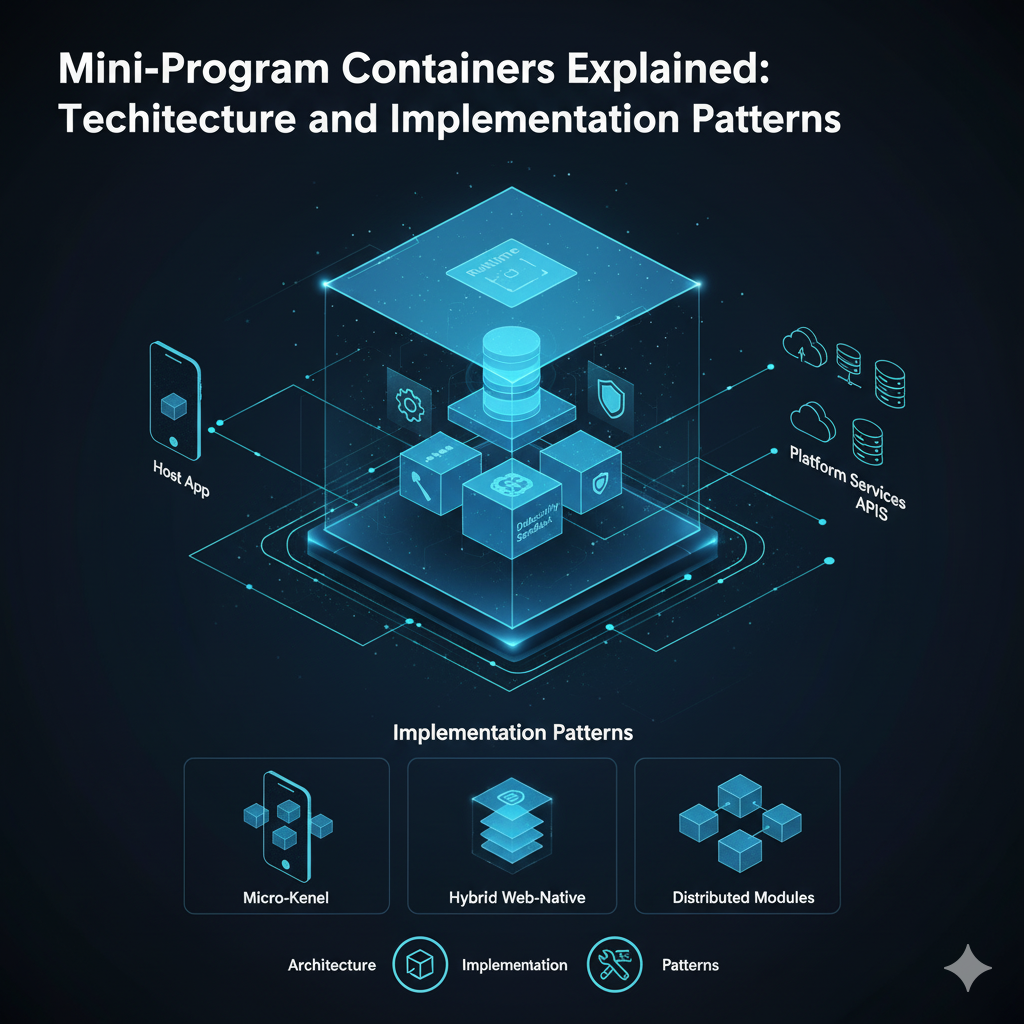
Mini-program containers represent specialized runtime environments designed specifically for lightweight, isolated application components operating within larger host platforms. Unlike traditional virtual machines or container technologies optimized for server deployment, mini-program containers address unique requirements including mobile resource constraints, user interface integration, and security isolation for untrusted code execution. Understanding their technical architecture reveals why this approach has become foundational for super app platforms, enterprise application modernization, and cross-platform development strategies.
The container model matters because it solves fundamental challenges in modern application development: how to deliver modular functionality without requiring full application downloads, how to maintain security when executing third-party code, and how to ensure consistent performance across diverse device capabilities. Traditional approaches to these problems—native applications, web applications, or hybrid frameworks—each present trade-offs between capability, performance, and deployment flexibility. Mini-program containers strike a different balance, prioritizing rapid deployment, secure isolation, and seamless integration within host environments.
Technical Architecture Components
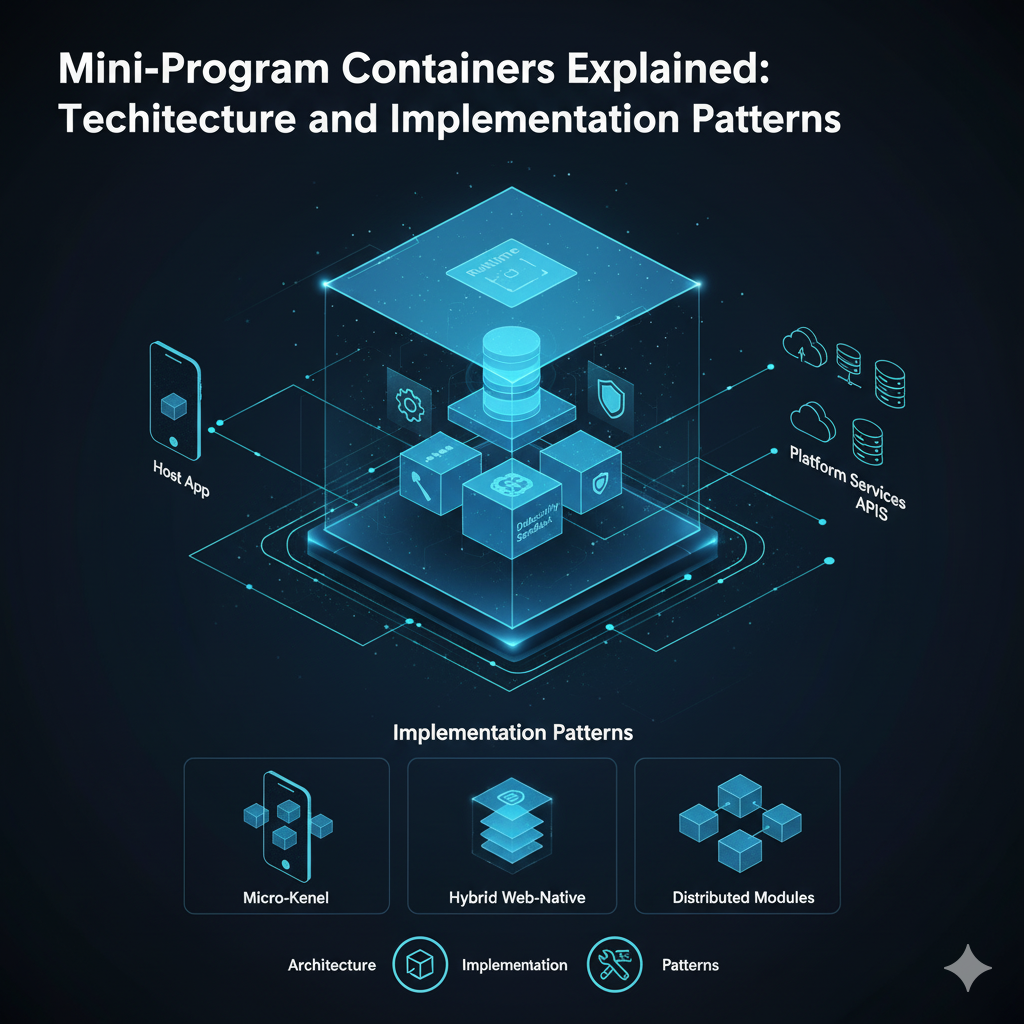
Mini-program containers consist of several interconnected technical components that work together to create isolated execution environments. The architecture typically includes a rendering engine, JavaScript runtime, native bridge, security sandbox, and resource management system—each optimized for the specific constraints of mobile and embedded environments.
The rendering engine handles user interface display and interaction. Unlike web browsers that use standardized rendering engines like WebKit or Blink, mini-program containers implement specialized rendering approaches optimized for their specific use cases. Some containers use web technologies (HTML, CSS) with custom rendering optimizations, while others implement native rendering engines that translate declarative UI descriptions directly to platform-native views. The choice between these approaches involves trade-offs: web-based rendering offers developer familiarity and rapid iteration, while native rendering provides better performance and platform integration.
JavaScript runtime executes application logic and manages state. Most mini-program containers use JavaScript as their primary programming language, leveraging its ubiquity and developer familiarity. However, the runtime implementations vary significantly from standard browser JavaScript engines. Optimizations include ahead-of-time compilation, bytecode generation, specialized memory management for mobile constraints, and extended APIs for platform-specific capabilities. Some containers support multiple language runtimes through WebAssembly or other execution environments, though JavaScript remains dominant for application logic.
Native bridge facilitates communication between the containerized application and host platform capabilities. This component exposes platform APIs—camera access, location services, payment systems, device sensors—to the mini-program in a secure, controlled manner. The bridge implements permission models, request validation, and data sanitization to prevent unauthorized access while maintaining functionality. Advanced bridge designs include capability negotiation, where mini-programs declare required permissions at load time, and lazy loading of native components to reduce initial memory footprint.
Security sandbox provides isolation between mini-programs and between mini-programs and the host application. This component implements multiple security layers: process isolation where supported by the operating system, memory protection through address space separation, capability-based access control for platform APIs, and content security policies for web-based components. The sandbox also monitors runtime behavior for potential security violations, terminating execution when detecting suspicious patterns like excessive resource consumption or unauthorized access attempts.
Resource management handles allocation and lifecycle control for system resources. Mini-program containers operate within constrained environments where memory, CPU, and battery consumption directly impact user experience and device performance. The resource manager implements policies for memory reclamation, background task suspension, network request throttling, and storage quota enforcement. These policies balance application functionality against system stability, prioritizing user experience over unfettered resource access.
Implementation Patterns and Trade-offs
Different mini-program container implementations emphasize various aspects of the architecture based on their primary use cases and design priorities. Four common patterns emerge from analysis of production systems: webview-based containers, native rendering containers, hybrid approaches, and specialized implementations for specific platforms or industries.
Webview-based containers leverage the platform's built-in web rendering capabilities through components like Android's WebView or iOS's WKWebView. This approach offers rapid implementation, strong web standards compatibility, and easy integration with existing web development workflows. However, it inherits webview limitations including performance constraints, inconsistent behavior across platform versions, and security vulnerabilities in the underlying web rendering engine. These containers typically excel in content-focused applications where web compatibility outweighs performance requirements.
Native rendering containers implement custom rendering engines that translate UI descriptions directly to platform-native views. This approach delivers superior performance, consistent behavior across devices, and seamless integration with platform design systems. The trade-off includes increased implementation complexity, larger container size, and potential divergence from web development workflows. These containers dominate in performance-sensitive applications like gaming, real-time collaboration tools, or applications requiring complex animations and transitions.
Hybrid approaches combine elements of both models, using web technologies for content rendering while implementing critical UI components natively. This pattern attempts to balance development efficiency with performance requirements, though it introduces additional complexity in coordinating between rendering systems. Successful hybrid implementations require sophisticated architecture decisions about which components to implement natively versus through web technologies, often based on performance profiling and user interaction analysis.
Specialized implementations target specific platforms, industries, or use cases with optimized architectures. Examples include containers for IoT devices with extreme resource constraints, financial applications with stringent security requirements, or gaming platforms with specialized rendering needs. These implementations typically sacrifice general applicability for optimized performance in their target domains, implementing custom security models, resource management policies, or rendering approaches tailored to specific requirements.
Performance Characteristics and Optimization Strategies
Mini-program container performance directly impacts user experience, engagement metrics, and ultimately adoption success. Four key performance dimensions require optimization: startup time, rendering responsiveness, memory efficiency, and battery consumption.
Startup time optimization focuses on reducing the delay between user initiation and functional availability. Strategies include preloading commonly used containers, implementing progressive loading that displays partial interfaces while background initialization completes, and optimizing bundle delivery through compression, differential updates, and intelligent caching. The most effective approaches combine multiple techniques: preloading high-probability containers based on usage patterns while implementing fast initial renders that provide immediate feedback even while secondary features load.
Rendering responsiveness determines how quickly the interface updates in response to user interactions or data changes. Optimization techniques include virtual DOM implementations for efficient UI updates, hardware-accelerated animations, intelligent rendering prioritization that updates visible elements before off-screen content, and predictive rendering that anticipates likely user actions. Container architecture decisions significantly impact rendering performance: native rendering generally outperforms web-based approaches for complex interfaces, though modern web rendering engines have narrowed this gap through advanced optimizations.
Memory efficiency becomes critical as users run multiple mini-programs simultaneously or switch frequently between applications. Effective memory management includes aggressive garbage collection, object pooling for frequently allocated resources, lazy loading of non-essential components, and intelligent caching policies that balance performance against memory consumption. Container implementations must also manage memory fragmentation—a particular challenge in long-running applications where allocation patterns create inefficient memory layouts over time.
Battery consumption optimization extends beyond simple efficiency to include intelligent resource scheduling. Containers should minimize background activity, batch network requests, optimize sensor usage frequency, and implement adaptive quality levels that reduce processing requirements when battery levels drop. The most sophisticated implementations include power profiling tools that help developers identify and address battery-intensive operations during development rather than in production.
Security Considerations and Implementation Approaches
Security represents a fundamental design requirement for mini-program containers, particularly when executing untrusted third-party code. The security model must balance functionality against protection, allowing legitimate operations while preventing malicious behavior. Four security layers typically work together: isolation, capability control, content validation, and runtime monitoring.
Isolation prevents mini-programs from accessing unauthorized resources or interfering with other applications. Implementation approaches include process-level isolation where supported by the operating system, memory protection through address space separation, and filesystem sandboxing that restricts file access to designated directories. The isolation layer also prevents mini-programs from directly invoking system calls or accessing hardware beyond defined interfaces.
Capability control manages what platform features and data each mini-program can access. This typically implements a permission model where mini-programs declare required capabilities, users grant or deny access, and the container enforces these decisions at runtime. Advanced capability systems include temporary permissions for one-time access, scoped permissions for specific operations, and permission escalation requiring user re-authorization for sensitive actions.
Content validation ensures that mini-program code and resources meet security requirements before execution. This includes cryptographic verification of code signatures, static analysis for potential security vulnerabilities, and runtime validation of data inputs and outputs. Validation systems often implement multiple checks: signature verification establishes code provenance, static analysis identifies potential issues, and runtime checks prevent exploitation of validation gaps.
Runtime monitoring detects and responds to suspicious behavior during execution. Monitoring systems track resource consumption patterns, API call sequences, network activity, and other indicators of potentially malicious behavior. When detecting suspicious patterns, the monitoring system can terminate execution, revoke capabilities, or alert security systems for further investigation. Effective monitoring requires balancing detection sensitivity against false positive rates to avoid disrupting legitimate applications.
Deployment and Integration Patterns
Mini-program container deployment involves technical decisions about distribution, updates, and host application integration. Three common patterns emerge from production implementations: embedded containers, standalone runtime environments, and platform-as-a-service approaches.
Embedded containers integrate directly into host applications, sharing process space and resources. This approach offers tight integration with host functionality, seamless user experience transitions, and efficient resource sharing. However, it requires host application modifications to support container integration and creates coupling between container and host versions. Embedded containers typically suit enterprise applications where the host application controls both container execution and content delivery.
Standalone runtime environments operate as independent applications that load and execute mini-programs. This approach separates container development from host applications, enabling independent update cycles and specialized optimization for container performance. The trade-off includes additional user installation steps and potential experience fragmentation between container and host applications. Standalone runtimes often appear in consumer-facing platforms where mini-programs come from diverse sources with varying requirements.
Platform-as-a-service approaches deliver containers through cloud infrastructure, with execution potentially occurring on servers rather than local devices. This model centralizes security enforcement, simplifies updates, and enables execution on devices with limited local capabilities. The limitations include network dependency, potential latency issues for interactive applications, and reduced offline functionality. Platform-as-a-service containers excel in scenarios requiring centralized control, such as enterprise deployment or applications with sensitive data processing requirements.
Integration with host applications involves both technical interfaces and user experience considerations. Technical integration includes shared authentication systems, data exchange mechanisms, and event communication channels. User experience integration focuses on navigation consistency, design system alignment, and transition smoothness between host application and container content. Successful integration makes containers feel like natural extensions of the host application rather than separate experiences bolted together.
Future Evolution and Industry Trends
Mini-program container technology continues evolving in response to changing device capabilities, developer requirements, and industry trends. Three directions show particular momentum: performance optimization through advanced compilation techniques, security enhancement through hardware-based isolation, and capability expansion through standardized APIs.
Performance optimization increasingly leverages ahead-of-time compilation, WebAssembly for computationally intensive operations, and machine learning-based optimization that adapts container behavior to usage patterns. These techniques address persistent challenges in mobile execution environments where computational resources remain constrained despite hardware improvements. The most advanced implementations compile mini-program code to platform-native binaries while maintaining security isolation through specialized runtime environments.
Security enhancement benefits from hardware security features becoming standard in mobile devices. Hardware-based memory protection, trusted execution environments, and secure enclaves enable stronger isolation between containers and host applications. These hardware capabilities, combined with improved software security models, create defense-in-depth architectures that withstand sophisticated attacks while maintaining performance for legitimate operations.
Capability expansion through standardized APIs enables mini-programs to access increasingly sophisticated platform features while maintaining security controls. Industry consortia like the W3C MiniApp Working Group develop specifications for cross-platform mini-program capabilities, creating consistent interfaces across different container implementations. These standards reduce fragmentation, lower development costs, and accelerate adoption by providing predictable capabilities across deployment environments.
The app-in-app architecture central to container implementations enables modular development where independent teams can build, test, and deploy mini-programs without coordinating full application releases. This architectural approach reduces development coordination overhead by 40-50% in enterprise deployments using FinClip while maintaining security isolation between components. The lightweight 3MB SDK implements the container runtime with full support for cross-platform execution across iOS, Android, Windows, macOS, Linux, HarmonyOS NEXT, and IoT devices.
Explore FinClip ChatKit — open-source AI chat middleware. GitHub