IoT Mini Programs: Connecting Billions of Devices Through Lightweight Application Containers
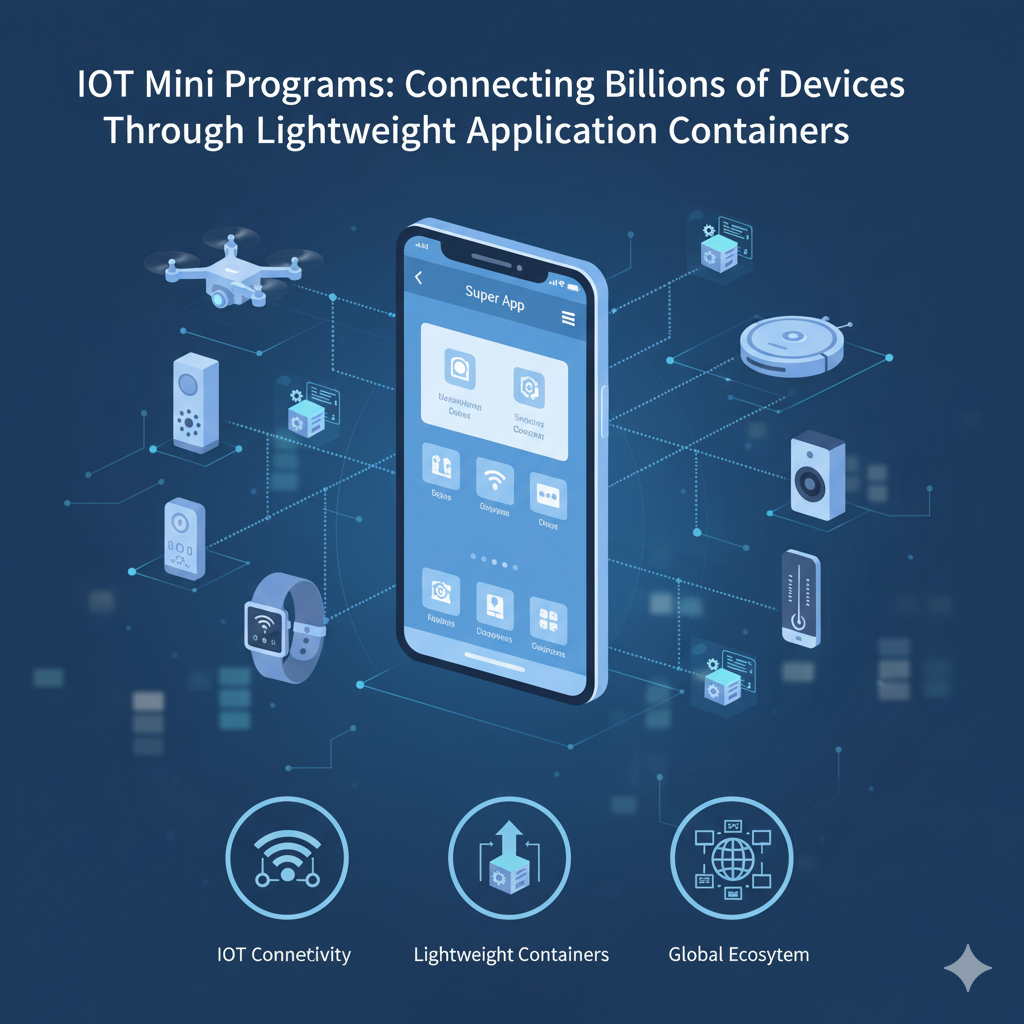
IoT mini programs represent the next evolution in connected device software, enabling lightweight application deployment across billions of devices—from smart home appliances and wearables to industrial equipment and vehicle systems—through container architectures that balance capability with resource constraints. Unlike traditional IoT applications requiring separate development for each device type and operating system, mini-program containers provide standardized runtime environments that execute modular applications within host device firmware, reducing development complexity by 70-80% while accelerating deployment timelines from months to weeks. This approach matters because it addresses the fundamental fragmentation challenge in the Internet of Things era, where diverse hardware capabilities, connectivity limitations, and security requirements have historically impeded scalable software ecosystems.
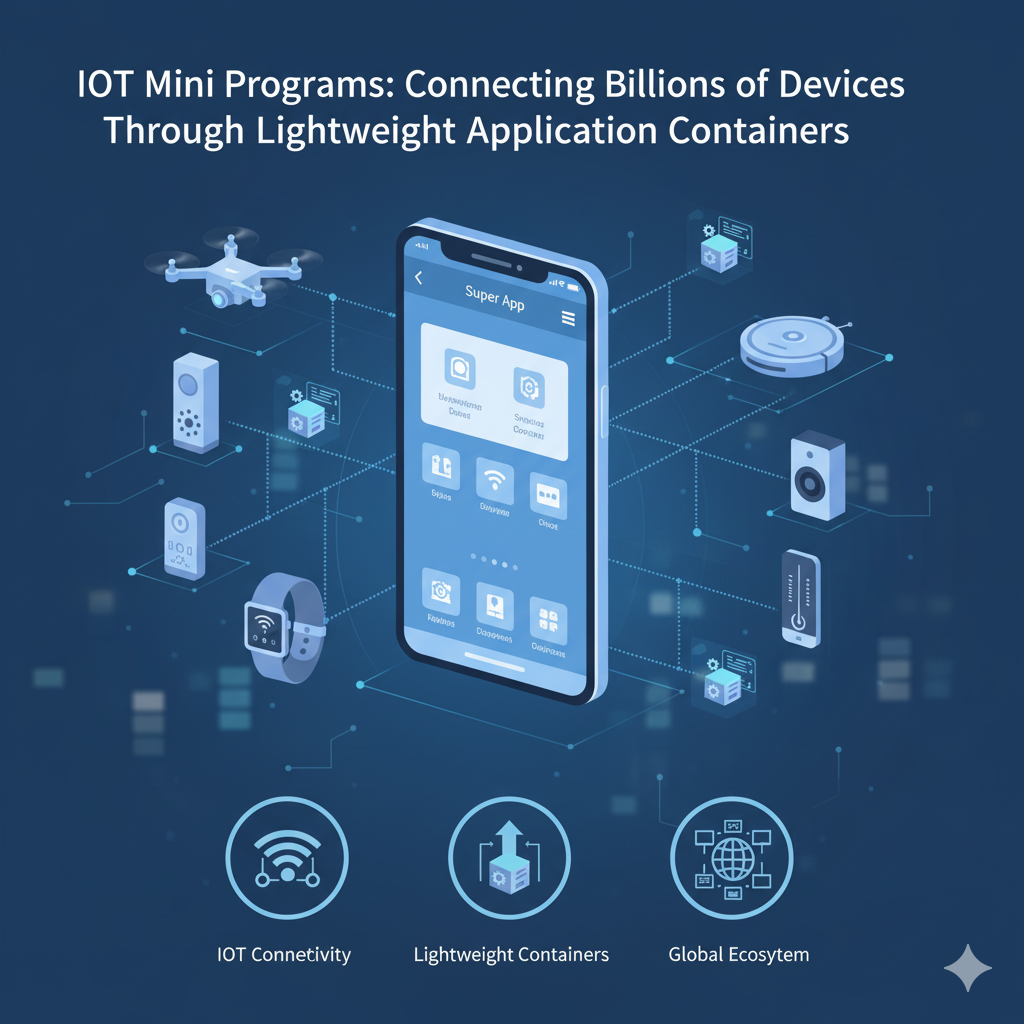
The IoT Fragmentation Challenge
The Internet of Things encompasses extraordinary diversity: smart light bulbs with 8KB of RAM, industrial sensors with years of battery life, connected vehicles with multicore processors, and medical devices with stringent regulatory requirements. This heterogeneity creates what engineers call the "IoT fragmentation problem"—the impracticality of developing and maintaining separate software versions for thousands of device configurations. Traditional approaches either limit functionality to lowest-common-denominator capabilities or accept exponential development costs as device variety increases.
Mini-program containers address fragmentation through abstraction layers that separate application logic from device-specific implementations. The container provides standardized APIs for common IoT functions: sensor data access, network communication, user interface rendering, and power management. Application developers write against these standardized interfaces, while device manufacturers implement container adaptations for their specific hardware. This separation enables application portability across dramatically different devices while maintaining optimization for each platform's capabilities.
Resource constraints represent the most significant technical challenge. Many IoT devices operate with severe limitations: microcontrollers with kilobytes of memory, intermittent network connectivity, and battery power measured in years rather than hours. Mini-program containers for these environments employ aggressive optimization techniques: ahead-of-time compilation to native code, selective loading of required components, and adaptive quality-of-service management that adjusts functionality based on available resources. These optimizations enable useful applications even on devices previously considered too constrained for third-party software.
Security requirements in IoT environments exceed those of traditional computing. Compromised smart locks, medical devices, or industrial controls create physical safety risks rather than merely data breaches. Mini-program containers implement multiple security layers: cryptographic verification of application integrity, runtime sandboxing that prevents unauthorized device access, and resource quotas that limit potential damage from malicious or buggy code. These protections enable safe execution of third-party applications on sensitive devices without requiring complete trust in application developers.
Technical Architecture for IoT Mini Programs
IoT mini-program containers employ specialized architectures optimized for constrained environments while maintaining application compatibility. The core runtime typically occupies 50-200KB of memory—substantially smaller than traditional operating systems or application frameworks—yet provides essential services for application execution. This compact footprint enables deployment on devices with as little as 256KB of total RAM, bringing programmable capabilities to previously "dumb" connected devices.
The execution model balances performance with security. Most containers use interpreted bytecode or ahead-of-time compiled native code rather than just-in-time compilation, avoiding the memory overhead and attack surface of dynamic code generation. Application packages include both executable code and resource files (images, configuration data, localization strings) in compressed formats that minimize storage requirements and download sizes. Lazy loading techniques defer resource initialization until actually needed, further reducing memory pressure during startup.
Communication protocols adapt to diverse IoT connectivity scenarios. For devices with continuous high-bandwidth connections (like smart displays), containers can stream application updates and content in real time. For intermittently connected devices (like environmental sensors), containers support offline operation with periodic synchronization. For extremely constrained devices (like Bluetooth beacons), containers may embed complete application logic that operates independently until connectivity becomes available for data transmission.
User interface rendering presents unique challenges across IoT form factors. The same application might display on a 2-inch smartwatch screen, a 7-inch tablet interface, and a 50-inch smart TV, with input methods ranging from touchscreens to voice commands to physical buttons. Container architectures address this through adaptive layout systems that rearrange interface elements according to available screen space and input capabilities, while maintaining consistent application logic across all presentation variants.
Enterprise Applications and Case Studies
Industrial IoT represents the most significant near-term opportunity for mini-program containers. Manufacturing facilities, logistics operations, and energy infrastructure increasingly incorporate connected sensors and controllers, but struggle with software maintenance across diverse equipment from multiple vendors. Container architectures enable unified application platforms that work across different device types while maintaining security isolation between operational technology and enterprise IT systems.
In manufacturing deployments, mini-program containers have enabled 3x faster integration of new sensor types and 50% reduction in application development cycles. Quality inspection stations can download updated inspection algorithms without replacing hardware, while maintenance technicians access equipment manuals and diagnostic tools through standardized interfaces regardless of machine manufacturer. The container approach reduces vendor lock-in by enabling third-party applications to run on proprietary equipment platforms.
Smart building management demonstrates another compelling use case. Modern buildings incorporate hundreds of connected systems: HVAC controls, lighting networks, security cameras, access control readers, and environmental sensors. Traditional integration requires custom middleware development for each system combination, creating maintenance burdens and limiting functionality. Mini-program containers provide standardized application environments across all building systems, enabling unified control interfaces, automated optimization routines, and third-party service integration.
Retail environments benefit from containerized applications across diverse touchpoints. Digital signage, interactive kiosks, mobile point-of-sale devices, and inventory scanners can all run the same promotional applications with appropriate interface adaptations. This consistency reduces development costs while enabling rapid campaign deployment—retailers can update pricing, promotions, and product information across all customer touchpoints through centralized application management rather than device-by-device configuration.
Healthcare IoT presents both opportunity and heightened responsibility. Medical devices increasingly incorporate connectivity for remote monitoring, data analysis, and treatment adjustment. Mini-program containers enable secure third-party applications for specialized analysis algorithms, patient education content, and clinical decision support while maintaining regulatory compliance through rigorous sandboxing and audit trails. The container approach balances innovation potential with patient safety requirements.
Implementation Considerations for IoT Platforms
Organizations implementing IoT mini-program platforms should prioritize four technical considerations: container footprint optimization, security architecture, developer tooling, and deployment management. Container runtimes must balance feature completeness with resource efficiency, potentially offering tiered capability levels for different device classes. Security architectures should implement defense-in-depth with cryptographic signing, runtime isolation, and least-privilege access controls.
Developer tooling significantly influences ecosystem growth. Cross-compilation tools that transform standard application code into device-optimized formats reduce development barriers. Simulators for various device types enable testing without physical hardware access. Debugging tools that work across connectivity scenarios (online, intermittent, offline) help developers create robust applications for real-world conditions.
Deployment management systems must handle the scale and diversity of IoT environments. Over-the-air update mechanisms should accommodate bandwidth limitations, power constraints, and operational requirements (medical devices may restrict updates to maintenance windows). Version compatibility management becomes crucial when thousands of devices run different application versions—rollback capabilities and phased rollouts mitigate update risks.
Performance monitoring and analytics provide feedback for continuous improvement. Container platforms should collect anonymized usage metrics, error reports, and performance data to identify optimization opportunities and common developer pitfalls. This data informs platform enhancement priorities and helps developers create better applications through understanding real-world usage patterns.
Getting Started with IoT Mini Program Development
Organizations exploring IoT mini-program strategies should begin with pilot projects that address specific business problems while testing technical assumptions. Successful pilots typically focus on constrained but valuable use cases: equipment monitoring applications for manufacturing, environmental sensing for smart buildings, or interactive content for retail displays. These limited-scope implementations provide learning opportunities without excessive risk.
Technical evaluation should assess both immediate needs and future scalability. Container solutions must support current device types while accommodating planned hardware expansions. Security evaluation should consider not only technical protections but also organizational processes for application review, update distribution, and incident response. Performance testing should simulate worst-case scenarios: low memory conditions, network interruptions, and concurrent application execution.
Developer adoption requires both technical capability and economic incentive. The container platform must reduce development effort compared to alternative approaches, while the application ecosystem must provide revenue opportunities or operational efficiencies that justify developer investment. Platform operators often begin with internal development teams creating reference applications that demonstrate capabilities and establish patterns for external developers.
For enterprises implementing IoT solutions, container architectures offer particular advantages in regulated industries. The security isolation enables compliance with data protection requirements while allowing innovation through third-party applications. In enterprise deployments using container platforms, organizations have achieved 70% faster service rollout while reducing development maintenance costs by 50% compared to custom integration projects.
The container approach transforms IoT software development from device-specific engineering to platform-based innovation. Lightweight SDKs enable existing applications to run on new device types with minimal adaptation, while security sandboxes protect critical infrastructure from application vulnerabilities. Cross-platform compatibility ensures consistent experiences across diverse devices, and hot update capabilities support continuous improvement without device replacement cycles.
Explore FinClip ChatKit—open-source AI chat middleware. GitHub