Google Play's SDK Security Crackdown: 239 Malicious Apps Expose Systemic Infrastructure Risks
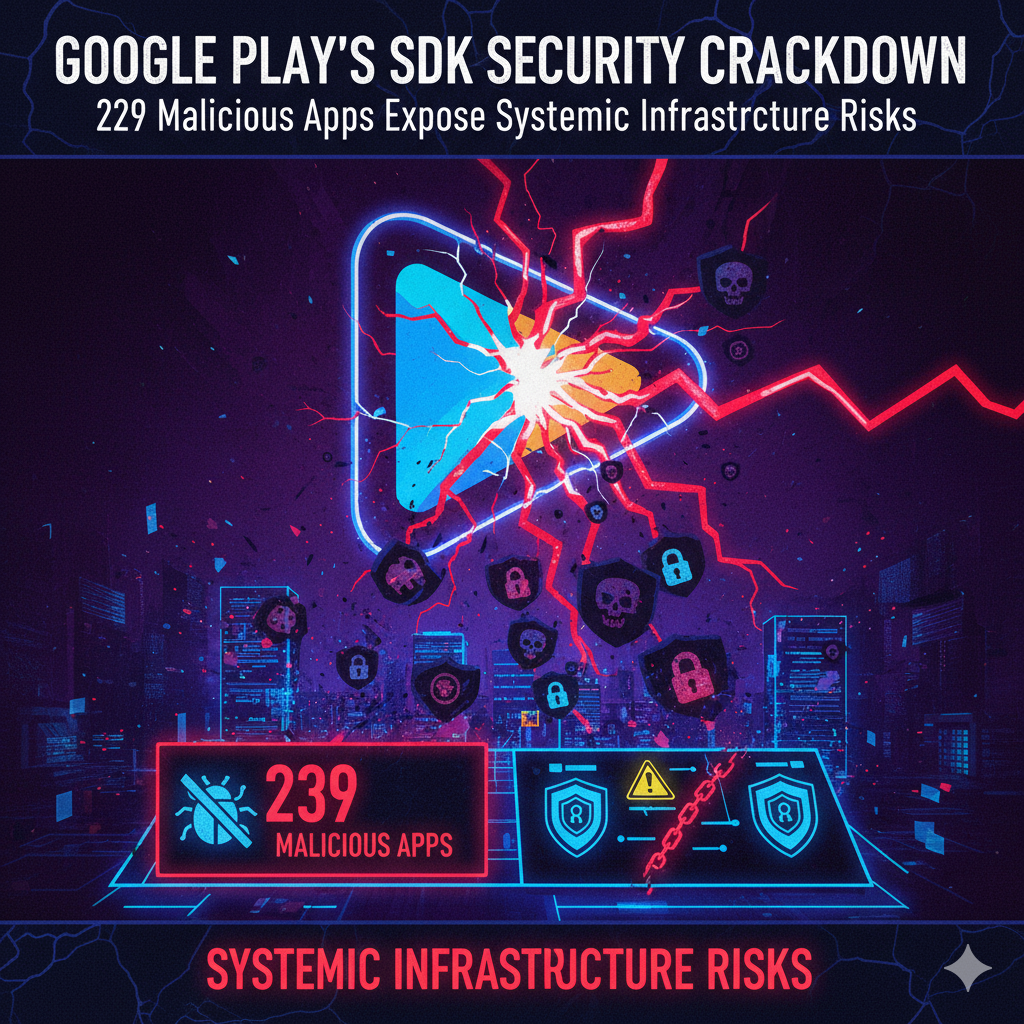
Google removed 239 applications with cumulative downloads exceeding 42 million from its Play Store this week after discovering that embedded third-party software development kits (SDKs) were performing unauthorized data collection, fraudulent advertising activities, and security violations without developers' knowledge. The enforcement action reveals systemic vulnerabilities in mobile application supply chains, where seemingly legitimate development components can introduce substantial security risks despite developers' compliance efforts. For organizations building mobile applications—particularly those handling sensitive user data or financial transactions—this incident underscores the critical importance of supply chain security and third-party component validation.
What Happened
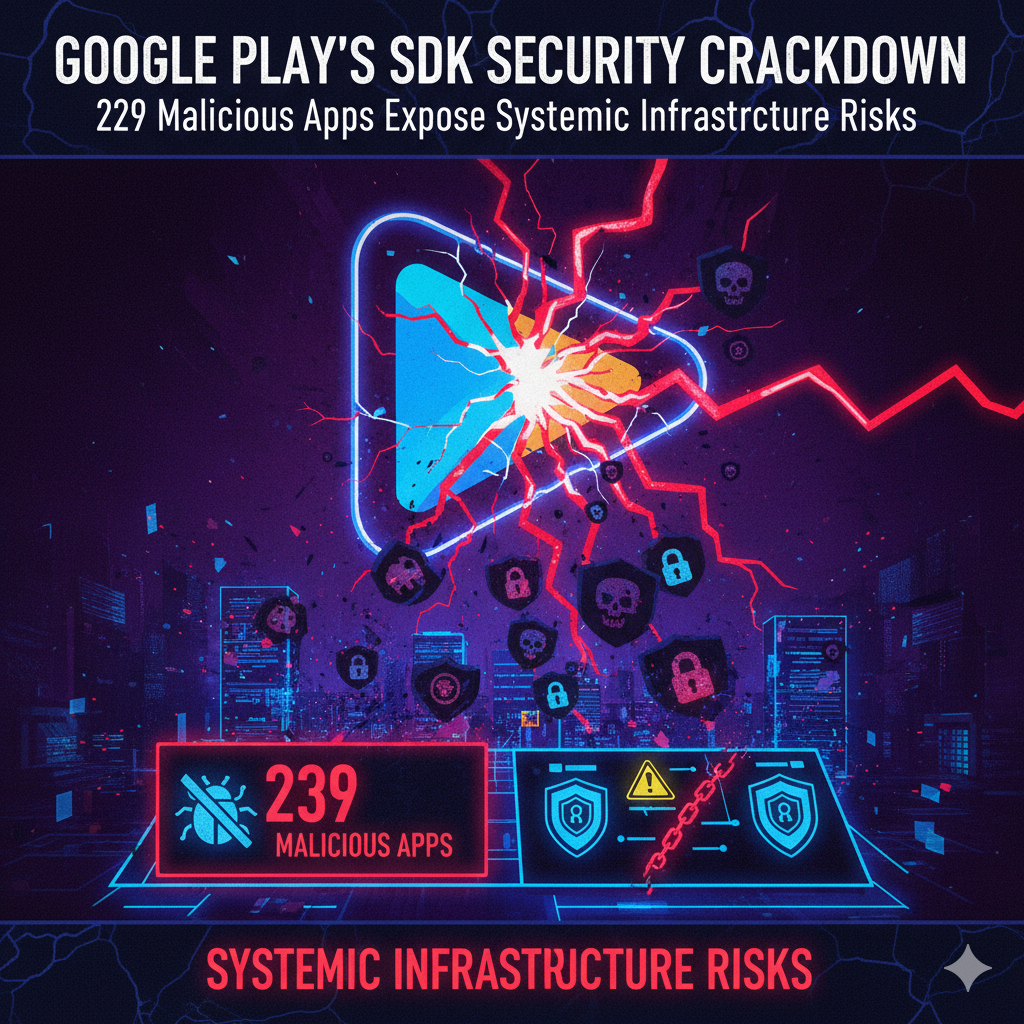
Google's Play Protect security system identified 239 applications that violated platform policies through actions performed by integrated third-party SDKs rather than the applications' core code. According to analysis published on March 7, 2026, these applications collectively accumulated over 42 million downloads before detection. The problematic SDKs operated covertly in the background, performing unauthorized activities including sensitive data collection, fraudulent advertising clicks, and excessive permission requests that exceeded legitimate application requirements. Google's detection systems flagged these behaviors as "suspicious activity patterns" and "spy-like operations," triggering the mass removal.
Technical analysis revealed that the SDKs engaged in several distinct violation categories. Some components collected device identifiers, installed application lists, and precise location data without proper disclosure or user consent. Others generated fraudulent advertising traffic through automated click simulation or hidden ad rendering. Several SDKs established connections to servers in multiple countries, transmitting collected data across jurisdictions without transparency about data handling practices. Importantly, the applications' developers often remained unaware of these activities, having integrated the SDKs based on documented functionality that concealed the unauthorized operations.
Google's enforcement coincides with the platform's implementation of enhanced dynamic analysis capabilities. The Play Protect system now employs sandbox environments that execute applications while monitoring network traffic, permission usage, and system interactions. This approach enables detection of behaviors that static code analysis might miss, particularly when SDKs implement dynamic loading mechanisms or conditionally trigger unauthorized activities. The platform's response reflects a strategic shift from reviewing declared permissions and privacy policies to actively monitoring runtime behavior across the application ecosystem.
Why This Matters for Mobile Application Security
The scale and nature of this enforcement action highlight fundamental challenges in mobile application security management. Third-party SDKs have become essential components in modern application development, providing functionality ranging from analytics and advertising to social integration and payment processing. However, their integration creates security dependencies that developers cannot fully control or audit. When SDK providers implement unauthorized functionality or suffer security breaches, the consequences extend to every application incorporating those components, regardless of the core application's security posture.
This incident demonstrates how traditional security approaches—focusing primarily on an application's own code—increasingly fail to address contemporary threat landscapes. Development teams typically conduct security reviews of their proprietary code while treating third-party components as trusted black boxes. This assumption breaks down when SDK providers either intentionally include malicious functionality or implement insufficient security controls that attackers can exploit. The resulting security gap enables threats to bypass application-level defenses by operating within ostensibly legitimate components.
Supply chain security implications extend beyond individual applications to affect entire organizations. When applications incorporate compromised SDKs, the resulting security incidents can damage brand reputation, trigger regulatory penalties, and undermine user trust. For enterprises operating in regulated industries—particularly finance, healthcare, and government services—these risks carry substantial compliance implications. The incident underscores the necessity of comprehensive third-party risk management programs that extend beyond traditional vendor assessments to include technical validation of integrated components.
The Bigger Picture
Mobile application security is undergoing a paradigm shift from application-centric to ecosystem-wide approaches. Early security models focused primarily on preventing vulnerabilities within an application's own codebase, treating third-party components as boundary conditions. As the industry matured, recognition grew that the security of any application depends fundamentally on the security of all integrated components. This understanding drives platform-level initiatives like Google's enhanced SDK monitoring and developer-focused requirements for supply chain transparency.
Regulatory developments amplify these trends. Global data protection regulations—including GDPR, CCPA, and emerging frameworks in Asia and Latin America—increasingly emphasize accountability throughout data processing chains. Application developers face legal responsibility for data handling performed by integrated SDKs, even when those activities occur without developers' direct knowledge or consent. This accountability framework creates strong incentives for development organizations to implement rigorous third-party component validation and ongoing monitoring programs.
Industry standardization efforts seek to address these challenges through technical specifications and certification programs. Initiatives like the App Defense Alliance and various industry consortiums work to establish security standards for mobile application components, including SDKs. These efforts aim to create verification mechanisms that enable developers to identify components meeting defined security requirements. While still evolving, such standardization represents a crucial step toward more manageable supply chain security in complex mobile ecosystems.
What Application Development Teams Should Do Now
Development organizations must immediately enhance their third-party component security practices in response to this incident. Current approaches that treat SDKs as trusted black boxes expose applications to unacceptable security risks. Teams should implement comprehensive SDK validation processes that extend beyond functional testing to include security assessment, behavior monitoring, and supply chain verification. These practices should become standard components of application development lifecycles rather than optional security enhancements.
Technical implementation should focus on several critical areas. First, establish SDK inventory and version tracking systems that provide visibility into all integrated third-party components. Second, implement automated security scanning for SDK binaries, including static and dynamic analysis techniques that can identify suspicious behaviors. Third, deploy runtime monitoring that detects anomalous activities from integrated components, such as unexpected network connections or permission usage. Fourth, maintain current information about SDK provider security practices and vulnerability management programs.
Organizations should also evaluate architectural approaches that mitigate third-party component risks. Containerization technologies can isolate SDK execution environments, limiting potential damage from compromised components. For applications handling particularly sensitive data or operations, consider implementing zero-trust architectures that validate all component activities regardless of source. These approaches require additional development effort but provide substantially enhanced protection against supply chain threats.
For enterprises implementing mini-program platforms in regulated environments, security isolation mechanisms like those provided by FinClip offer relevant architectural patterns. FinClip's security sandbox creates device-side isolation similar to Docker containers, enabling secure execution of third-party components while preventing unauthorized data access or system interactions. This approach demonstrates how containerization can balance functionality integration with security requirements in complex application environments.
FinClip's security sandbox—device-side isolation like Docker—ensures third-party components operate securely within enterprise applications. Book a 30-min demo