Google Play Reduces Commission to 20%, Opens Third-Party Payments in Major Policy Shift
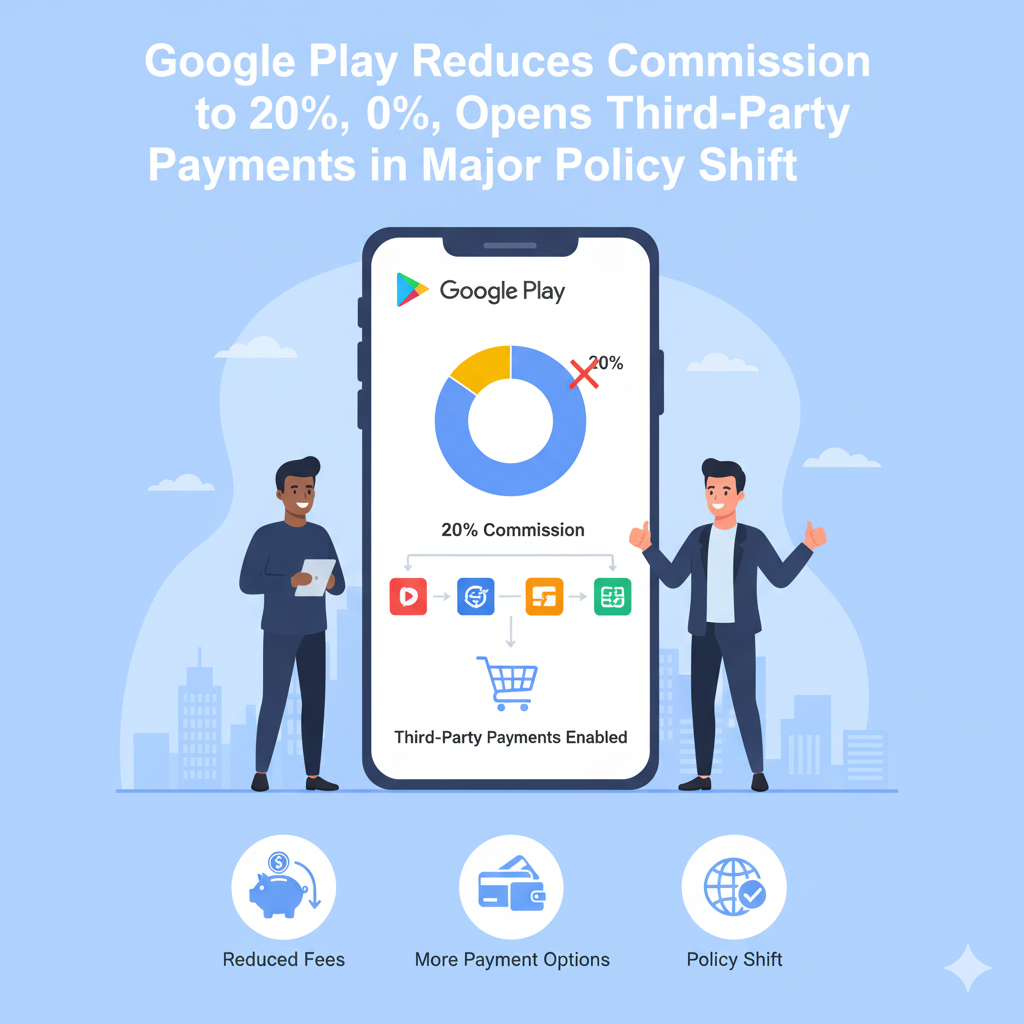
Google has announced sweeping changes to its Play Store commission structure, reducing fees for new installs to 20% while opening the platform to third-party payment systems. The policy shift, effective June 30, 2026, in the European Economic Area, United Kingdom, and United States, represents the most significant reduction in Google's revenue share since the store's inception. For developers building mobile applications, this change alters distribution economics and creates new opportunities for monetization strategies that were previously constrained by platform fees reaching 30%.
The timing matters. Mobile application development costs have increased 40% since 2022 due to rising engineering salaries and infrastructure expenses, while user acquisition costs have grown even faster in competitive categories. Platform commissions represented the single largest variable cost for many subscription-based and transaction-heavy applications, directly impacting profitability and investment decisions. Google's move follows similar adjustments by Apple in specific regions and reflects growing regulatory pressure and market competition from alternative distribution channels.
What Happened
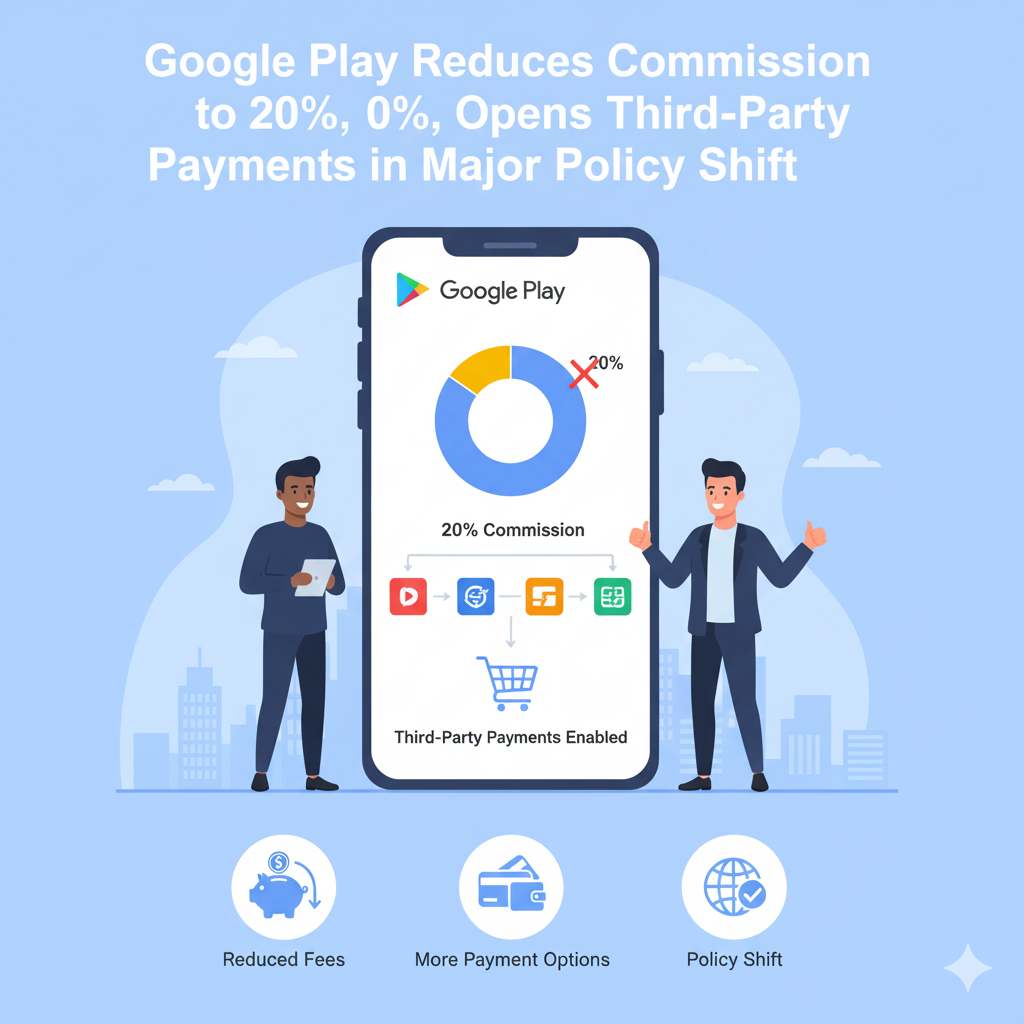
On March 8, 2026, Google published updated developer documentation outlining a comprehensive restructuring of its Play Store commission model. The changes, which will roll out regionally through 2027, include three core components: commission rate reductions, payment system flexibility, and a new fee structure.
First, the standard 30% commission for digital goods and services drops to 20% for new user installs. Subscription renewals see an even larger reduction from 15% to 10%. This represents a 33% decrease for initial transactions and a similar 33% reduction for recurring revenue. The reduction applies only to new installations after the policy takes effect in each region, creating a phased implementation that gives developers time to adjust their pricing and monetization strategies.
Second, Google will allow developers to integrate third-party payment systems within their applications. This includes both offering alternative payment options alongside Google Play Billing and directing users to complete transactions outside the Play ecosystem through in-app links and prompts. The policy change removes the previous requirement that all digital transactions use Google's payment processing, which had been a point of contention in multiple antitrust investigations.
Third, the company introduced a new fee structure that separates platform services from payment processing. Developers who continue using Google Play Billing will pay the reduced commission rates plus an additional 5% payment processing fee in some markets. Those who implement third-party payment systems will pay only the platform service fee, which ranges from 10-15% depending on the transaction type and developer program participation.
The regional rollout begins with the European Economic Area, United Kingdom, and United States on June 30, 2026. Australia follows on September 30, 2026, with Japan and Korea implementing the changes by December 31, 2026. Global implementation completes by September 30, 2027, creating a staggered transition that considers local market conditions and regulatory environments.
Why This Matters for Mobile Application Development
Google's policy changes directly impact developer economics, user experience, and platform competition in ways that extend beyond simple fee reduction. The most immediate effect is financial: applications with high transaction volumes or subscription models gain significant margin improvement. For a subscription service with $10 monthly plans, the previous 15% commission represented $1.50 per user monthly. The new 10% rate reduces this to $1.00, increasing developer revenue by 50 cents per subscriber. At scale, this difference transforms business models and investment calculations.
The third-party payment option introduces more complex considerations. While avoiding Google's payment processing fee can save an additional 5%, developers must now evaluate alternative payment providers, implement multiple payment flows, manage compliance across different systems, and potentially face higher fraud rates or payment failure rates. The technical complexity increases development and maintenance costs, potentially offsetting some of the commission savings. However, for applications with existing payment infrastructure or those operating in markets where Google Play Billing has limited reach, the flexibility provides meaningful advantages.
User experience represents another critical dimension. Multiple payment options within a single application can create confusion, increase checkout abandonment, and fragment the payment experience. Developers must decide whether to offer Google Play Billing alongside third-party options, present them as alternatives, or default to one system based on user preferences or market conditions. These decisions affect conversion rates, user satisfaction, and support volume, requiring careful testing and optimization.
Platform competition dynamics shift with these changes. Alternative app stores and distribution channels gain relative attractiveness as the commission differential narrows. Developers previously locked into Google Play by its payment monopoly now have genuine alternatives for distribution, particularly in regions where third-party app stores already have significant market share. This could accelerate the fragmentation of Android distribution, creating both challenges and opportunities for developers seeking to reach global audiences.
The Bigger Picture
Google's commission reduction reflects broader trends in digital platform economics and regulatory environments. Three factors converge to explain the timing and magnitude of these changes: regulatory pressure, competitive dynamics, and platform evolution.
Regulatory scrutiny has intensified globally. The European Union's Digital Markets Act, United States v. Google antitrust case, and similar investigations in South Korea, Japan, and India have challenged the traditional app store commission model. These proceedings question whether 30% commissions represent fair compensation for distribution services or constitute anti-competitive behavior that harms innovation and consumer choice. Google's preemptive adjustments likely aim to mitigate regulatory risk while maintaining control over the implementation timeline and specifics.
Competitive pressure from alternative distribution channels has grown substantially. Microsoft's Windows Store, Huawei's AppGallery, Samsung's Galaxy Store, and various regional alternatives have gained traction by offering lower commissions or specialized services. Epic Games' ongoing efforts to establish its own distribution ecosystem, though facing significant challenges, demonstrate that major developers are willing to invest in alternatives. Google's reduced commissions make the Play Store more competitive against these emerging options, potentially slowing their adoption among mainstream developers.
Platform evolution towards services beyond simple distribution explains the fee restructuring. Google increasingly positions Play Services as a comprehensive development platform offering analytics, testing, security scanning, and user acquisition tools. By separating platform services from payment processing, Google can more clearly articulate the value proposition of its broader ecosystem. Developers who use these additional services may find the reduced commission rates more justifiable, while those who only need basic distribution can opt for minimal fees with third-party payments.
These changes also reflect the maturation of mobile application markets. Early platform economics prioritized rapid ecosystem growth over developer profitability, with high commissions funding platform development and user acquisition. As markets mature and developer expectations evolve, platforms must balance revenue extraction with ecosystem health. Google's adjustment acknowledges that sustainable developer economics support long-term platform success, particularly as applications become more complex and development costs increase.
What Mobile Application Developers Should Do Now
Developers should immediately assess their current commission exposure and projected savings under the new structure. Begin by analyzing user acquisition patterns, transaction volumes, and revenue distribution across regions scheduled for early implementation. Create financial models comparing current commission expenses with the new rates, factoring in the potential costs of implementing third-party payment systems if relevant.
Technical teams should evaluate payment system architecture. For applications considering third-party payment integration, assess current payment infrastructure capabilities, regulatory compliance requirements, and implementation timelines. Consider starting with a phased approach: maintain Google Play Billing as the primary option while testing alternative payment providers in specific markets or for certain transaction types. This minimizes risk while gathering data on user preferences and conversion rates.
Payment experience design requires careful attention. If offering multiple payment options, implement clear user interfaces that explain choices without overwhelming users. Consider defaulting to Google Play Billing for users with existing payment methods stored, while offering alternatives for those who prefer different options. Test different presentation approaches through A/B testing to optimize conversion rates and minimize support inquiries.
Distribution strategy warrants reevaluation. With reduced commission differentials between Google Play and alternative stores, reassess the cost-benefit analysis of multi-store distribution. Some alternative stores offer specialized discovery features, regional focus, or hardware integration that may justify continued or expanded presence despite Google's more competitive rates.
Monitor implementation timelines and regional variations carefully. The staggered rollout creates complexity for global applications, requiring different payment configurations and commission calculations across markets. Establish clear tracking systems to ensure compliance with varying requirements and optimize revenue across regions.
Consider how container-based architectures used in enterprise deployments using FinClip can provide flexibility in payment system implementation. The lightweight 3MB SDK enables rapid integration of alternative payment providers while maintaining security isolation and deployment consistency across platforms. This approach reduces development overhead when implementing multiple payment options across different distribution channels.
FinClip's 3MB SDK integrates into existing apps in minutes. Start for free