Elon Musk's X Money Super App Enters Final Testing Phase, Targets 6% APY and Visa Integration
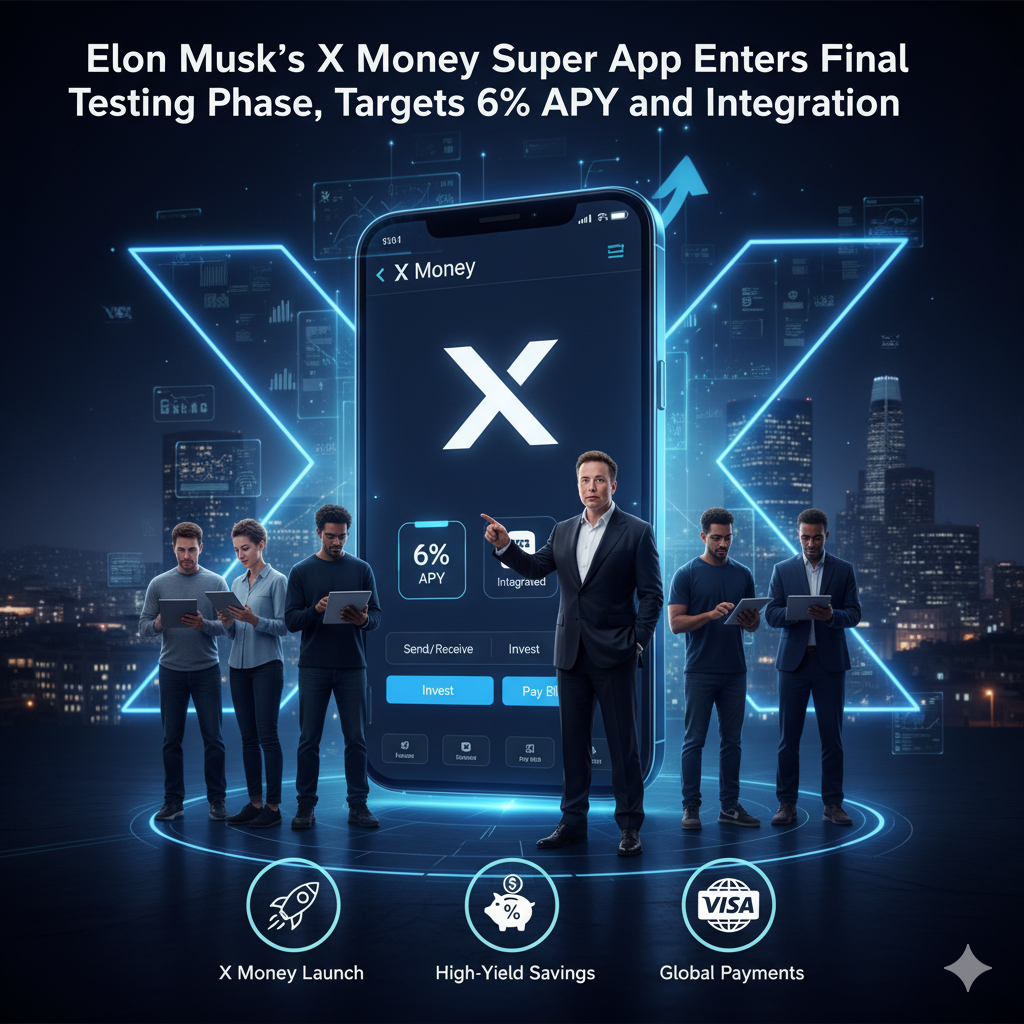
Elon Musk announced on March 10, 2026, that X Money will open for early public access next month, marking the most significant step yet in his 25-year ambition to build a financial super app. The payment product, which offers a 6% annualized yield on deposits, represents Musk's attempt to transform X from a social media platform into a comprehensive financial gateway. With Visa as its inaugural payment partner and FDIC insurance through Cross River Bank, X Money enters a crowded U.S. payment market where user habits, regulatory scrutiny, and established competitors create substantial barriers to adoption. This development matters because it tests whether the super app model—successful in Asia through platforms like WeChat—can overcome cultural and behavioral differences in Western markets.
What Happened
On March 10, 2026, Elon Musk personally announced on the X platform that X Money would begin early public access in April 2026. The announcement triggered immediate market reactions: Dogecoin surged approximately 15% within hours, reflecting the crypto community's anticipation of potential cryptocurrency integration, while financial analysts began reassessing competitive threats to established payment platforms. X Money represents the culmination of Musk's publicly stated ambition since acquiring Twitter (now X) to create an "Everything App" modeled after China's WeChat.
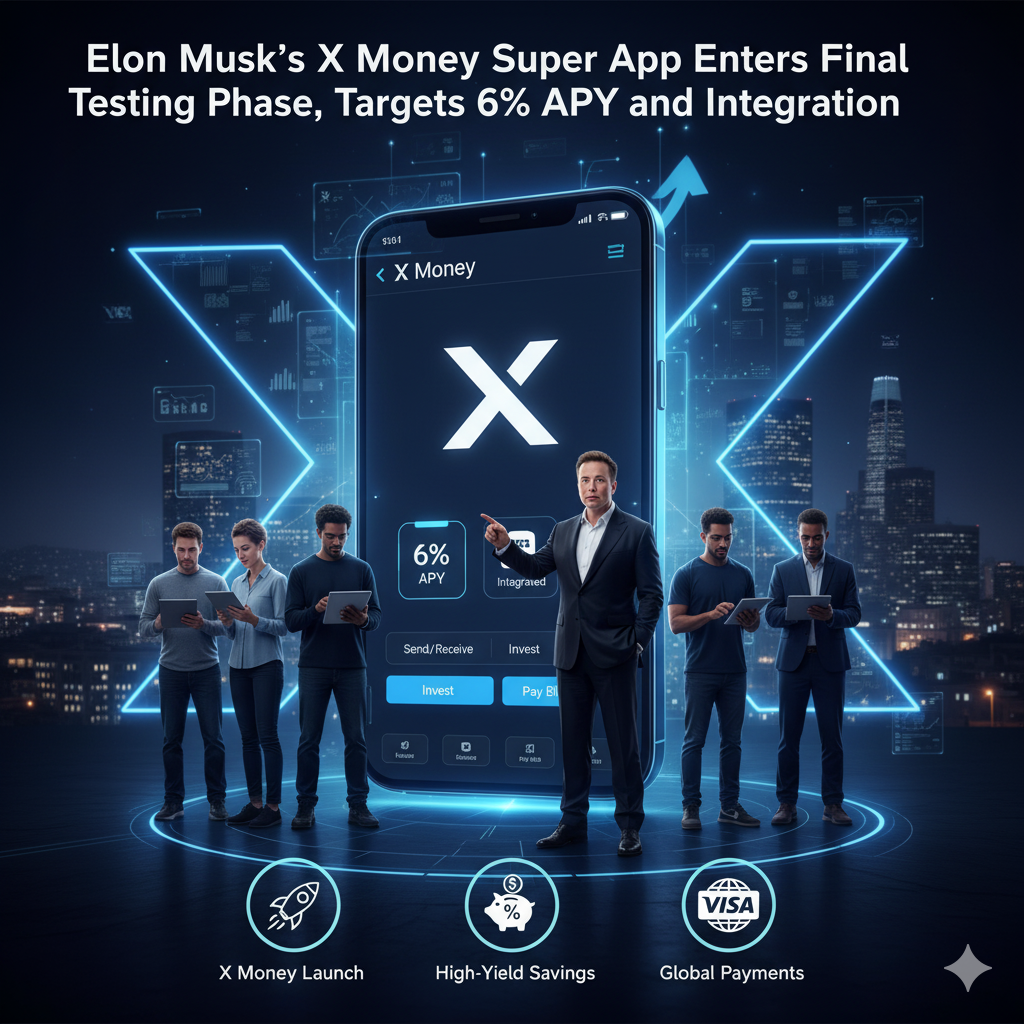
The product specifications reveal a comprehensive financial offering rather than a simple payment tool. Core features include a 6% annual percentage yield on deposits—significantly higher than the average 0.5% offered by traditional U.S. savings accounts—alongside P2P instant transfers, direct deposit capabilities, metal debit cards engraved with usernames, cashback rewards, and zero foreign exchange fees. The interface organizes functionality into three primary tabs: "Account" for balance and transaction management, "Rewards" for cashback and incentives, and "Activities" for transaction history and financial insights.
Transaction settlement relies on the Visa Direct network, enabling near-instantaneous fund transfers. This partnership, announced in January 2025, combines X's massive user base (approximately 600 million monthly active users) with Visa's global payment infrastructure, avoiding the need to build clearing systems from scratch. From a regulatory perspective, X has obtained Money Transmitter Licenses in over 40 U.S. states and the District of Columbia, with applications pending in remaining jurisdictions including New York. User funds receive FDIC insurance up to $250,000 through custodial arrangements with Cross River Bank.
The testing phase employed unconventional marketing tactics characteristic of Musk's approach. Through actor William Shatner, X conducted a charity auction where donations of $1,000 or more earned participants early access invitations, with only 42 slots available. Shatner became one of the first external testers, sharing product screenshots on social media to generate organic buzz. Internal testing reportedly involved thousands of X employees over several months, focusing on security protocols, user experience flows, and compliance verification.
Why This Matters for Financial Super Apps
X Money's launch represents the most ambitious Western attempt to replicate the Asian super app model, testing fundamental assumptions about user behavior, platform trust, and financial service integration. Unlike WeChat Pay's emergence in China's underdeveloped mobile payment landscape, X Money enters a mature U.S. market dominated by Apple Pay, Venmo, PayPal, and Zelle, with credit card networks deeply embedded in consumer psychology. The 6% APY serves as a customer acquisition tool during a period of declining interest rates, but its sustainability depends on X's ability to generate sufficient returns from deposited funds—a challenge that has troubled other fintech ventures offering above-market yields.
The psychological barrier represents X Money's most significant obstacle. American consumers traditionally separate social interactions from financial activities, viewing social platforms as entertainment or information sources rather than secure financial repositories. X's history of account suspensions and content moderation controversies exacerbates trust concerns, particularly regarding fund accessibility and data privacy. Regulatory scrutiny has already emerged: in 2025, a New York State senator urged the Department of Financial Services to exercise caution when reviewing X Money's license application, citing privacy risks and platform governance issues.
From a competitive perspective, X Money's distribution advantage cannot be overlooked. Reaching 600 million monthly active users requires minimal customer acquisition costs compared to standalone fintech applications. If even 5% of X's user base adopts X Money for primary banking functions, the platform would immediately rank among the top U.S. digital banks by customer count. The metal debit cards and personalized engraving tap into material culture and identity expression, potentially appealing to younger demographics who value both financial utility and social signaling.
The cryptocurrency question remains deliberately ambiguous. Musk has publicly supported Dogecoin and Bitcoin for years, and market speculation immediately connected X Money's announcement to Dogecoin's price surge. However, the initial launch focuses exclusively on fiat currency systems, avoiding additional regulatory complexity while preserving optionality for future crypto integration. This strategic ambiguity allows X to monitor regulatory developments and user demand before committing to specific digital asset implementations.
The Bigger Picture
X Money represents a critical test case for the global applicability of super app economics. The Asian model succeeded through unique conditions: rapid mobile adoption coinciding with underdeveloped financial infrastructure, cultural comfort with platform multipurposing, and regulatory environments that permitted experimentation. Western markets present opposite conditions: mature financial ecosystems, cultural preferences for specialized applications, and stringent regulatory frameworks developed over decades.
The super app battle now unfolds across three distinct fronts. In Asia, WeChat and Alipay demonstrate the model's ultimate potential, with mini-programs handling everything from ride-hailing to medical appointments within messaging interfaces. In emerging markets, platforms like Grab and Gojek combine transportation, food delivery, and financial services for populations leapfrogging traditional infrastructure. In developed Western markets, the question remains whether any platform can overcome entrenched habits and regulatory barriers to achieve similar integration.
X Money's 6% yield strategy reveals the customer acquisition costs required to disrupt established behaviors. Traditional banks maintain customer relationships through branch networks, long-standing trust, and integrated service ecosystems. Digital challengers like Chime and Current gained traction through fee-free structures and early direct deposit access. X must convince users not only to try a new payment method but to transfer significant financial assets to a platform primarily associated with public discourse and entertainment.
The regulatory dimension introduces additional complexity. Financial services operate under fundamentally different rules than social media platforms, with requirements for capital reserves, anti-money laundering controls, consumer protection mechanisms, and examination procedures. X's compliance infrastructure must demonstrate robustness not only to regulators but to potential users concerned about fund security. The FDIC insurance through Cross River Bank provides baseline protection, but consumer confidence depends on perceptions of platform stability and governance.
Looking forward, X Money's success or failure will influence investment decisions across the fintech sector. Venture capital has poured billions into embedded finance initiatives, betting that non-financial platforms can monetize user relationships through financial services. X represents the largest-scale test of this hypothesis, with outcomes informing whether e-commerce platforms, social networks, or hardware manufacturers should pursue similar strategies.
What Financial Platforms Should Do Now
Financial institutions and technology platforms observing X Money's launch should focus on three strategic responses: competitive positioning, partnership opportunities, and architectural preparedness. Traditional banks should emphasize their regulatory expertise and risk management capabilities, positioning themselves as secure alternatives to platform-based financial services. Digital banks and fintechs should accelerate feature development in areas where X may have weaknesses, particularly around specialized financial products, small business services, and international capabilities.
For technology companies considering super app strategies, the X Money experiment offers valuable lessons about integration complexity and user education. Platforms with large user bases should evaluate whether financial services align with core user expectations and trust levels. The technical implementation requires substantial investment in compliance systems, security infrastructure, and partnership development—areas where specialized fintech providers may offer more efficient pathways through white-label solutions.
Organizations building their own platform ecosystems should consider mini-program container architectures that enable incremental financial service integration without complete platform rebuilding. These lightweight SDKs allow existing applications to incorporate payment processing, account management, and financial tools through modular components rather than monolithic reconstruction. In enterprise deployments using FinClip, organizations have achieved 80% faster integration timelines while reducing development costs by 60% compared to building proprietary financial infrastructure.
The container approach addresses several challenges exposed by X Money's development journey. Security isolation ensures financial transactions operate within protected environments separate from social or entertainment functions. Cross-platform compatibility enables consistent experiences across iOS, Android, and web interfaces without maintaining separate codebases. Hot update capabilities allow rapid feature deployment without app store review delays, supporting A/B testing and gradual feature rollouts based on user feedback.
FinClip's 3MB SDK integrates into existing apps in minutes. Start for free