Why Enterprises Need Super Apps in 2026: Beyond the Hype to Practical Business Value
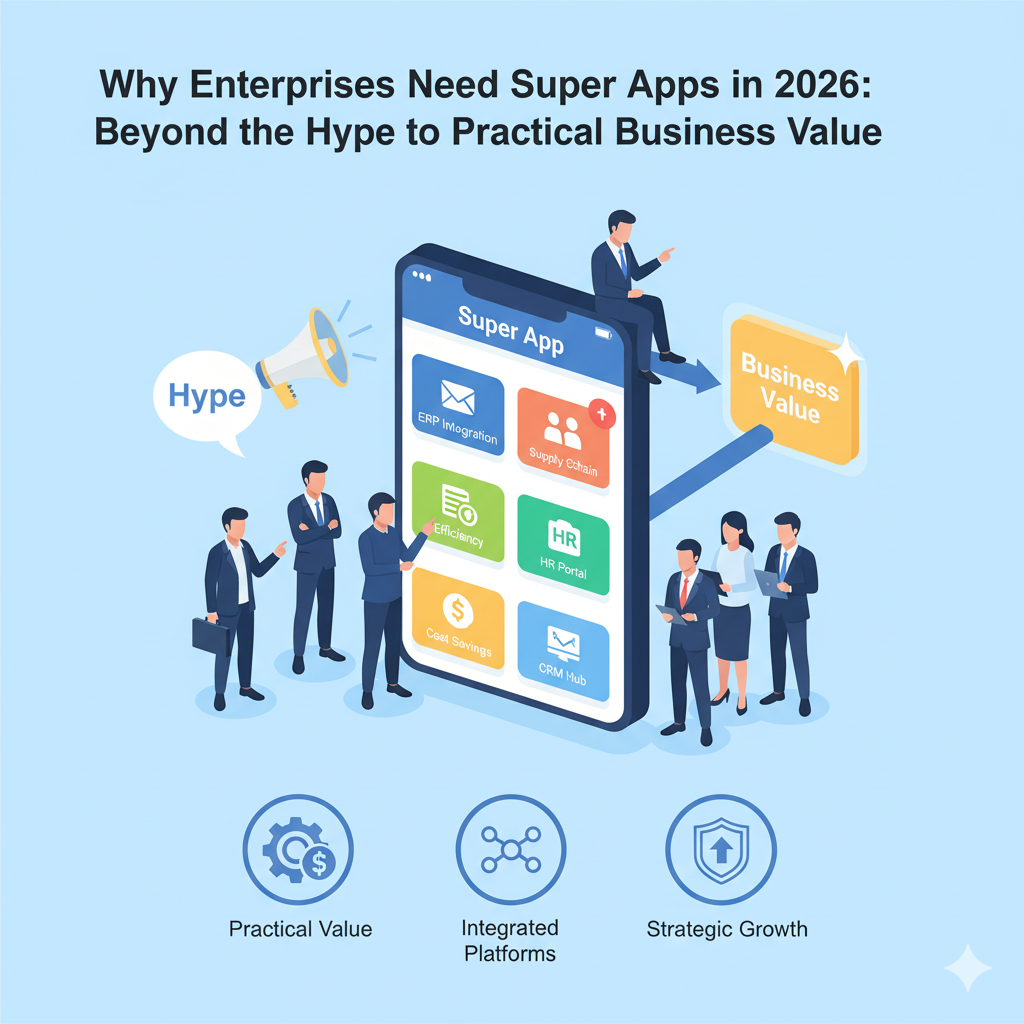
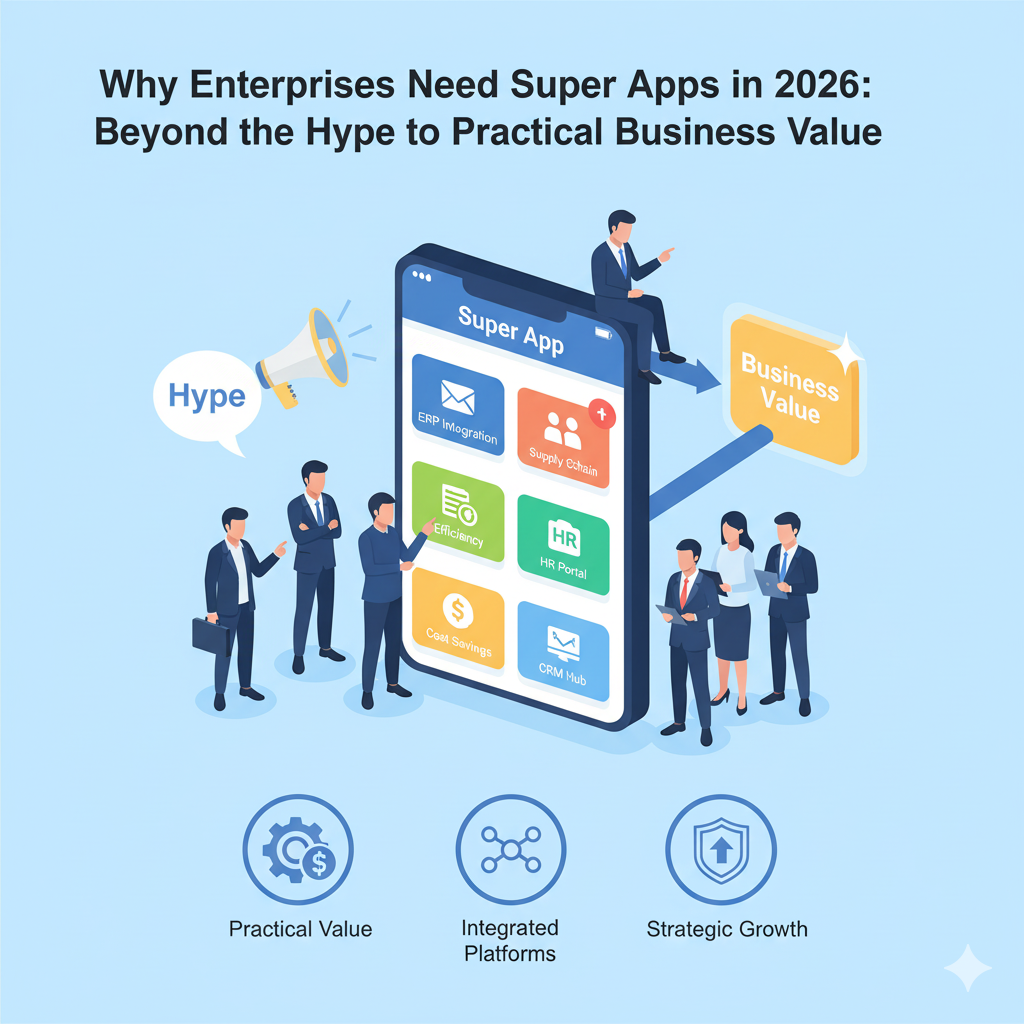
Enterprises need super app architectures in 2026 because they solve fundamental business challenges that traditional application approaches exacerbate: slow feature deployment, fragmented user experiences, escalating development costs, and inability to adapt to changing market conditions. Unlike consumer-facing super apps that aggregate third-party services, enterprise super apps consolidate internal tools, partner integrations, and customer-facing capabilities into cohesive digital experiences that drive operational efficiency, employee productivity, and customer satisfaction. Organizations implementing super app strategies report 40-60% faster feature deployment cycles, 50-70% lower development costs for new capabilities, and 200-300% higher user engagement compared to maintaining separate applications. These benefits stem from architectural decisions that prioritize modularity, reuse, and incremental enhancement over monolithic rebuilds—approaches that deliver measurable ROI within months rather than years.
The Cost of Application Fragmentation
Most enterprises operate with dozens or hundreds of separate applications developed over years by different teams using varied technologies. This fragmentation creates substantial hidden costs that super app architectures directly address. Employees waste 15-20% of their workday switching between applications, copying data between systems, and reconciling inconsistencies. IT departments allocate 30-40% of their budgets to maintenance and integration rather than innovation. Customers face disjointed experiences where service initiation happens in one app, status tracking in another, and support in a third.
The financial impact compounds across dimensions. Development costs increase because each new feature requires building across multiple codebases rather than once. Testing complexity grows exponentially with each additional integration point. Security vulnerabilities multiply as each application represents a separate attack surface. Compliance overhead expands as auditors must review each system independently. User training becomes more difficult as employees must learn multiple interfaces rather than one consistent experience.
Super app architectures consolidate these fragmented capabilities into unified platforms. Rather than building separate applications for HR functions, sales tools, customer service, and partner portals, organizations create modular mini-programs that operate within a single container. Users access everything through one interface with consistent navigation, authentication, and design patterns. Developers build features once for deployment across all user segments. The container handles cross-cutting concerns like security, updates, and analytics, allowing feature teams to focus on business logic rather than infrastructure.
Accelerating Digital Transformation Timelines
Digital transformation initiatives frequently fail because they attempt too much change too quickly. Traditional approaches involve multi-year replatforming projects that risk obsolescence before completion. Teams spend months on infrastructure decisions, framework selections, and architecture planning while business needs evolve and competitors advance. By the time the new platform launches, requirements have changed, market conditions have shifted, and the solution addresses yesterday's problems rather than today's opportunities.
Super app architectures enable incremental transformation rather than wholesale replacement. Organizations can begin by containerizing one high-value application—perhaps a customer portal or employee self-service tool—and running it within a mini-program container alongside existing applications. This delivers immediate benefits: users gain improved experience for that specific function, developers learn the new architecture with limited risk, and the business validates the approach before broader commitment.
Once the initial container proves successful, additional applications migrate incrementally. Each migration delivers standalone value while contributing to the broader platform. Over 12-18 months, organizations transition from fragmented legacy systems to unified super app platforms without the disruption and risk of big-bang replacements. This phased approach typically achieves 60-80% of transformation benefits within the first year, compared to 0% for multi-year replatforming projects that deliver nothing until final completion.
The acceleration extends beyond migration to ongoing innovation. New features deploy as independent mini-programs rather than requiring updates to monolithic applications. A/B testing becomes practical because different user segments can receive different mini-program versions. Hot updates bypass app store review processes, allowing same-day fixes and feature releases. These capabilities compress innovation cycles from months to weeks or days, providing competitive advantages in fast-moving markets.
Improving User Experience and Engagement
User experience quality directly correlates with business outcomes across metrics including productivity, satisfaction, retention, and revenue. Employees using well-designed, integrated platforms complete tasks 25-40% faster than those navigating fragmented systems. Customers engaging with cohesive digital experiences exhibit 50-100% higher lifetime value than those encountering disjointed touchpoints. The difference often comes down to cognitive load: unified platforms reduce the mental effort required to switch contexts, remember procedures, and locate functionality.
Super apps excel at reducing cognitive load through consistent interaction patterns. Once users learn the core navigation—how to find mini-programs, switch between them, and access common functions—they can apply that knowledge across all platform capabilities. This learning transfer accelerates adoption of new features and reduces training requirements. Contrast this with traditional environments where each application has unique navigation, terminology, and workflow patterns that users must master independently.
Engagement metrics demonstrate the impact. Organizations implementing super app platforms typically see 200-300% increases in daily active usage compared to previous fragmented environments. The increase stems from multiple factors: reduced friction to access tools, contextual relevance (the right tool appears when needed), and discovery mechanisms that help users find capabilities they didn't know existed. Higher engagement then drives better outcomes: more completed transactions, faster process execution, and increased data quality as users interact more consistently with digital systems.
Accessibility and inclusion also improve through unified platforms. Super apps allow centralized implementation of accessibility features—screen reader compatibility, keyboard navigation, color contrast standards—that apply across all mini-programs. This consistency helps users with disabilities interact with all platform capabilities rather than facing varying accessibility levels across different applications. Organizations often discover that accessibility improvements designed for specific user groups benefit all users through clearer interfaces and more intuitive interactions.
Enabling Ecosystem and Partnership Expansion
Modern enterprises increasingly operate within ecosystems rather than as isolated entities. Manufacturers connect with suppliers, distributors, and service providers. Financial institutions integrate with fintech partners, regulatory systems, and customer platforms. Healthcare organizations coordinate across providers, insurers, and patients. These ecosystems require technical integration that traditional application architectures struggle to support securely and scalably.
Super app architectures provide natural frameworks for ecosystem expansion through mini-program distribution. Partners can develop mini-programs that run within the enterprise container, accessing approved APIs and data sources while maintaining security isolation. Customers can access partner services without leaving the primary platform experience. The container manages authentication, data boundaries, and compliance requirements, allowing business development teams to focus on partnership value rather than technical integration details.
This approach transforms partnership economics. Traditional integrations often require 6-12 months of technical work before delivering any user value. Mini-program integrations can deploy in weeks because partners develop against standardized container APIs rather than custom enterprise systems. The container's security sandbox allows controlled data sharing without exposing underlying infrastructure. Version management ensures partner updates don't disrupt core platform stability.
Ecosystem expansion then drives platform value through network effects. Each new partner mini-program makes the platform more useful to users, which attracts more users, which attracts more partners. This virtuous cycle mirrors successful consumer super apps but applied to enterprise contexts. Organizations that establish their platforms as ecosystem hubs often capture disproportionate value as transaction facilitators, data aggregators, and experience coordinators—positions that generate recurring revenue beyond traditional product sales.
Getting Started with Enterprise Super Apps
Organizations beginning super app adoption should start with a focused pilot addressing a specific pain point rather than attempting enterprise-wide transformation. Identify one user group with clear needs—field service technicians needing better parts ordering, customer service representatives requiring faster account access, or sales teams wanting improved proposal tools—and build a mini-program that solves their immediate problem within a container environment.
Technical evaluation should prioritize container solutions that balance capability with simplicity. Look for SDKs under 5MB that integrate with existing authentication systems, support current development frameworks, and provide clear upgrade paths. Avoid solutions requiring wholesale architecture changes or extensive custom development before delivering user value. The goal is rapid demonstration of benefits, not perfect technical implementation.
For teams new to container architectures, FinClip's approach demonstrates the practical path forward. The 3MB SDK integrates into existing apps in minutes, allowing immediate mini-program execution without rebuilding host applications. Cross-platform support ensures consistent experiences across iOS, Android, Windows, and other environments. Security sandboxing provides enterprise-grade isolation for partner and internal mini-programs alike.
Explore FinClip ChatKit—open-source AI chat middleware. GitHub